THE OMEGA BOOK #3 (Mad Cave Studios)
Brady and Alexander are now racing to stop anymore of the Omega Books’ inventions from becoming a reality and ultimately ending humanity. But Brady must trust his father, which he has never done before so they can find Cless and stop whatever he is trying to put into motion. However, once Brady enters the machine that allows him to quantumly entangle with other people, he will learn things about his father he never knew.
The Omega Book #3 - Written By James Patrick – Art By Pauli Junquera - Letters By Pat Brosseau - Edited By Jon Moisan - Published By Mad Cave Studios
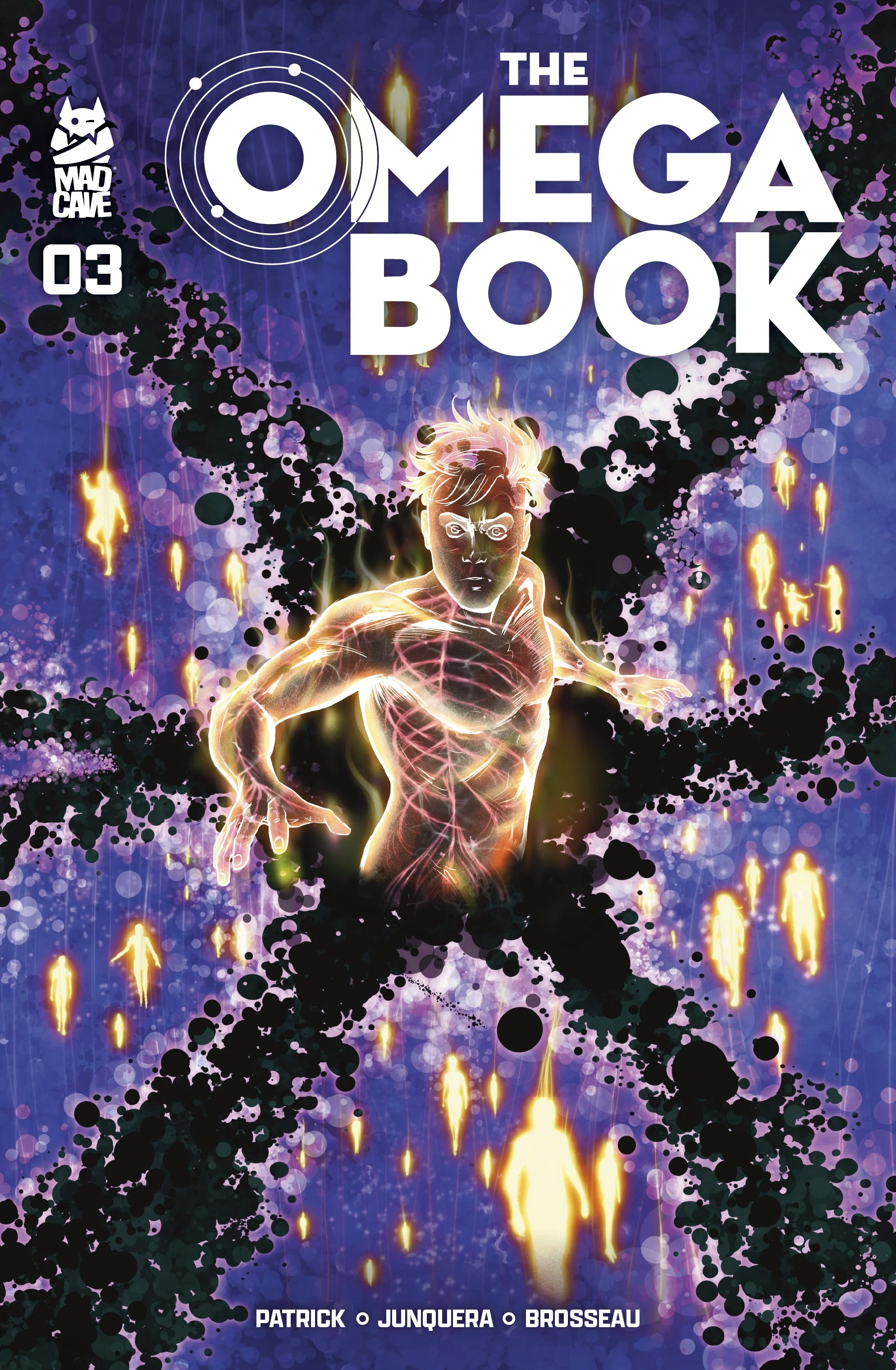
Credit: Mad Cave Studios
*** POSSIBLE SPOILER WARNING ***
WRITING:
This issue delivers some of the series’ strongest emotional material by placing Brady and Alexander’s damaged father-son relationship at the center of the conflict. James Patrick does more than simply tell the reader that Brady resents his father; he shows how years of distrust, disappointment, and unanswered questions shape nearly every decision Brady makes. As the series has progressed, that resentment has slowly begun to weaken, but this chapter forces Brady to confront it more directly than ever. At first, he has to trust Alexander for the most basic reason possible: survival. Brady must believe that his father can guide him through the machine’s dangerous process and keep him from becoming lost. That immediate danger gives their uneasy cooperation real tension because Brady is placing his life in the hands of the person he has spent so long doubting. The emotional impact becomes even greater when Brady quantumly entangles with Alexander and gains access to pieces of his father’s past, memories, and true feelings. Instead of hearing another explanation that he could dismiss, Brady experiences the truth from Alexander’s perspective. This allows him to see the fear, regret, and love hidden beneath his father’s strange behavior and obsessive work. The scene does not erase their problems or repair their relationship instantly, which makes it feel more honest. Instead, it gives Brady a new understanding of Alexander and creates the possibility that forgiveness may eventually replace resentment. That emotional weight captures the reader’s heart and makes the strained family dynamic feel just as important as the larger threat surrounding the Omega Books.
The science-fiction side of the story becomes increasingly wild in this issue, yet it never spins so far out of control that the plot becomes impossible to follow. Patrick walks a difficult line by introducing ideas rooted in real scientific language especially quantum entanglement, while also pushing those ideas into imaginative territory involving shared consciousness, unstable machinery, and inventions capable of producing consequences on a massive scale. In a less controlled story, that amount of explanation could overwhelm the characters or bury the emotional stakes beneath technical details. Instead, Patrick gives the reader only the information needed to understand what Brady is attempting, what could go wrong, and why the experiment matters. The concepts are explained through action, conversation, and Brady’s immediate reactions rather than through long stretches of exposition. This keeps the pacing moving and prevents the science from feeling like a lecture. It also helps that Brady is not an expert who instantly understands everything happening around him. He is confused, cautious, and often frightened by the same things that may confuse the audience, which makes him an effective guide into this strange world. As Brady asks questions, makes connections, and discovers the rules of the machine, the reader learns alongside him. That shared uncertainty makes the more complicated ideas easier to accept because the story never pretends that its characters have complete control over them. The result is a world that feels mysterious and dangerous without becoming needlessly complicated. Readers may not understand every scientific possibility behind the technology, but they always understand Brady’s goal, the personal cost of failure, and the growing threat created by Alexander’s inventions. That balance keeps the issue accessible while still allowing its science-fiction ideas to feel ambitious, unpredictable, and exciting.
ARTWORK:
The artwork in this issue significantly elevates the story’s science-fiction atmosphere by giving its most abstract concepts a convincing visual form. Pauli Junquera takes the strange machinery, quantum environments, and shifting sense of reality at the center of the issue and presents them with enough clarity that the reader can understand what is happening without losing the mystery that makes the world so compelling. The scenes inside the quantum realm carry the sleek, digital energy of films such as Tron and The Matrix, giving the imagery a touch of visual familiarity while still allowing Junquera to create a setting that feels distinctive, futuristic, and unpredictable. Layered backgrounds, unusual perspectives, glowing pathways, and energetic compositions make the realm appear vast and unstable, as though its physical rules could change at any moment. That sense of scale reinforces Brady’s vulnerability and reminds the reader that he has entered a place far beyond his experience or control.
Even though the quantum realm dominates much of the issue, the glimpses of the real world are equally important. Junquera slows the visual pace during these quieter scenes, focusing on body language, facial expressions, and the physical distance between characters. These grounded moments add warmth and emotional weight, revealing the personal consequences behind the larger science-fiction conflict. By moving smoothly between cosmic spectacle and intimate character work, Junquera makes the extraordinary elements feel believable while ensuring that Brady and Alexander’s relationship remains the visual and emotional center of the story.
As impressive as Junquera’s linework and page composition are, the color palette gives the artwork much of its identity and energy. The blues, greens, purples, and yellows used throughout the quantum realm create a vivid visual language that immediately separates it from ordinary reality. Bright highlights and sharp contrasts make the machinery, pathways, and bursts of energy appear illuminated from within, causing important details to stand out even when the pages are filled with dense technology or surreal imagery. The colors do more than make these sequences visually striking; they also communicate instability and danger. Sudden shifts in hue and intensity make the realm feel alive, volatile, and difficult to control, reinforcing the idea that Brady is moving through a space governed by unfamiliar rules. The palette guides the reader’s eye across each page, drawing attention to characters, points of impact, and crucial discoveries without disrupting the flow of the action. By comparison, the reality-based scenes use softer, more restrained colors. Earthier tones, muted backgrounds, and gentler contrasts create a quieter atmosphere that allows the characters’ expressions and interactions to carry greater emotional weight. This contrast between the dazzling quantum world and the subdued real world gives each setting its own mood while strengthening the transition between spectacle and character drama. The result is a thoughtful use of color that not only makes the pages pop but also supports the storytelling, clarifies shifts in location, and deepens the emotional tone of the issue.
Pat Brosseau’s lettering is another major strength because it guides the reader through the issue’s complicated ideas and visually dense sequences with remarkable clarity. The narration is positioned so that it provides necessary context without covering important parts of Junquera’s artwork, while the dialogue balloons follow a natural reading order that makes it immediately clear who is speaking. This is especially valuable during scenes in the quantum realm, where shifting perspectives, layered imagery, and rapid exchanges could easily become confusing. Brosseau keeps the page organized by giving each line of dialogue enough space to breathe and by using placement to lead the eye smoothly from one panel or focal point to the next. Changes in emphasis, balloon shape, and sound effects also help establish volume, urgency, and rhythm, allowing the reader to sense when a moment is quiet and reflective or sudden and dangerous. The sound effects feel integrated into the environments rather than simply placed on top of them, adding impact to the machinery and bursts of quantum energy without distracting from the characters. Because the lettering remains so controlled, readers can spend more time absorbing the artwork and emotional details instead of stopping to determine the order of the conversation. Junquera and Brosseau work together to create pages that are imaginative but still easy to navigate, balancing visual spectacle with clear storytelling. Their combined efforts give the issue a strong sense of movement, bring the strange world to life, and keep the narrative flowing even during its most complex scenes.
CHECK OUT MY REVIEW OF THE OMEGA BOOK #1
Final Thoughts:
The Omega Book #3 delivers an emotional and visually ambitious issue that deepens Brady and Alexander’s relationship without losing the series’ sense of mystery and danger. James Patrick’s accessible science-fiction storytelling, Pauli Junquera’s vivid artwork, and Pat Brosseau’s clear lettering combine to make this a compelling issue that leaves readers eager for what comes next. This series is a must for any science-fiction fan! Grab a copy when you are at the shop this week and consider adding this title to your Pull List.
FINAL GRADE: 9.2/10
Let me know your thoughts on The Omega Book #3 in the comments below. Thanks for reading!