THE OMEGA BOOK #1 (Mad Cave Studios)
A Mad Scientist isn’t so mad after all! Or so should be the takeaway upon reading the first issue of Mad Cave Studios’ newest series, The Omega Book. Alexander is a scientist who everyone thinks is crazy especially his son Brady. However, after Alexander’s untimely death, Brady discovers maybe his old man wasn’t as crazy as everyone thought.
The Omega Book #1 - Written By James Patrick – Art By Pauli Junquera - Letters By Pat Brosseau - Published By Mad Cave Studios
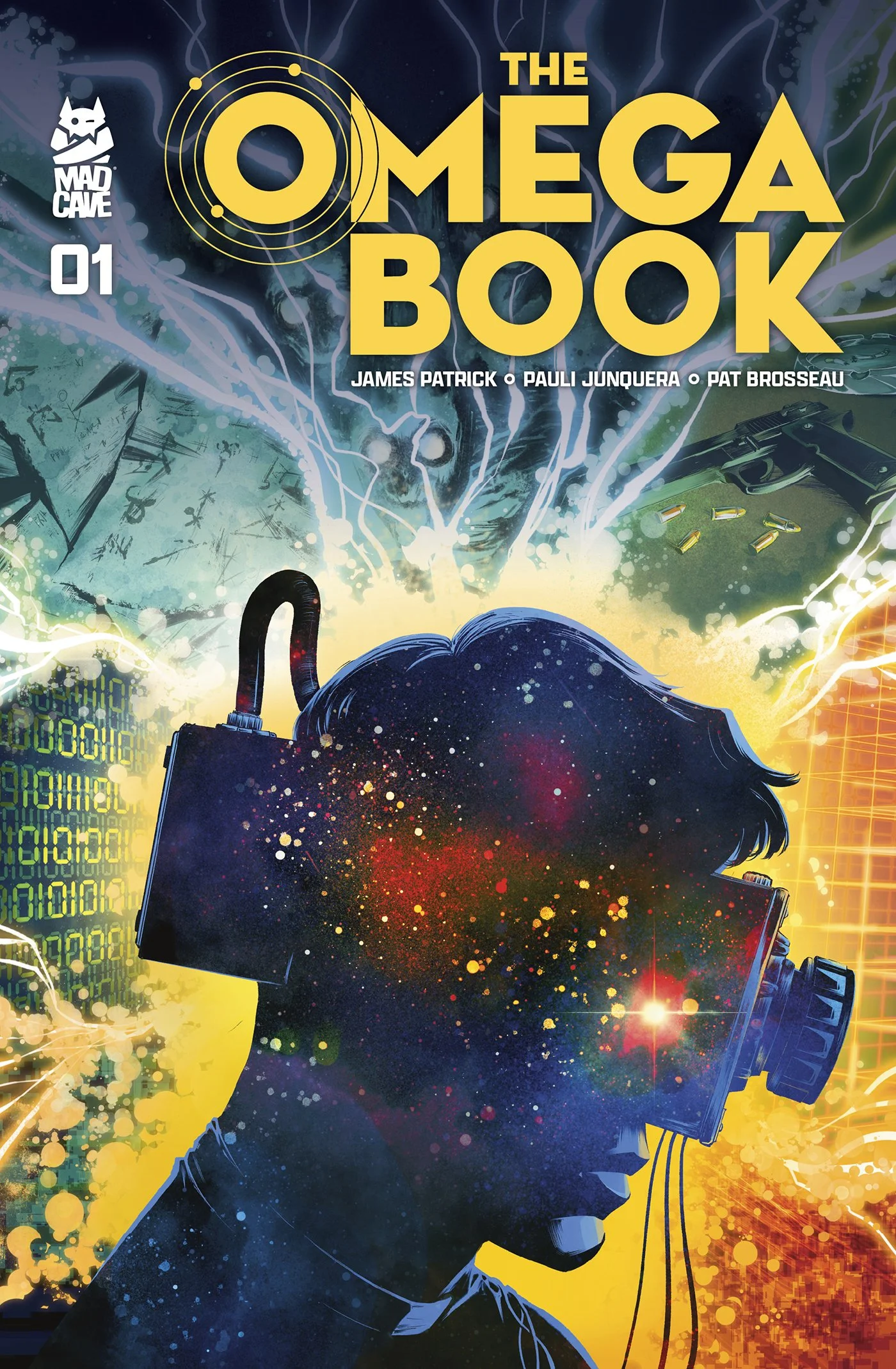
Credit: Mad Cave Studios
*** POSSIBLE SPOILER WARNING ***
STORY OVERVIEW:
Alexander is a Mad Scientist who is believed to be crazy. However, after being killed by some creatures from another dimension, it might seem that he’s not that crazy. At the funeral his estranged son Brady is given a locked case that was willed to him by his dad. Even though he doesn’t want it, he can’t help but find out what’s inside. What appear to some more of his dad’s crazy inventions turn out to be so much more. Now Brady who is a Priest, must face down not only the truths about the universe, but also that his dad may not have been crazy after all. Unfortunately for Brady he doesn’t have much time to let this sink in as his father’s enemies want the secrets that Brady now possess.
WRITING:
This first issue wastes no time pulling readers into the strange, dangerous, and surprisingly emotional world of The Omega Book. James Patrick opens the story with immediate momentum, showing Alexander in the middle of the type of impossible situation that makes everyone around him believe he is nothing more than a mad scientist. The opening pages work well because they do more than simply show off the weirdness of the premise. They establish that Alexander has enemies, that his work is connected to something much larger than ordinary science, and that his death is not just a shocking inciting incident but the beginning of a much bigger mystery. By the time the title page arrives, the issue has already created a strong sense that the reader has stepped into a story with hidden history, dangerous secrets, and consequences that reach far beyond one family.
Patrick then grounds all of that cosmic chaos through Brady, which gives the issue its strongest emotional hook. Brady’s relationship with Alexander is clearly complicated, and the script does a good job making that tension feel real rather than simply stated. Brady does not just think his father was eccentric; he carries the frustration, disappointment, and distance of a son who has spent years trying to separate himself from a parent he felt never had time for or loved him. Making Brady a priest adds another effective layer because it places him on the opposite side of Alexander’s worldview. Alexander devoted his life to science, theories, inventions, and proof, while Brady has built his identity around faith, belief, and spiritual certainty. That contrast gives the story an age-old science versus faith tension, but Patrick does not treat it like a simple argument where one side immediately wins. Instead, the issue uses Brady’s grief and confusion to show how fragile his assumptions become once he is forced to confront the possibility that his father may have not been crazy.
That idea becomes especially compelling once Brady begins exploring the strange objects Alexander left behind. The locked case is a familiar setup, but Patrick uses it effectively because it comes with emotional baggage as much as plot importance. Brady does not want to inherit his father’s obsessions, yet curiosity and unresolved grief pull him toward the truth anyway. When the goggles reveal something far larger and more impossible than Brady expected, the issue shifts from family drama into cosmic adventure without losing the personal stakes. The discovery forces Brady to question not only what his father knew, but also what the universe may actually be. Those moments make the issue feel bigger than a simple chase for a mysterious artifact. They suggest that the Omega Book is tied to knowledge, power, and realities that could challenge everything Brady believes about God, creation, and his own place in the world.
Patrick also keeps the issue moving by cutting away to the people hunting for the Omega Book. The Jealous Man and the Woman with the .45 give the story an immediate outside threat, and their presence keeps the plot from becoming too focused on Brady simply processing his father’s death. They bring danger, urgency, and a pulpy sense of adventure to the issue, making it clear that Brady has inherited more than a box of strange inventions. He has inherited his father’s enemies as well. That danger is important because Brady does not fully understand the stakes yet, while the reader can already see that violent forces are closing in around him. This creates strong dramatic tension and makes the final stretch of the issue feel like a fuse has been lit.
Overall, the writing succeeds because Patrick balances exposition, mystery, character drama, and action in a way that feels confident for a first issue. There is a lot of information being introduced, but the issue rarely feels overloaded because the story stays focused on Brady’s emotional reaction to each new discovery. The script gives readers enough answers to understand the basic conflict, while still holding back enough secrets to make the larger mythology feel intriguing. By the end, The Omega Book #1 feels like both a personal story about a son reevaluating the father he dismissed and a larger adventure about hidden knowledge, dangerous enemies, and a universe much stranger than it first appears. It is a strong opening issue that gives readers plenty of reasons to come back and see how deep Alexander’s secrets really go.
ARTWORK:
The artwork in this first issue is absolutely stunning and gives the reader a front row seat to every strange, wild, and impossible thing happening on the page. Pauli Junquera takes this outlandish science-fiction story and not only brings it to life, but makes the world of The Omega Book feel even stranger and more unpredictable than the script alone could suggest. What stands out right away is how clearly the art understands the tone of the book. This is not sleek, clean, futuristic sci-fi where everything looks polished and perfect. Instead, the visuals have a rougher, stranger, more handmade quality that fits Alexander and his inventions extremely well. The world feels like it is built out of obsession, desperation, and imagination, which makes the science-fiction elements feel personal rather than generic.
Junquera’s backgrounds and scenery stay somewhat simple and unassuming, but that restraint works in the issue’s favor. Rather than crowding every panel with unnecessary detail, the art makes sure the reader’s eye stays locked on the characters, the inventions, and the bizarre scientific phenomena unfolding in front of them. That choice helps the storytelling remain clear even when the concepts become bigger and more abstract. The layouts are easy to follow, and the action never becomes confusing, which is important for a book that is asking readers to accept dimensional creatures, strange technology, and cosmic revelations all in the same opening chapter. The simplicity in the environments also creates a strong contrast whenever the issue introduces something impossible, making those moments feel larger and more surprising.
The character designs are another major strength. Alexander looks and feels like the kind of man the world would dismiss as a mad scientist, but the art also gives him enough presence to suggest there is more going on beneath the surface. Brady, meanwhile, is drawn with a grounded quality that makes him feel believable as someone who has spent his life trying to distance himself from his father’s chaos. Even before the story fully pulls him into Alexander’s world, his expressions and body language communicate reluctance, grief, frustration, and curiosity. That emotional clarity gives the issue more weight because the reader can see Brady slowly being pulled from skepticism into uncertainty. The visual storytelling sells that shift just as much as the dialogue does.
However, the two best parts of the art are the crazy gizmos and the visual effects that make the science-fiction elements stand out. The tech and inventions that Alexander uses, and that Brady later inherits, do not look like they came from a pristine laboratory or a massive corporation. They look like cheap prototypes, strange experiments, and dangerous ideas assembled from whatever Alexander could get his hands on. That detail gives the devices character. They feel unstable, personal, and oddly believable, which makes it even more impressive when they actually work. The homemade quality of the equipment also tells the reader a lot about Alexander without needing extra exposition. He was not just a genius; he was someone obsessively building proof of things no one else believed existed.
The visual effects are where the artwork really opens up. Between Junquera’s linework and color choices, every time one of Alexander’s devices is used, the page makes it clear that the reader is witnessing something beyond ordinary science. Whether it is trails that suggest time and space bending, strange shapes that hint at other universes, or bursts of impossible energy surrounding the inventions, those images dominate the page in the best way. They create a sense of awe and discovery that matches Brady’s own reaction to what he is seeing. The effects do not just decorate the story; they help sell the idea that the Omega Book and Alexander’s inventions are connected to something massive, dangerous, and beautiful. Overall, Junquera’s art gives The Omega Book #1 a strong visual identity, balancing grounded character work with moments of cosmic weirdness that make the issue feel exciting, mysterious, and memorable.
CHECK OUT MY REVIEW OF THE LAST STARFIGHTER #1
Final Thoughts:
The Omega Book #1 is a strong debut that blends family drama, strange science fiction, and cosmic mystery into a first issue that feels exciting and emotionally grounded. Brady’s struggle to understand his father gives the story real weight, while Alexander’s inventions, hidden enemies, and the mystery of the Omega Book create plenty of momentum for what comes next.
James Patrick’s writing gives readers just enough answers to follow the premise while leaving the larger mythology intriguing, and Pauli Junquera’s artwork gives the book a memorable visual identity full of handmade inventions and cosmic weirdness. Overall, this is absolutely worth picking up for readers who enjoy sci-fi with mystery, heart, and a strong sense of adventure.
FINAL GRADE: 9.5/10
Let me know your thoughts on The Omega Book #1 in the comments below. Thanks for reading!