THE FOLK OF DOONEY HOLLOW #1 (IGNITION PRESS)
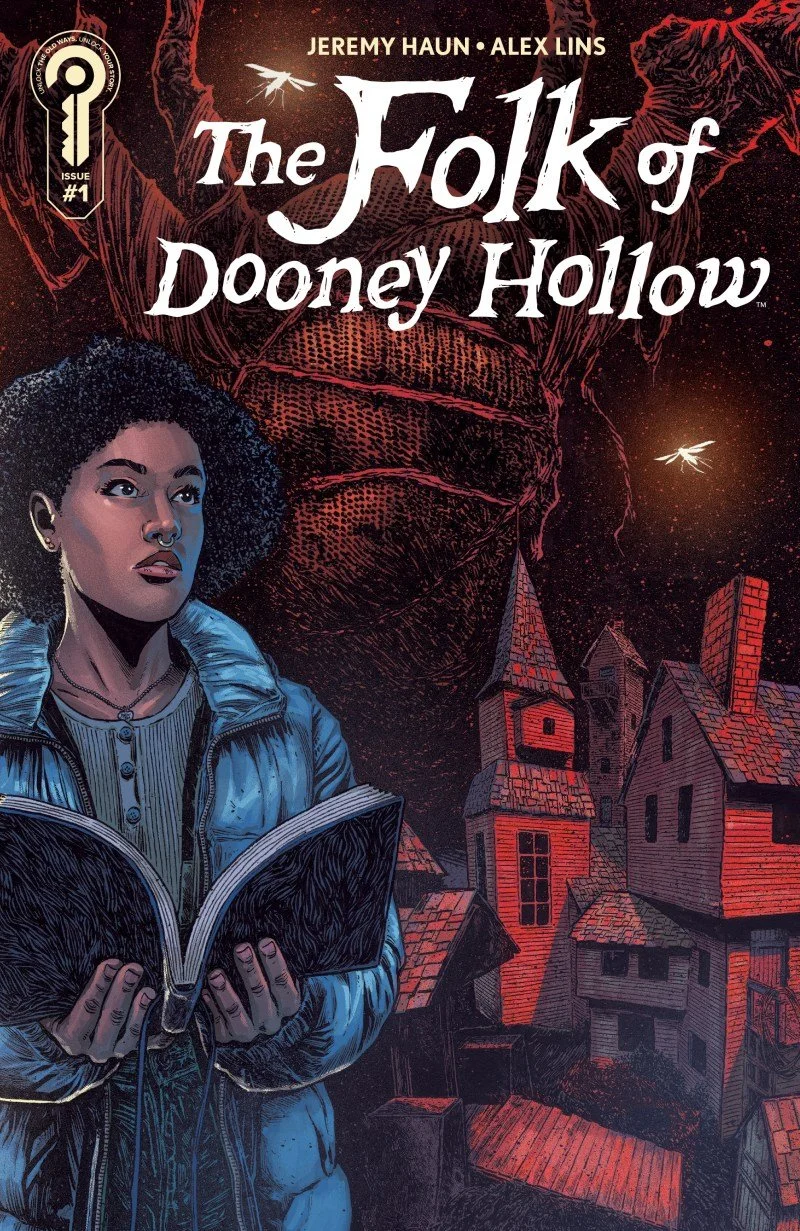
The Ozark Mountains are beautiful and scenic, but they also may head a strange and deadly side. A young lady named Kerri Hayes is about to find this out firsthand. As a long with her we enter the mysterious and creepy world of the newest series from Ignition Press, The Folk of Dooney Hollow.
The Folk of Dooney Hollow #1 - Written By Jeremy Haun – Art By Alex Lins – Colors By Trish Mulvihill - Letters By Andworld Design – Edited By Jamie S. Rich - Published By Ignition Press
Credit: Ignition Press
*** POSSIBLE SPOILER WARNING ***
STORY OVERVIEW:
We open with a young man running in the wilderness from something we can’t see. But after getting tripped up it looks like this young man has taken his last breath. We then meet Kerri Hayes who has just arrived in the Ozark Mountains. She seems to be distracted by a conversation or lack there of on her cell phone. She is met by Otis who is a local that is helping her set up her campsite. In the truck is his wife Maxine, who isn’t so well after a spell during a heatwave years ago. As Kerri takes in the scenery and nature in the mountains, she can’t help but have an eerie feeling that she’s being watched. As she encounters more and more strange things, including an encounter with a running naked Maxine, she gets the feeling that this place is a little off. However, nothing can prepare her for the horror she is about to discover and thrust straight in the middle of.
WRITING:
The first issue of The Folk of Dooney Hollow does more than introduce its central mystery; it carefully establishes the rules of its atmosphere. Jeremy Haun opens with immediate danger, using the unidentified young man’s flight through the wilderness to tell the reader that something lethal is already moving through the Ozarks. That sequence gives the issue momentum before Kerri Hayes arrives, while the lack of a clear explanation turns the opening into a question that hangs over every scene that follows. Once the story shifts to Kerri, Haun slows the pace without releasing the tension. Ordinary actions, arriving at a campsite, speaking with a local, checking a phone, and taking in the landscape feel uneasy because the reader already knows the surrounding woods conceal a threat.
The Ozark Mountain setting is especially effective because Haun treats isolation as both a physical condition and a psychological pressure. The region is expansive, but Kerri’s unfamiliarity with it makes that openness feel strangely confining. She is surrounded by wilderness, separated from dependable help, and dependent on people she has only just met. Haun builds dread from that vulnerability rather than rushing toward overt horror. The sense that Kerri may be watched, the uncomfortable gaps in what Otis reveals, and Maxine’s unpredictable behavior gradually transform a scenic retreat into a place where every sound or movement might carry a warning. This patient escalation allows the environment to become part of the threat long before the source of the danger is identified.
Haun also handles exposition with restraint. The issue provides enough information to orient the reader: who Kerri is, why she is in the area, and who Otis and Maxine are without offering easy answers about the larger mystery. Instead, the script relies on fragments, behavioral clues, and unsettling encounters. That approach encourages the reader to examine every detail and form theories alongside Kerri. Just when the story appears to settle into one explanation, Haun redirects it, then uses the final reveal to complicate the situation again. These reversals work because they grow from details already planted in the issue rather than feeling like arbitrary shocks. The mystery deepens, but the narrative remains clear, giving the reader uncertainty without confusion.
Kerri is still intentionally underdeveloped at this stage, but Haun gives her enough emotional texture to make her an effective point-of-view character. Her distracted phone interaction suggests that she has arrived carrying personal concerns, and that private tension makes her feel vulnerable even before the external danger becomes apparent. At the same time, she is observant enough to recognize that something is wrong, which prevents her from seeming passive. Her reactions guide the reader through the issue: curiosity gives way to discomfort, discomfort becomes alarm, and alarm finally becomes horror. The result is a strong “final girl” energy without reducing her to a familiar archetype. The script creates concern for Kerri not by explaining everything about her past, but by placing her in a situation where her limited knowledge mirrors the reader’s own.
Otis and Maxine strengthen that uncertainty because neither character can be read in a simple way. Otis appears helpful, yet his familiarity with the area and his connection to Maxine raise questions about what he knows and what he may be withholding. Maxine’s condition initially invites sympathy, but her sudden appearance running through the woods turns that sympathy into fear and confusion. Haun uses these shifting impressions to keep the reader emotionally off balance. By the final pages, the issue has moved naturally from rural unease to full horror, and the closing revelation lands because the script has spent the entire issue tightening its atmosphere. Rather than resolving the central mystery, the ending confirms that the danger is real while opening larger questions about Dooney Hollow, its inhabitants, and the forces surrounding Kerri. It is an effective first issue because it delivers a complete escalation of tension while leaving enough unanswered to make the next issue feel essential.
ARTWORK:
The artwork is essential to the uneasy tone of The Folk of Dooney Hollow #1. Alex Lins does not simply illustrate Jeremy Haun’s script; he gives the mystery a physical presence through composition, scale, and carefully controlled detail. His depiction of the Ozarks captures the region’s natural beauty while consistently suggesting that the landscape is concealing something dangerous. Wide views emphasize the mountains and dense wilderness, yet the placement of trees, shadows, and figures makes that open space feel restrictive. Kerri can appear small against the environment, reinforcing both her isolation and the sense that she has entered a place governed by forces she does not understand.
Lins’s visual storytelling is particularly effective during the quieter scenes. Rather than depending on constant action, he creates tension through body language, facial expressions, and the distance between characters. Kerri looks capable and alert, but subtle changes in her posture and expression reveal her growing discomfort. That balance allows her to read as a strong lead without making her seem unaffected by the danger around her. Otis initially has the approachable appearance of a helpful local, but his expressions and physical presence retain enough ambiguity to make the reader question what he knows. Maxine is equally unsettling because Lins can shift her from a vulnerable figure to an unpredictable presence without losing the humanity in her design.
The page layouts also support the issue’s gradual escalation. Calm, readable sequences allow the reader to absorb the setting and notice suspicious details, while tighter compositions increase the pressure as Kerri’s situation becomes more threatening. The opening pursuit communicates speed and panic, but later pages favor stillness and observation, creating the feeling that danger may be waiting just outside the frame. This contrast makes each sudden movement or disturbing discovery more effective. Lins understands when to provide a broad view of the environment and when to move closer to a face or object, guiding attention without making the visual clues feel overly obvious.
The mysterious monolith is one of the strongest designs in the issue. Its form is simple enough to be immediately recognizable, but unfamiliar enough to invite questions about its construction, origin, and purpose. It does not clearly belong to either the natural landscape or the human structures around it, which makes it feel like an intrusion into the setting. That visual uncertainty strengthens the larger mystery: the reader can study the object and form theories, but its appearance alone never provides a comfortable explanation. The final-page image follows the same principle on a more openly threatening level. Lins gives the reveal weight through scale, silhouette, and staging, ensuring that the last image feels menacing rather than merely surprising.
Trish Mulvihill’s colors deepen every one of these choices. Her restrained, darker palette gives the wilderness a heavy, almost oppressive quality without flattening the natural beauty of the location. Earth tones help the setting feel grounded, while cooler shadows and muted transitions suggest that danger is always nearby. The color work also helps control the reader’s emotional response: warmer or more natural passages can briefly imply safety, only for darker values and sharper contrasts to reintroduce unease. This makes the horror feel as though it is emerging from the landscape rather than being placed on top of it.
Together, Lins and Mulvihill create an environment that is scenic, isolating, and threatening at the same time. The character acting keeps the mystery grounded in believable reactions, the layouts lead the reader through a steady rise in tension, and the designs provide memorable visual questions that the story has not yet answered. The artwork therefore does more than establish the appearance of Dooney Hollow; it defines the emotional experience of entering it, making the setting itself feel like one of the book’s central characters.
Check Out MY REVIEW OF CULT-DE-SAC #1
Final Thoughts:
The Folk of Dooney Hollow #1 is a compelling horror debut that pairs a steadily unfolding mystery with atmospheric artwork and an unsettling Ozark setting. Its strong pacing, memorable final reveal, and lingering unanswered questions make the next issue an easy recommendation. Make sure to pick a copy of this first issue up when you are at the shop this week. Also, well you are there, you should just add this to your Pull List as I’m confident that you will want more of this amazing and eerie world.
FINAL GRADE: 9.5/10
Let me know your thoughts on The Folk of Dooney Hollow #1 in the comments below. Thanks for reading!