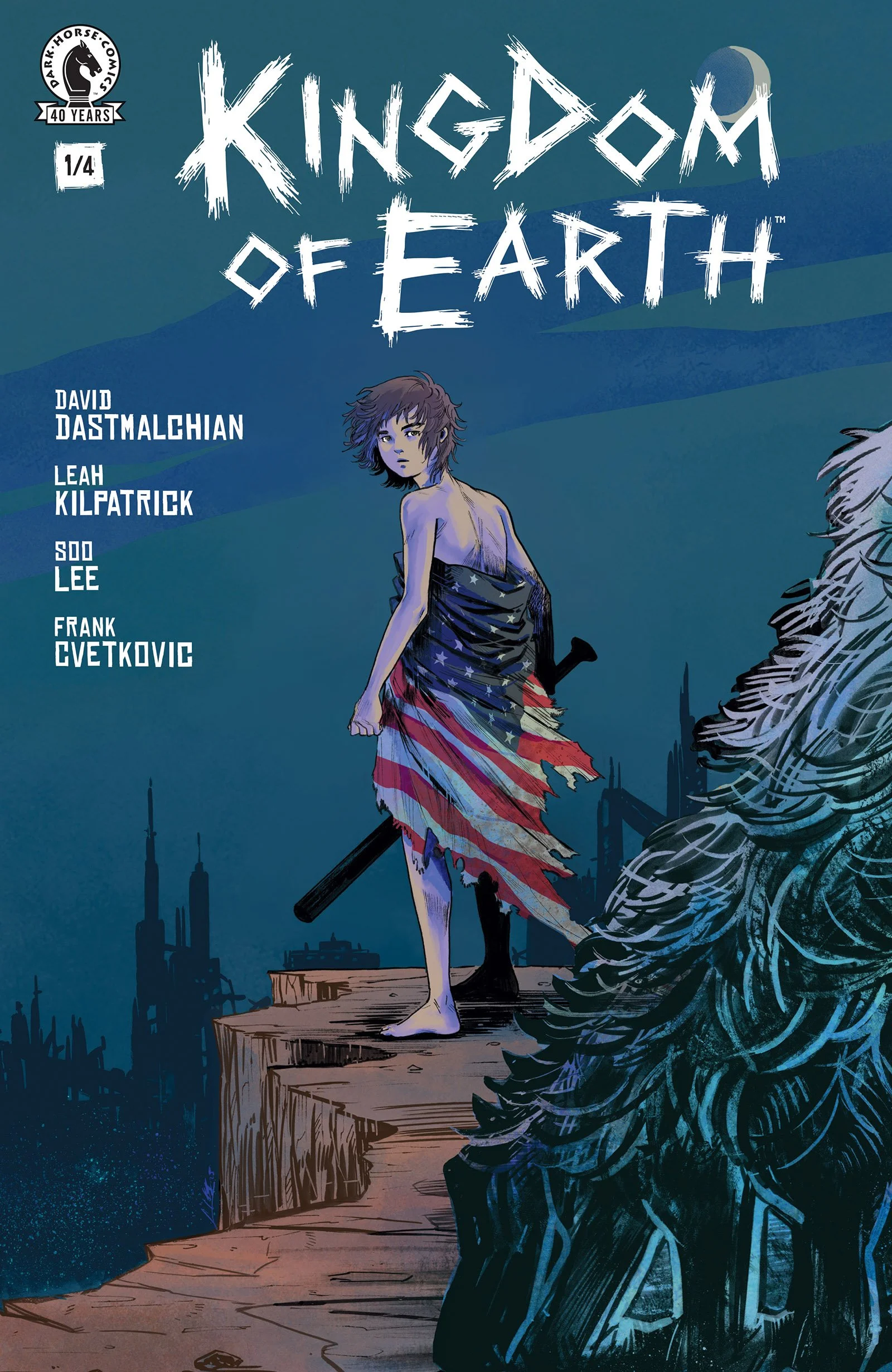
KINGDOM OF EARTH #1 (Dark Horse Comics)
The team of David Dastmalchian & Leah Kilpatrick are back again, and they are bringing you a monster filled post-apocalyptic fantasy story. In 2036 monsters and demons have taken over North America and have carved it into four territories known as the Four. Humans are only used as slaves and food and are hunted for both.
Kingdom of Earth #1 – Story By David Dastmalchian & Leah Kilpatrick – Art By Soo Lee - Letters By Frank Cvetkovic – Edited By Patrick Thorpe - Published By Dark Horse Comics
Credit: Dark Horse Comics
*** POSSIBLE SPOILER WARNING ***
STORY OVERVIEW:
In 2036 North America is carved into 4 territories commonly known as the Four. But these territories are not run by humans, instead different monsters have taken over this post-apocalyptic terrain. The Northerner Territory is run by a Dark Watcher known as the Administrator. The Administrator rules with an iron fist and when a foreman of the “cattle” train messes up, she replaces him with an Ozark Howler named Virago who kills the previous foreman. The “cattle” are humans, as since the monsters arrived from the sea two years prior, humans have been hunted for food and slave labor. We then get introduced to a young human boy who is just trying to survive and not be captured. This is where our adventure truly starts and the journey begins.
WRITING:
This horror fantasy hits the ground running and immediately drops the reader into the middle of a strange, violent, and unstable new world. David Dastmalchian and Leah Kilpatrick do not ease into the premise so much as they throw the doors open and let the madness spill out onto the page. From the opening moments, there is a clear sense that North America has been completely reshaped by something monstrous, and that the old rules of civilization no longer apply. The idea of the continent being carved into territories ruled by different creatures gives the story an ambitious scope right away, making the world feel bigger than just one survivor’s journey. It feels like there is an entire mythology sitting underneath the surface, waiting to be explored as the series continues.
What makes the setup effective is how quickly the writers establish the power dynamic between monsters and humans. Humans are no longer treated as people in this world; they are livestock, labor, and prey. That simple but horrifying idea gives the issue an immediate sense of danger. Every mention of the “cattle” train reinforces how far humanity has fallen, and the cold, organized way the monsters manage their captives makes the horror feel even more disturbing. The Administrator’s introduction also works well because she gives the monster society structure. She is not just a creature causing chaos; she represents authority, control, and punishment. Her decision to replace the failed foreman with Virago shows that this world has rules, consequences, and a brutal chain of command.
The different monsters, specters, and mythological beings roaming the landscape give the book a strong fantasy flavor while still keeping the tone rooted in horror. There is a lot of fun in seeing these creatures treated as political powers instead of random threats. The interaction between them suggests that Dastmalchian and Kilpatrick have put real thought into how this society functions after the collapse of humanity. The hierarchy among the monsters, the way they speak to one another, and the way they view humans all help sell the idea that this is not just an apocalypse, but a new order that has already begun to settle in. That makes the world feel dangerous in a different way because the monsters are not temporary invaders anymore. They are rulers.
The introduction of the young human protagonist adds another important layer to the issue. After spending time with the monsters and seeing how they treat humans, following a young survivor instantly raises the emotional stakes. His presence brings a small sense of hope into an otherwise bleak setting, but it also creates a lot of tension because the reader understands exactly what could happen to him if he is caught. The writing uses that knowledge effectively, allowing the danger around him to feel immediate even before anything major happens. He becomes the reader’s entry point into the world, and his survival gives the story a more personal focus after the larger worldbuilding of the opening pages.
The twist at the end of the issue is also one of the strongest hooks. It comes suddenly and feels completely unexpected, which makes it effective as a final-page surprise. It changes the way the reader thinks about what came before and gives the second issue a lot of momentum going forward. However, that same surprise also highlights the biggest weakness of the first issue. While I appreciate a story that trusts the reader and leaves mysteries to unfold over time, this issue holds back so much information that parts of the story become a little unclear. There are moments where the book seems to want the reader to feel disoriented, but the lack of context occasionally makes the confusion feel less intentional and more frustrating.
A few more context clues would have gone a long way in helping the reader understand the rules of the world, the timeline of the monster invasion, and the importance of certain characters. Even with the big reveal, I found myself needing to double-check whether the character who appears at the end was the same character introduced earlier. That kind of uncertainty slightly undercuts the impact of the twist because the reader has to pause and reorient themselves instead of simply reacting to the reveal. Still, the concept is strong, the world is intriguing, and the issue leaves enough unanswered questions to make me want to come back for issue two. The next chapter will just need to deliver more clarity and context to fully capitalize on the strong foundation this debut sets up.
ARTWORK:
The artwork in this first issue does a lot of heavy lifting in bringing this fantasy horror world to life. Soo Lee immediately gives the book a strong visual identity by making the post-apocalyptic landscape feel both strange and dangerous. The environments do not just look empty or damaged; they feel like places that have been taken over and reshaped by something unnatural. The backgrounds and surrounding areas help sell the idea that humanity has lost control of the world, and that the monsters now own every corner of it. There is a bleakness to the setting that makes the reader understand the danger without the story needing to explain every detail.
Lee’s biggest strength in this issue is the character and monster design. The different creatures all stand out from one another, which is important in a story that introduces so many monsters so quickly. Each design has its own shape, attitude, and personality, making the world feel larger and more varied. The Administrator has a commanding presence that makes her feel powerful before she even does much on the page, while Virago’s design feels more aggressive and physical. These visual choices help define the characters right away and make the monster hierarchy easier to understand through appearance alone.
There is also a lot of creativity in the way Lee balances horror and fantasy. The monsters are not drawn as simple background threats; they feel like beings that belong to this world and have already settled into positions of power. That makes the visuals more interesting because the creatures are not just scary, they also feel organized and established. The designs suggest history, culture, and conflict, which adds depth to the worldbuilding. Seeing so many unique creatures in the first issue gives the series a strong sense of possibility, as if this is only the beginning of what this world can show us.
Lee also does a strong job with visual storytelling when it comes to the human characters. The young human boy is drawn in a way that makes him look vulnerable without making him feel helpless. His body language and expressions help the reader connect with him quickly, especially after seeing how cruelly humans are treated in this world. That contrast between the monstrous figures and the human survivor gives the artwork an emotional edge. It reminds the reader that beneath all the fantasy elements and creature designs, this is still a survival story about people trying to stay alive in a world that no longer belongs to them.
Check Out MY REVIEW OF WITNESS POINT #1
Final Thoughts:
Overall, the art gives Kingdom of Earth #1 a memorable look and helps the issue stand apart. The combination of grim landscapes, expressive characters, and imaginative monster designs makes the world feel fully realized even when the writing is still holding back information. Lee’s visuals give readers enough to grab onto and make the setting feel dangerous, weird, and exciting. If the series continues to expand on these designs and environments, the artwork could easily become one of the book’s strongest selling points.
FINAL GRADE: 8/10
Let me know your thoughts on Kingdom of Earth #1 in the comments below. Thanks for reading!