WITNESS POINT #1 (Dark Horse Comics)
The sleepy town of Baraboo, Wisconsin has a secret and it’s not that it’s affectionately known as Circus City. No, it is secretly known as Witness Point by people in the FBI and U.S Marshall’s. But now, that secret appears to be out and this quiet Wisconsin town is about to become a whole lot less quiet.
Witness Point #1 - Created By Nathan Fillion, Heath Corson, & Soo Lee – Script By Heath Corson – Art & Colors By Soo Lee – Letters By Joshua Reed – Edited By Chuck Howitt-Lease - Published By Dark Horse Comics
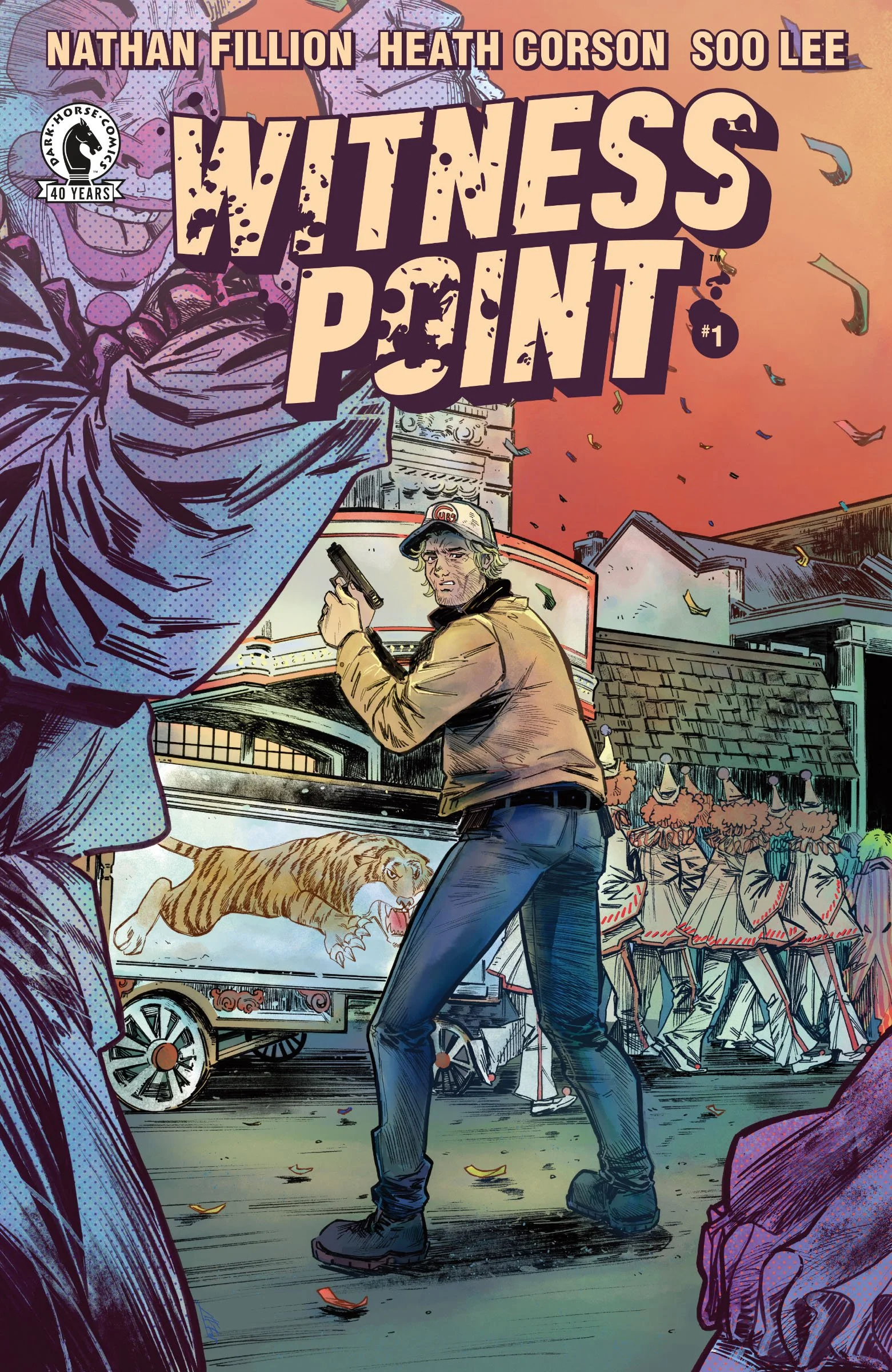
Credit: Dark Horse Comics
*** POSSIBLE SPOILER WARNING ***
STORY OVERVIEW:
Sheriff Carter Calhoon, affectionately known to everyone as Kite, is the Sheriff of Baraboo, Wisconsin. This quiet quaint town in Wisconsin is best known for being the winter home for the Ding-A-Ling Circus and is how it got its nickname of Circus City. Heck, the mayor of Baraboo is a former circus clown even. However, a grisly murder has just taken place that threatens to unveil a secret that most of the townsfolk didn’t even know. You see Baraboo has another more secretive nickname and that’s Witness Point. This nickname came from the FBI and U.S Marshall’s who overused Baraboo as a witness protection location. Now it appears someone has found out this secret and is looking for someone who is hiding in Baraboo. Unfortunately, for the first guy who came, his target killed him before he got them. Now Sheriff Calhoon and Marshall Priya Khabrani need to find out who killed the would-be assassin, so they can uncover who found out about Witness Point, before more hitmen are sent and more murders happen. But with a town with so many former criminals, this will be no easy task.
WRITING:
The first issue of Witness Point introduces Baraboo, Wisconsin and the secret sitting underneath it with a confidence that makes the premise immediately engaging. Nathan Fillion & Heath Corson do a strong job easing the reader into the town, Sheriff Carter “Kite” Calhoon, and the central murder mystery without overexplaining everything right away. The issue understands that the best way to sell this kind of noir setup is not to dump all the answers on the page, but to let the reader feel the town’s strange personality first. Baraboo comes across as quiet, friendly, and almost too quaint on the surface, which makes the discovery of a grisly murder feel even more disruptive. The contrast between the town’s small-town charm and the darkness hidden within it gives the issue a strong hook from the start.
One of the smartest choices in the writing is how Baraboo itself becomes just as important as the people living in it. The town is best known for its circus history and sleepy Midwestern personality, but those familiar details become a cover for something far more dangerous. The idea that Baraboo has been used as a dumping ground for people in the Witness Protection Program turns the entire community into a pressure cooker. Suddenly every neighbor, shop owner, teacher, parent, and local oddball could be someone with a violent past or a reason to keep quiet. That instantly gives the story a bigger sense of paranoia because the mystery is not only about who committed the murder, but also about who everyone really is underneath the lives they have built for themselves.
Sheriff Calhoon is also a strong entry point into the series. Kite’s calm, laid-back nature reflects the town’s usual rhythm, but it also makes him interesting because this is clearly the kind of case that can test that patience. He does not come across as the typical hard-boiled detective who charges into every situation with swagger. Instead, he feels like someone who knows his town, understands its rhythms, and may be carrying more awareness than he lets on. That quietness gives the character room to grow as the situation gets worse. If the first issue is about keeping everything contained, the larger question becomes how long Kite can stay calm once the truth about Witness Point begins tearing through the community.
The arrival of Marshall Priya Khabrani gives the issue another important source of tension. Her presence changes the dynamic because she is not simply there to help Kite solve a local murder; she represents the larger federal mess that Baraboo has been forced to live with. That creates an effective push and pull between local control and outside authority. Kite knows the town, while Priya understands the dangerous implications of what has been exposed. Their partnership has the potential to become one of the strongest parts of the series because they are approaching the same problem from very different angles. The writing uses that contrast well, setting them up as two people who need each other even if the situation does not make trust easy.
What really makes the premise work is how naturally the murder expands the scope of the story. The death of the would-be assassin is not treated as a simple inciting incident and then pushed aside. Instead, it immediately raises several questions that make the issue more compelling. Who was the target? How did someone discover the truth about Witness Point? How many people outside the town know what Baraboo has been used for? And, maybe most importantly, how many residents are willing to kill again to protect the new lives they have made? Those questions give the book a strong mystery engine while also allowing the writers to explore the fear and suspicion spreading through the town.
The issue also balances its darker noir elements with a sense of personality that keeps it from feeling too grim. The detail about the local newspaper being gone and the school paper becoming the closest thing the town has to real news is a great example of that. It adds humor and texture while still serving the larger plot, especially since the students chasing conspiracy theories suddenly do not seem quite as ridiculous once the town’s actual secret comes to light. That kind of world-building makes Baraboo feel lived-in rather than just being a backdrop for the murder. The oddball details help create a place that is believable enough to invest in, but strange enough that readers know anything could happen there.
ARTWORK:
The artwork in this first issue matches the vibe of the story extremely well and does a lot of work in helping sell the central mystery. Soo Lee captures the small-town feeling of Baraboo in a way that makes it feel welcoming at first glance, but never completely safe. The streets, homes, shops, and public spaces all have that quiet Midwestern charm that fits the town’s reputation, yet there is always a subtle tension underneath the surface. That balance is important because the entire premise depends on Baraboo looking like the kind of place where nothing too serious should happen, while also slowly revealing that this same ordinary-looking town is hiding something dangerous.
The design of the town tells a lot of the story before the dialogue even has to explain anything. Lee makes Baraboo feel lived-in rather than generic, and that gives the mystery a stronger foundation. The town does not come across like a random backdrop where the plot happens; it feels like a real community with its own history, habits, and personality. That makes the darker reveals more effective because the reader can understand why someone would want to disappear there. It looks quiet enough to protect secrets, but familiar enough that any disruption immediately feels noticeable. That visual contrast between normalcy and danger is one of the strongest parts of the issue’s presentation.
The character designs are also spot on for the personalities of the people we meet. Sheriff Kite Calhoon has a relaxed, approachable look that fits his easygoing presence, while still leaving room for the reader to believe there is more going on behind his calm exterior. Marshall Priya Khabrani has a sharper, more focused visual presence, which helps her stand apart from the rest of the town and reinforces the idea that she brings a larger federal problem into this local setting. Even the supporting characters have enough visual distinction to make them memorable, which is important in a mystery series where every person could eventually become a suspect, a victim, or someone with a hidden past.
Lee’s facial expressions and body language are probably the most effective parts of the visual storytelling. The characters often reveal more through small reactions, glances, posture, and hesitation than they do through their words. That matters a lot for a story built around secrets because the artwork encourages the reader to study the panels closely. A slight look of concern or a character standing a little too stiffly can make a scene feel more suspicious without the script needing to spell everything out. Those little visual tells help create the feeling that everyone in Baraboo may be hiding something, which makes the reader want to pay attention to the details from the very beginning.
The color palette Lee uses also does a strong job capturing the mood of the issue. The brighter colors used during the everyday town scenes help establish Baraboo as a place that appears normal and comfortable on the surface. Then, when the story shifts into darker territory, those brighter tones give way to heavier blues, grays, and shadowed colors that immediately change the emotional temperature of the page. That visual shift helps guide the reader through the issue’s tonal changes without feeling forced. The colors do not simply make the pages look good; they help communicate when the story is moving from ordinary small-town life into something more dangerous and unsettling.
Overall, the artwork strengthens the issue because it understands that Witness Point is not just a murder mystery, but a story about a place where the truth is hidden in plain sight. Lee’s work makes Baraboo feel charming enough to be believable as a refuge, but uneasy enough that readers can sense the danger underneath it. The art, colors, expressions, and staging all work together to support the noir atmosphere and keep the reader questioning what is really going on in every scene. It is a strong visual foundation for the series and a big reason why the first issue’s mystery lands as well as it does.
Check Out MY REVIEW OF MASTERMINDS #5
Final Thoughts:
Witness Point #1 succeeds because it gives readers enough answers to understand the stakes while holding back enough information to make the next issue feel necessary. The town full of protected witnesses creates a built-in suspect list that could carry the series for a long time, and the writing wisely leans into that uncertainty. Every resident now feels like a possible threat, a possible victim, or both. That sense of distrust should make the mystery entertaining as the story continues to unfold. If the series can keep developing Kite, Priya, and the dangerous history of Baraboo with this same level of control, then Witness Point has the potential to be a very engaging small-town noir mystery. This is definitely an issue you should give a shot when you visit the Comic Shop this week. Who knows, maybe you have found your new favorite mystery series.
FINAL GRADE: 9/10
Let me know your thoughts on Witness Point #1 in the comments below. Thanks for reading!