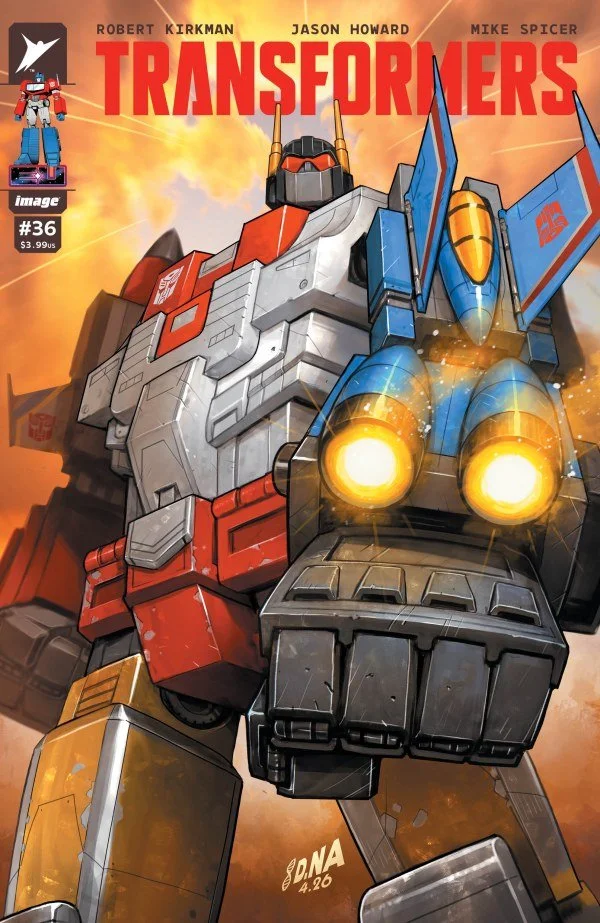
TRANSFORMERS #36 (SKYBOUND ENTERTAINMENT/IMAGE COMICS)
Cobra-La has officially made itself known in the Transformers section of the Energon Universe! As the Aerialbots and Decepticons have to form a sort of alliance to survive an encounter with Cobra-La Marauders. Can they be successful against this new threat to them and the world in general?
Transformers #36 - Written By Robert Kirkman - Art By Jason Howard - Colors By Mike Spicer – Letters By Rus Wooten - Edited By Ben Abernathy - Published By Skybound Entertainment/Image Comics
Credit: Skybound Entertainment/Image Comics
*** POSSIBLE SPOILER WARNING ***
STORY OVERVIEW:
The Aerialbots and Decepticons have to work together in a way as they get ambushed by the Cobra-La Marauders. This unlikely and shakey alliance didn’t last but was necessary for survival. The bigger threat is that now the Cobra-La feel threatened and are ready to move on the offensive even without Pythona. Back at Shadow Watch Base, Dr. Arkeville is helping to repair the injured and fallen Autobots. However, it’s hard not to feel like Arkeville has ulterior motives and there is something definitely off about him. Meanwhile, Starscream is back and he has found the Cybertron Shard in the Pacific Ocean, as well as all of the things Wheeljack was working on there.
WRITING:
The story and drama continue to build throughout this issue, with each new development making the larger conflict feel more dangerous and unpredictable. Robert Kirkman is not simply moving the characters from one battle to the next; he is carefully positioning several threats that could collide in devastating ways. The return of Starscream is especially important because he has now located the Cybertron Shard in the Pacific Ocean, along with the technology and unfinished work Wheeljack left behind. Starscream is already one of the most ambitious and dangerous Decepticons, but access to Autobot secrets and powerful Cybertronian resources could make him an even greater threat. His discovery gives the issue an ominous undercurrent and suggests that the consequences will extend far beyond a single confrontation.
Kirkman also delivers Cobra-La’s true introduction to this corner of the Energon Universe, and the group immediately feels like more than another temporary enemy. The Cobra-La Marauders are powerful enough to force the Aerialbots and Decepticons into a reluctant alliance, which communicates the severity of the danger without requiring excessive explanation. Their battle is intense and visually exciting, but it also serves the larger story by showing how fragile every existing rivalry becomes when an unfamiliar enemy appears. The alliance does not last, nor should it, yet the fact that it happens at all reveals how dramatically Cobra-La has disrupted the balance of power. With Cobra-La now feeling threatened and preparing to act without Pythona, the conflict seems close to reaching a dangerous tipping point.
The confrontation also provides a major payoff for the Aerialbots as they unite to form Superion. This moment is more than a crowd-pleasing transformation; it demonstrates that the team can overcome its divisions when the situation demands it. Superion’s arrival gives the Autobots a powerful new advantage, but it also raises questions about how well the Aerialbots can maintain that unity under pressure. Kirkman leaves plenty of room for this development to grow, making Superion feel like both an immediate answer to the Cobra-La attack and an important piece of the series’ future battles.
At Shadow Watch Base, the tension surrounding Dr. Arkeville adds a quieter but equally compelling layer of uncertainty. Although he is helping repair the injured and fallen Autobots, his behavior continues to suggest that he has motives beyond assisting the heroes. Kirkman has been patient with this subplot, offering suspicious details rather than revealing Arkeville’s intentions too quickly. In this issue, even General Flagg takes notice of his questionable behavior, confirming that the unease extends beyond the reader’s perspective. Arkeville feels like the kind of threat that could emerge from within at the worst possible moment, and the gradual buildup makes his eventual role more intriguing. By planting these seeds now, Kirkman ensures that the story’s danger comes not only from open warfare, but also from secrecy, manipulation, and uncertain loyalties.
ARTWORK:
The artwork in this issue continues to be one of the series’ greatest strengths, delivering striking character designs, expansive environments, and action sequences that make the conflict feel appropriately massive. Jason Howard gives each location its own visual identity, preventing the story’s frequent shifts between settings from becoming confusing or repetitive. The vast outdoor landscapes emphasize the scale of the world, while the more confined areas at Shadow Watch Base create a colder and more controlled atmosphere. These contrasting environments help distinguish the different storylines and make the world feel larger than the immediate battle taking place on the page. Howard also fills the backgrounds with enough detail to establish each setting without allowing those details to overwhelm the characters or distract from the central action.
Howard’s interpretations of the Transformers remain the visual highlight of his run. The characters retain the recognizable silhouettes, colors, and mechanical features associated with their classic appearances, but the artist adds sharper lines, expressive poses, and small design flourishes that make them feel suited to this modern version of the Energon Universe. Even during crowded scenes, the Transformers are easy to identify because each one has a distinct shape and physical presence. Their movements also communicate personality: some characters appear controlled and tactical, while others charge into combat with a heavier and more aggressive style. This attention to body language gives the robots a surprising amount of expression, even when their faces remain relatively mechanical.
The debut of Superion is an especially impressive showcase for Howard’s sense of size and composition. Superion immediately looks powerful enough to change the direction of the battle, and the framing of his appearance allows the reader to understand how enormous he is compared with the individual combatants around him. His design successfully combines the recognizable elements of the Aerialbots without becoming visually cluttered. The separate components remain visible, yet they come together as one sleek and unified form. Howard balances bulk with speed, giving Superion the intimidating mass expected from a combiner while still making him look capable of moving quickly through combat. The result is a design that feels both nostalgic and newly energized.
The Cobra-La Marauders are equally effective because their organic appearance contrasts so sharply with the clean mechanical forms of the Transformers. Howard gives the creatures distinctive shapes, textures, and silhouettes, making them feel like members of the same dangerous species without simply repeating one design. Their unusual anatomy and aggressive movement introduce an unsettling visual element to the battle, reinforcing the idea that Cobra-La represents a threat unlike anything the Autobots or Decepticons normally face. The variety among the Marauders also suggests that Cobra-La possesses a much larger and more diverse force than what appears in this issue, which helps establish the group as a formidable long-term enemy rather than a temporary obstacle.
Howard also excels during the fight sequences. The action is fast, chaotic, and destructive, but the panel layouts keep the reader oriented as the advantage shifts between the Aerialbots, Decepticons, and Cobra-La forces. Wide compositions capture the scale of the battlefield, while tighter panels focus on individual strikes, reactions, and moments of impact. The characters’ poses carry a strong sense of momentum, and the damage inflicted during the battle gives each attack weight. The pacing rarely slows once the confrontation begins, yet the visual storytelling remains clear enough that the reader can follow both the immediate combat and the larger tactical situation.
Mike Spicer’s colors complement Howard’s linework and strengthen the visual separation between characters, locations, and competing factions. Bright character colors stand out against the backgrounds, drawing the eye toward the most important figure or action in each panel. The environments use varied color palettes to establish atmosphere, while flashes of energy, explosions, and weapon fire add intensity without making the pages difficult to read. Spicer’s colors also help communicate depth and scale, particularly in panels filled with multiple combatants. Together, Howard and Spicer create artwork that feels energetic, readable, and cinematic, giving the issue the visual scope needed to support its expanding cast and increasingly dangerous conflict.
Check out MY review of transformers #35
Final Thoughts:
Transformers #36 delivers an exciting escalation for the Energon Universe, pairing the arrival of Cobra-La with Superion’s impressive debut and several ominous developments involving Starscream and Dr. Arkeville. Strong writing and dynamic artwork make this a compelling issue that leaves the larger conflict more unpredictable than ever.
FINAL GRADE: 9/10
Let me know your thoughts on Transformers #36 in the comments below. Thanks for reading!