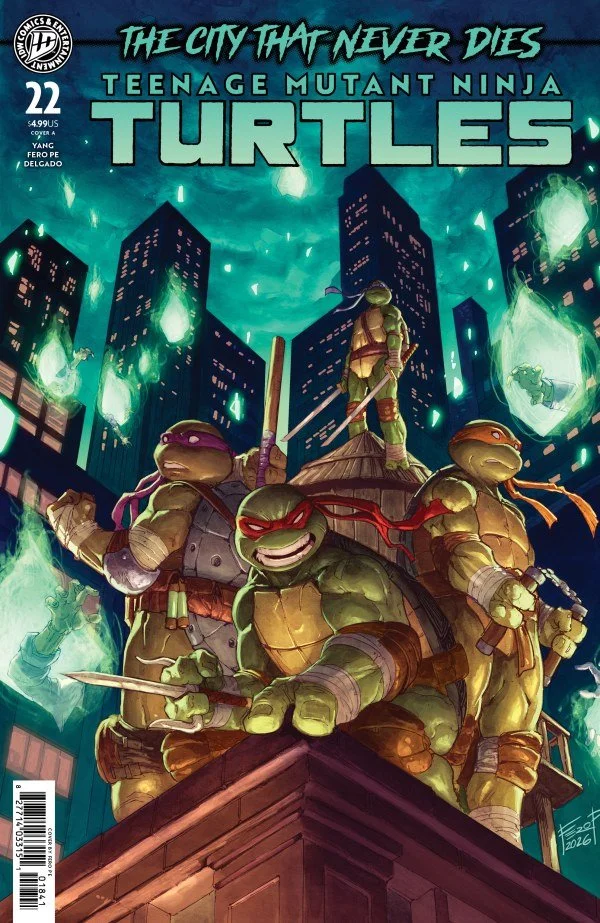
TEENAGE MUTANT NINJA TURTLES #22 (IDW Publishing)
The Turtles are still dealing with the fallout from the veil being torn between the world of the living and Yomi-No-Kuni. Unfortunately for them today is Obon, the Hungry Ghost Festival, the one day a year where the veil between the living and the dead is most permeable. But with how damaged that veil is already, plus Baxter Stockman messing with his own portal, this years Obon may have gotten a lot more dangerous.
Teenage Mutant Ninja Turtles #22 - Written By Gene Luen Yang – Art By Fero Pe - Colors By Luis Antonio Delgado - Letters By Shawn Lee - Edited By Jake Thomas - Published By IDW Publishing
Credit: IDW Publishing
*** POSSIBLE SPOILER WARNING ***
STORY OVERVIEW:
The Turtles along with Splinter and Shen have gone to Chinatown to find Shinigami who has been hanging around the Ghost Boys after having her fallout with Karai. When they get there, they realize that today is Obon, the Hungry Ghost Festival, the one day a year where the veil between the living and the dead is the thinnest. With all that has been going on with the damage caused by Yoshi & Shen this could mean very bad things. The Turtles find Shinigami, but she is being defended by Papa Beng and the Ghost Boys. After a short tussle, Shinigami realizes that they have brought her the door knocker that opened the initial portal to Yomi-No-Kuni. She agrees to help them destroy it, but it’s much more complicated than that. Meanwhile, Baxter Stockman is trying to get his portal to open multiple portals still. Karai is challenging him on why he can’t get that done. However, due to forces outside of their control, his goal is to be accomplished, but no one will be ready for that means for the land of the living.
WRITING:
This issue continues The City That Never Dies story arc by deepening the mystery surrounding the damaged barrier between the living world and Yomi-No-Kuni. Gene Luen Yang places the Turtles in the difficult position of having to stop a crisis that their own family helped set in motion, giving the story a strong sense of responsibility, guilt, and urgency. They are not simply reacting to a new villain’s plan; they are confronting the consequences of choices that have already destabilized the supernatural order. That pressure is apparent in their willingness to seek help from Shinigami despite the complications surrounding her relationship with Karai and her connection to the Ghost Boys. Turning to someone they may not fully trust shows how desperate the situation has become and makes it clear that the Turtles understand they are running out of time.
Yang steadily builds the tension by tying the immediate threat to the larger mythology of the arc. The revelation that the Ujigami mask the object transformed into the door knocker to Yomi-No-Kuni was created by General Eight Thunders adds another layer of intrigue. It raises important questions about why such an artifact was made, what purpose it originally served, and how long the current disaster may have been developing behind the scenes. When more of that history is revealed later in the issue, the conflict becomes more complicated than a simple case of Splinter making a terrible mistake. The new information does not erase his role in what happened, but it suggests that he may have been manipulated by forces and plans he did not fully understand. That added context makes the story more interesting because it shifts the focus from blame alone to the larger question of who has been controlling events and why.
The issue’s strongest turn comes when the attempt to destroy the door knocker unexpectedly becomes the catalyst that allows Baxter Stockman’s portal machine to succeed. Rather than solving the problem, the heroes’ actions make it far worse, completely tearing open the veil between the two realms. This reversal works because it connects the separate plotlines in a meaningful way: the Turtles’ supernatural mission and Stockman’s scientific experiment collide with disastrous consequences. Yang uses that collision to escalate the story from a contained mystical problem into a citywide catastrophe. The return of the dead to the world of the living introduces an entirely new level of danger, while also opening the door for emotionally charged confrontations with figures from the characters’ pasts.
By the end of the issue, the major motivations are clearer, but the situation facing the Turtles is more overwhelming than ever. New York is under attack, the boundary between life and death has collapsed, and the heroes must deal with both the physical threat of the returning dead and the personal consequences of everything that has been unleashed. Yang balances exposition, character tension, mystery, and action without allowing any one element to overwhelm the others. The result is an issue that expands the mythology of the series while setting up an even more dangerous confrontation in the next issue. With the stakes now both deeply personal and potentially catastrophic, the Turtles truly have their work cut out for them, giving readers plenty of reason to be excited, and anxious about what comes next.
ARTWORK:
The artwork in this issue continues to be one of the book’s greatest strengths, with Fero Pe bringing the conflict to life through expressive character work, energetic action, and richly detailed environments. His depiction of Chinatown during the Obon festival immediately establishes a vivid sense of place. Lanterns, decorations, traditional clothing, festival crowds, and the elaborate dragon dance prop all help the celebration feel active and authentic rather than functioning as a simple background. These details create the impression that the neighborhood is filled with movement and history, allowing readers to feel immersed in the festival alongside the Turtles.
What makes Pe’s work especially effective is the way he uses that lively atmosphere to conceal the supernatural danger developing beneath the surface. The festival is visually colorful, crowded, and celebratory, yet the damaged veil between the living and the dead gives many scenes a growing sense of unease. That contrast between celebration and catastrophe adds an important layer to the story. The characters are surrounded by symbols of remembrance and tradition at the exact moment when the dead are beginning to return in a far more dangerous and unnatural way. Much of that tension is communicated visually, through changes in composition, shadow, character placement, and background detail, rather than through exposition alone.
Pe also handles the issue’s action sequences with clarity and personality. The confrontation between the Turtles and the Ghost Boys carries the rhythm of a classic TMNT fight: it is fast, physical, and slightly chaotic, with each character’s movement reflecting a distinct fighting style. The panels maintain a clear sense of geography, so the reader can follow where the characters are positioned and how the momentum of the battle shifts. Later, the clashes involving the returned Xiang Fei Tong and Lao Ban feel different in both tone and presentation. These encounters are more personal and supernatural, and Pe emphasizes their unsettling nature through more dramatic poses, sharper expressions, and compositions that make the returning dead appear imposing and disconnected from the ordinary world around them.
The most memorable visuals in the issue are the scenes showing the dead crossing back into the land of the living. Pe takes care to make these figures recognizable as once-living people while still making it immediately clear that they no longer belong in this world. Their appearances, body language, and the visual effects surrounding them separate them from the living cast without making the pages difficult to read. That distinction is important because the issue contains several overlapping supernatural ideas, yet the artwork prevents the growing chaos from becoming confusing. Readers can quickly understand who has returned, who is still alive, and where the greatest threats are coming from.
Luis Antonio Delgado’s colors strengthen every part of Pe’s artwork. The warm, vibrant palette of the festival gives the early scenes a welcoming energy, while darker shadows and unnatural tones gradually signal that something is wrong. As the supernatural danger increases, the color contrasts become more dramatic, helping the dead feel visually separate from the living and making the portal-related effects stand out on the page. Delgado’s choices also guide the reader’s eye through crowded panels, ensuring that important characters and actions remain easy to identify. Together, Pe and Delgado create artwork that is atmospheric, exciting, and highly readable, capturing both the festive beauty of Obon and the horror of a damaged boundary between life and death.
check out my review of teenage mutant ninja turtles #21
Final Thoughts:
Teenage Mutant Ninja Turtles #22 delivers an exciting escalation of The City That Never Dies, combining supernatural mystery, family consequences, and clear, atmospheric artwork. Gene Luen Yang, Fero Pe, and Luis Antonio Delgado turn Obon into the backdrop for a compelling catastrophe, leaving the Turtles facing a larger and more personal threat. It is a strong, fast-moving issue that builds anticipation for what comes next.
FINAL GRADE: 9/10
Let me know your thoughts on TMNT #22 in the comments below. Thanks for reading!