SHREDDER #12 (IDW Publishing)
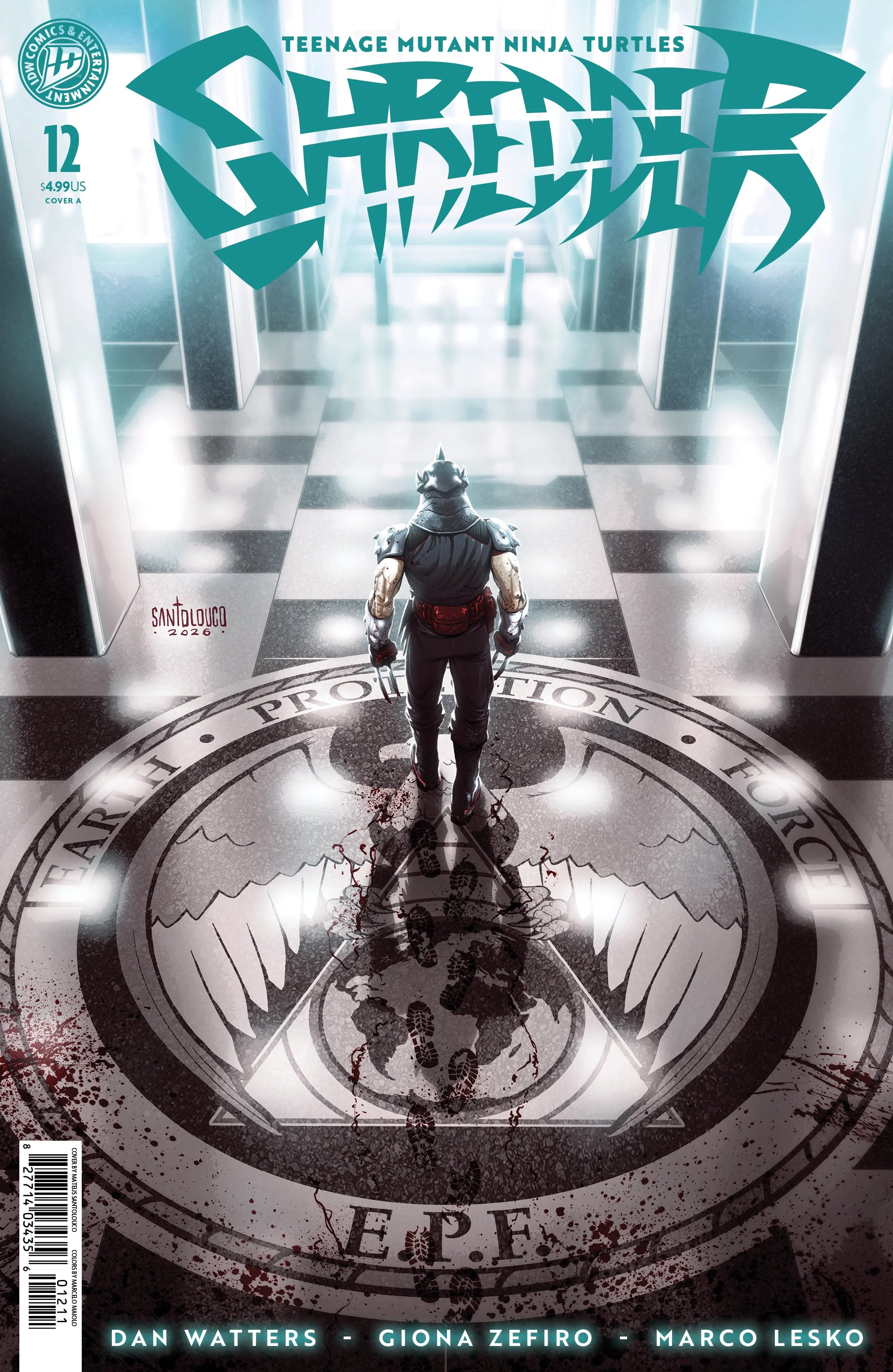
After taking over the E.P.F Headquarters, the nations that are a part of the coalition that gives the E.P.F power have come to take back the E.P.F. However, the Shredder is not in the giving back mood. Will the nations be forced to sit with the Shredder and hear his demands? Or will their fate be far more hazardous?
Shredder #12 - Written By Dan Watters – Art By Giona Zefiro - Colors By Marco Lesko - Letters By Darran Robinson - Edited By Jake Thomas -Published By IDW Publishing
Credit: IDW Publishing
*** POSSIBLE SPOILER WARNING ***
STORY OVERVIEW:
The Shredder has taken over the E.P.F Headquarters with the help of the Dog Star Clan, and the Vreen. He has amassed an army and has threatened the status quo in just over a year. As the nations that are apart of the coalition try and get their Headquarters back, the fight becomes futile as the E.P.F Headquarters is impenetrable. Fortunately, or unfortunately for them the Shredder wants to negotiate, so he offers 6 of the 12 representatives to come in and here his demands. Of course, a few of them are dumb enough to try and take his life, but with his Vreen watching over the system, it is impossible to get the drop on him. Couple the Vreen, with the now drugged Director Braunze, who has a special gift of seeing the future, and it makes it impossible to keep a secret from Shredder. After the coalition realizes that they will have to deal with the Shredder, he makes his demand, he wants to run the E.P.F.
WRITING:
This issue works exceptionally well as a bridge between major story arcs, giving readers a clearer sense of where both the narrative and the larger series are headed. Dan Watters uses the quieter, negotiation-focused structure to strengthen the Shredder’s motivation for seizing control of E.P.F. Headquarters. What initially appeared to be a straightforward act of revenge is revealed to be something far more calculated, ambitious, and carefully planned. Rather than taking the facility simply to punish his enemies, the Shredder has used the takeover as leverage in a much larger campaign for power. Watters makes it clear that every move has been designed to place Oroku Saki several steps ahead of the coalition, even when the gathered representatives believe they still have options.
The revelation that capturing E.P.F. Headquarters was only a means to becoming director of the organization is one of the issue’s strongest developments. It is an unexpected goal, but Watters frames it in a way that feels completely consistent with the Shredder’s character. Saki does not present himself as a conqueror interested only in domination. Instead, he argues that his leadership is necessary to protect Earth from threats beyond the planet. That claim adds an intriguing layer of uncertainty to the confrontation. The Shredder appears sincere, and his recent victories give credibility to his belief that he can succeed where the coalition has failed. At the same time, readers know that he rarely reveals the full extent of his plans. Even if his desire to defend Earth is genuine, it is difficult to believe that control of the E.P.F. is his only objective.
Watters also does an excellent job demonstrating the strength of the forces now under the Shredder’s command. The Dog Star Clan gives him a disciplined army, while the Vreen provide him with near-total awareness of what is happening throughout the facility. Director Braunze’s ability to see the future makes the Shredder’s position even more intimidating, because it eliminates the possibility of surprise and turns every assassination attempt into a predictable mistake. These elements allow the issue to show the Shredder’s power without relying on a prolonged battle. He does not need to overwhelm the coalition with excessive violence; he only needs to prove that resistance is pointless. That restraint makes him feel more dangerous, not less, because it shows that he has complete confidence in his control of the situation.
The lack of a traditional action sequence could have made the issue feel slow, but the political tension and hostile negotiations provide plenty of momentum. Every exchange carries the threat of violence, and the representatives’ growing realization that they must negotiate on the Shredder’s terms gives the conversation an increasingly uneasy edge. Watters turns dialogue into a weapon, allowing Saki to dominate the room through preparation, intimidation, and carefully timed revelations. The conflict is not about whether he can defeat the coalition in combat; it is about whether they can find any way to deny him legitimacy after he has already taken away their leverage.
By the end of the issue, the demand to lead the E.P.F. feels both shocking and inevitable. Watters has taken what could have been a simple headquarters siege and transformed it into a major shift in the balance of power. The Shredder’s cunning, patience, and ability to manipulate his enemies add even more depth to an already complex character. Combined with the tease of a crossover involving the main TMNT universe, the issue succeeds as more than transitional material. It resolves the immediate standoff, establishes the direction of the next arc, and creates several compelling questions about what the Shredder truly intends to do once he has the authority he demands.
ARTWORK:
The artwork in this issue continues the series’ impressive standard, with Giona Zefiro bringing both the enormous scale of the conflict and the quieter tension of the negotiations to life. From the opening assault on E.P.F. Headquarters, Zefiro immediately establishes that the Shredder is operating from a position of overwhelming strength. The facility is drawn as a massive, fortified structure that feels less like an ordinary headquarters and more like an untouchable stronghold. Its size, heavy architecture, and defensive presence visually reinforce the idea that the coalition is not facing a simple occupation that can be ended with superior firepower.
That sense of invulnerability becomes even clearer when the coalition launches its attack. Zefiro gives the bombardment tremendous visual force, filling the sequence with enough energy and destruction to make it seem as though the assault should tear through almost any defense. When the attack ultimately fails, the moment communicates more than dialogue could. The coalition has exhausted its most direct option, while the Shredder remains secure inside the fortress. This contrast makes the later negotiations feel unavoidable rather than convenient. The representatives do not meet with him because they believe diplomacy is the best solution; they meet with him because the artwork has already shown that they have no practical way to remove him.
Zefiro’s character work is equally effective. The Shredder looks imposing in every appearance, but his power comes from more than the armor itself. His controlled posture and physical stillness suggest that he never doubts the outcome of the confrontation. While everyone around him reacts with anger, fear, or desperation, he carries himself like someone who has already won. The redesigned Dog Star Clan supports that impression by appearing more disciplined, dangerous, and unified under his command. Their presence makes the Shredder’s growing army feel organized rather than chaotic, emphasizing that he is building a force capable of challenging far more than the coalition gathered outside the headquarters.
The Vreen also continues to have one of the issue’s most distinctive visual designs. Zefiro takes advantage of the character’s unusual appearance and abilities to create a presence that feels alien, unsettling, and perfectly suited to surveillance. The Vreen is not simply another soldier standing beside the Shredder; the character becomes a visual reminder that nothing happening inside the facility escapes Saki’s attention. Combined with Director Braunze’s ability to see the future, that constant awareness gives the meeting an oppressive quality. The coalition members may be speaking across a table, but the composition repeatedly reminds readers that they are surrounded, observed, and unable to act without the Shredder anticipating their next move.
Where Zefiro’s artwork is most impressive, however, is in the facial acting during the negotiations. Because much of the issue depends on conversation rather than continuous combat, the characters’ expressions must carry a significant amount of the drama. The coalition representatives display frustration, disbelief, anger, and growing hopelessness as they realize how little leverage they possess. Even before a character speaks, a tightened jaw, narrowed eyes, or tense posture reveals how the discussion is affecting them. These reactions give the standoff a strong emotional rhythm and ensure that the dialogue-heavy scenes never feel visually static. The failed attempts on the Shredder’s life are especially effective because the artwork captures both the representatives’ desperation and Saki’s complete lack of surprise.
Marco Lesko’s colors add another important layer to the storytelling. The palette helps distinguish the characters, environments, and shifting moods without overwhelming Zefiro’s linework. The explosive attack on the headquarters is given the intensity it requires, while the interiors feel colder and more controlled, creating a strong contrast between the chaos outside and the Shredder’s command within. Lesko also uses color to guide attention toward expressions, armor details, and key figures in crowded scenes. The result is artwork that remains clear even when the page contains multiple characters, advanced technology, and competing visual elements.
Together, Zefiro and Lesko make the E.P.F. standoff feel enormous in scale while preserving the personal tension at the center of the issue. The fortress, alien technology, military forces, and failed assault sell the threat on a global level, while the expressions and body language keep the conflict grounded in the representatives’ immediate fear and frustration. The art team does not merely illustrate the script; it strengthens the Shredder’s dominance, explains why the coalition must negotiate, and gives every stage of the confrontation a distinct visual identity. Once again, the artwork brings this corner of the TMNT universe to life with energy, clarity, and an appropriately intimidating atmosphere.
Check Out My Review of Shredder #10
Final Thoughts:
Shredder #12 is a tense, well-crafted issue that turns political maneuvering into a compelling display of Oroku Saki’s power and ambition. Dan Watters delivers a smart transition into the next arc, while Giona Zefiro and Marco Lesko give the standoff scale, clarity, and menace. With strong character work and an intriguing new direction, this remains a must-read series. I say it every month, but I will say it again, if you are not reading this series, what are you doing? Grab a copy of this issue and add this series to your Pull List NOW.
FINAL GRADE: 9/10
Let me know your thoughts on Shredder #12 in the comments below. Thanks for reading!