TEENAGE MUTANT NINJA TURTLES #21 (IDW Publishing)
After the milestone 300th issue it’s time to get back to business as usual. This issue kicks off the new story arc The City That Never Dies. As the Hamato family try to fix the mistake they made when they tore the veil between our world and Yomi-No-Kuni. But things have gotten far worse since Raphael gave a piece of the knocker to Karai and Baxter Stockman. Can the Hamato’s return order to our world and the dead back to theirs?
Teenage Mutant Ninja Turtles #21 - Written By Gene Luen Yang – Art By Fero Pe - Colors By Luis Antonio Delgado - Letters By Shawn Lee - Edited By Jake Thomas - Published By IDW Publishing
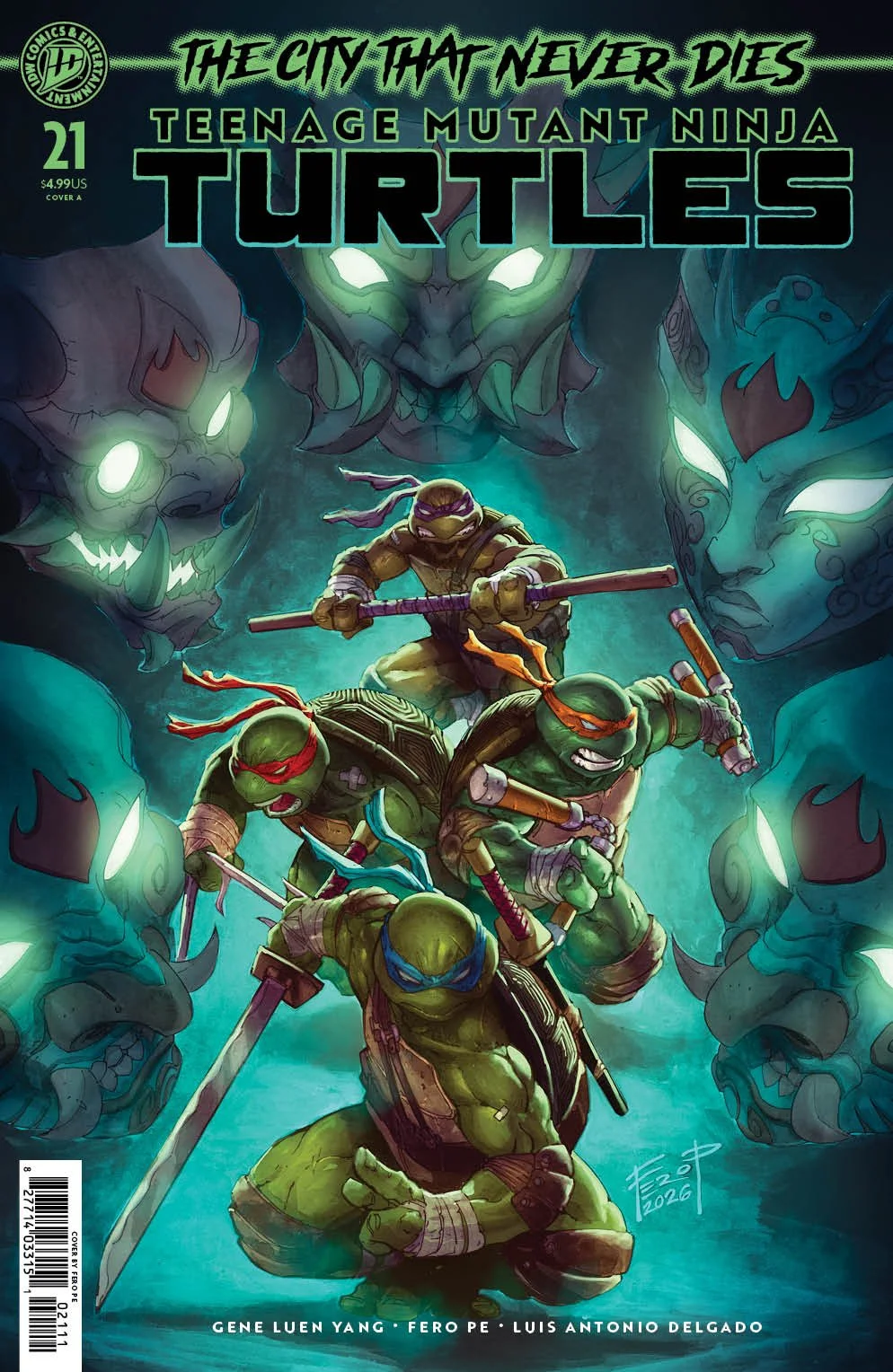
Credit: IDW Publishing
*** POSSIBLE SPOILER WARNING ***
STORY OVERVIEW:
As our world and the world of Yomi-No-Kuni become more and more blended due to not just Shen and Splinter entering our world. But also, the machine Baxter Stockman built powered by the piece of the door knocker Raphael gave to Karai. There has become great unrest, so great that even the Shredder has to drop by and have a conversation with Shen & Splinter. After said meeting the Hamato family decides to split up to recover the missing piece. Leonardo, Raphael, and Splinter go to Baxter Stockman’s, where they find the machine he has built that’s powered by the piece of the knocker. After witnessing him resurrect his father so he could just kill him again, they swoop in and try to recover the piece. Meanwhile, Shen, Michaelangelo, and Donatello go to Oroku Karai’s Penthouse to see if her and the Foot Clan have a piece. They are welcomed by Karai’s undead guards who threaten to take out our heroes. Can the Hamato family reclaim the piece of the knocker and return both realms to normalcy?
WRITING:
This issue kicks off the latest arc, which also serves as the final arc for Gene Luen Yang on his TMNT run, and Yang clearly approaches that responsibility with a sense of urgency. Rather than easing readers into the next chapter, he immediately throws the Hamato family back into the consequences of their own choices. The line between the living world and Yomi-No-Kuni has been damaged, and Yang makes sure that this is not treated like a simple mystical problem that can be solved with one fight or one heroic speech. Every decision that led to this point matters: Splinter originally opening the gate, Shen being brought back into the world of the living, and Raphael handing a piece of the Ujigami Door Knocker to Karai because of his guilt over Casey Jones. Each of those moments may have come from an emotional or understandable place, but together they have created a supernatural crisis that is now spilling out in dangerous and unpredictable ways.
What works especially well is how Yang frames the conflict as both a physical threat and a moral reckoning. The Hamato family is not simply fighting monsters or cleaning up someone else’s mess; they are being forced to stare directly at the consequences of choices they made while trying to protect the people they love. That gives the issue more weight than a standard action-heavy opener. Shinigami’s change in position adds another layer to that tension, because she originally supported Karai’s use of the gateway between worlds but now recognizes how badly the situation has spiraled. Even the Shredder’s appearance feels significant because he is not just showing up as a familiar villain. His warning underlines how serious the damage has become when even someone with his history against the Hamato family understands that the balance between life and death has been dangerously disrupted.
Yang also keeps the pacing sharp by splitting the team into two missions, which gives the issue momentum while allowing different character combinations to shine. Leonardo, Raphael, and Splinter heading to Baxter Stockman’s operation brings the story into darker, more disturbing territory, especially once Baxter’s machine and his twisted resurrection of his father are revealed. That scene does a lot to show just how tempting and grotesque this power can become in the wrong hands. Meanwhile, Shen, Michelangelo, and Donatello going to Karai’s penthouse creates a very different kind of tension, one rooted in the Foot Clan’s ambitions and the eerie presence of Karai’s undead guards. Cutting between these two fronts keeps the action moving and makes the crisis feel larger than any one location or villain.
By the end of the issue, Yang has successfully raised the stakes without losing sight of the emotional core that has defined his run. The supernatural chaos is exciting, but it lands because it is tied so closely to family, grief, guilt, and the desire to undo loss. Raphael’s earlier decision continues to haunt the story, Splinter and Shen’s presence complicates the meaning of life and death for the entire family, and Baxter and Karai both represent how quickly that same power can be exploited for selfish or dangerous purposes. The result is a fast-paced, entertaining, and emotionally loaded opening issue that makes The City That Never Dies feel like a major final statement for Yang’s time with the franchise. Things go from bad to worse in exactly the right way, leaving the next installment with plenty of tension, unresolved danger, and character drama to build on.
ARTWORK:
The artwork in this issue is fantastic and continues the streak of strong visual storytelling that has helped define this run. Fero Pe handles the line art for this issue, and his work gives the opening of this new arc the scale, energy, and urgency it needs. Because the story is dealing with the barrier between New York City and Yomi-No-Kuni breaking down, the artwork has to make the world feel grounded while also letting the supernatural elements feel strange and unsettling. Pe does that very well. The city does not feel like a generic backdrop; the streets, interiors, rooftops, Baxter Stockman’s operation, and Karai’s penthouse all give the issue a strong sense of place. New York feels alive, crowded, and tense, which makes the idea of the dead spilling into the living world feel even more dramatic.
Pe’s character work is also a major strength of the issue. The Turtles, Splinter, Shen, Karai, Shinigami, Baxter, and even the undead guards all have clear personalities in the way they are posed and staged on the page. The familiar characters still look exactly like themselves, but they are drawn with enough expression and body language to sell the emotional weight of the story. Raphael’s intensity, Leonardo’s focus, Michelangelo and Donatello’s reactions, and Splinter and Shen’s complicated presence all come through visually before the dialogue even has to do much work. That is especially important in an issue where grief, guilt, and responsibility are driving so much of the conflict.
The action scenes are energetic, easy to follow, and full of personality. Pe gives the fights a strong sense of motion without making the pages feel cluttered or confusing. When the Hamato family moves into action, the panels capture the speed and physicality that readers expect from a Teenage Mutant Ninja Turtles comic, but the staging also leaves room for the horror-inspired elements of the story to breathe. Baxter’s machine and the grotesque resurrection of his father bring a darker edge to the visuals, while Karai’s undead guards create a creepy, supernatural menace that fits the arc’s bigger theme. The issue balances fun superhero action with a more eerie atmosphere, and the art is a big reason that balance works.
Luis Antonio Delgado’s colors push the artwork even further. His palette is vibrant and eye-catching, but it never overwhelms the storytelling. The brighter colors make the Turtles and the action pop off the page, while the darker and more unnatural tones help sell the danger surrounding Yomi-No-Kuni and the broken boundary between life and death. Delgado’s work helps guide the reader’s eye through each page, making big moments feel bigger and quieter moments feel more atmospheric. Together, Pe and Delgado make this issue look polished, exciting, and cinematic. The art does not just support the story; it elevates the entire issue and makes the kickoff to The City That Never Dies feel as epic and important as the script wants it to be.
check out my review of teenage mutant ninja turtles #300
Final Thoughts:
Teenage Mutant Ninja Turtles #21 is a strong opening issue for The City That Never Dies and a confident start to Gene Luen Yang’s final arc on the series. The issue wastes no time showing how badly the Hamato family’s choices have damaged the balance between the living world and Yomi-No-Kuni, while still keeping the story rooted in family, guilt, grief, and responsibility. Yang gives the book high stakes without losing the emotional core, and the split mission between Baxter Stockman’s operation and Karai’s penthouse keeps the pacing tense and exciting. Fero Pe’s expressive artwork and Luis Antonio Delgado’s vibrant colors make the action, horror elements, and citywide danger feel big and cinematic. Altogether, this is an energetic, emotional, and visually impressive issue that sets up the next chapter extremely well and proves that TMNT remains one of the most consistently engaging books on the stands.
FINAL GRADE: 9.5/10
Let me know your thoughts on TMNT #21 in the comments below. Thanks for reading!