THE FOREVER HOME #1 (ONI PRESS)
What happens when you live in a house that not only keeps you safe from the apocalypse, but also stops you from aging? The Forever Home from Oni Press is what happens! A family has lived out the apocalypse in a custom built house that protects them from the world outside. However, what happens when the order of their new world comes crashing down?
The Forever Home #1 - Written By Christian Ward – Art By Sami Kivelä – Colors By Jason Wordie – Letters By Hassan Otsmane-Elhaou – Edited By Sierra Hahn with Allyson Gronowitz – Published By Oni Press
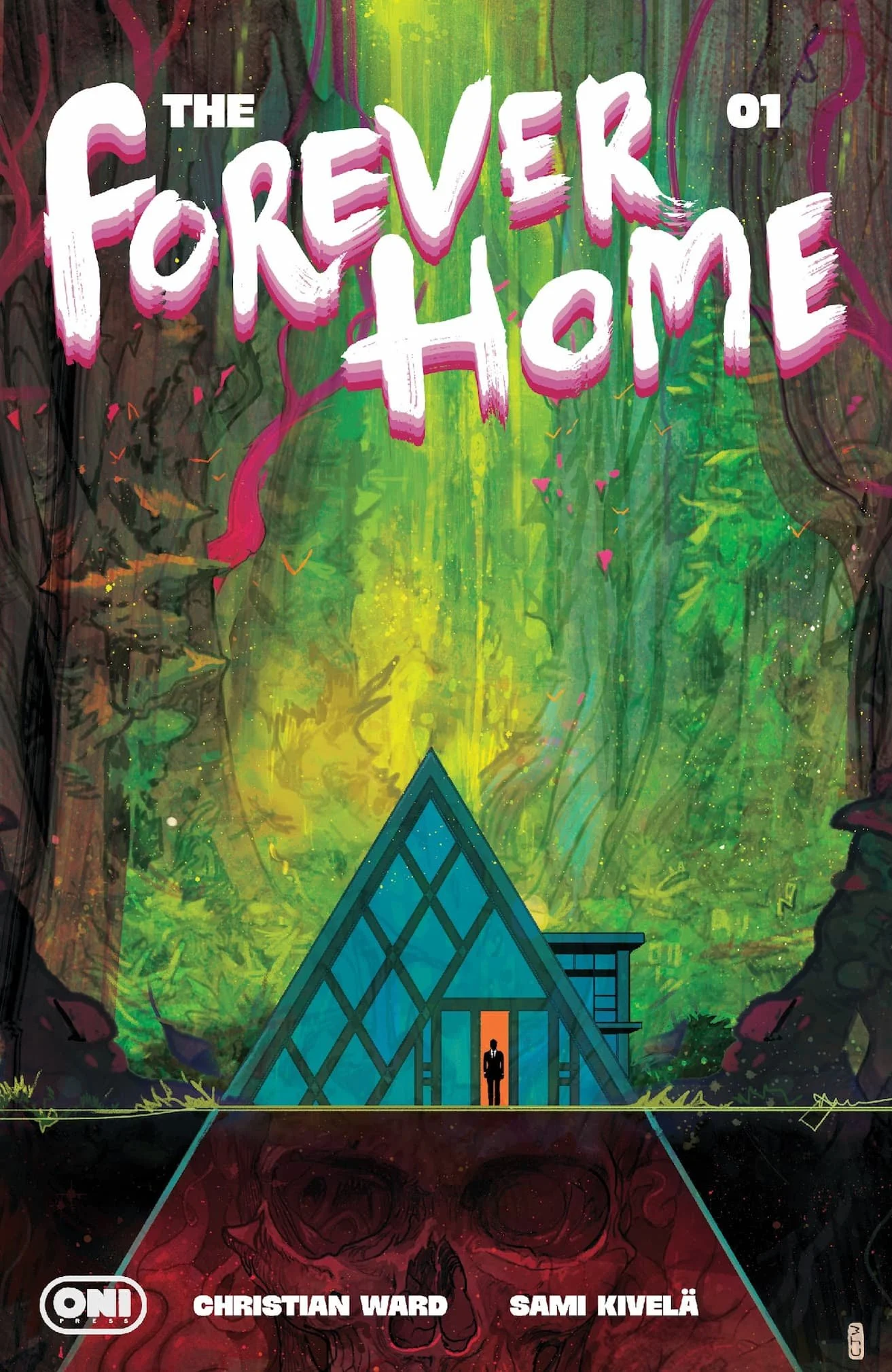
Credit: Oni Press
*** POSSIBLE SPOILER WARNING ***
STORY OVERVIEW:
Henry created a home that would last through the apocalypse and keep him and his family safe. Not only did the house stand up to the challenges of the apocalypse itself, but it also overperformed in the aftermath. You see, the house had a side effect that not even Henry could’ve predicted. It slows down time for those inside, as the outside world ages more rapidly. One hour in the real world is only twenty minutes in the house to be exact. Inside the house is Henry, his wife Elisabeth, daughter Sarah, and son Tommy, along with their robot servants, security, and foragers. The house is fortified so that the “vermin” known as the outside people can’t get in. Because of the outside threat Henry has made it clear that nobody is to go outside. However, one day after one of the robots comes back from their rounds the family dog, Dodo gets out of the house and Tommy chases after him. The house locks them out and won’t let them back in. Henry won’t even break his own rules to save his son. But his son may not need his help after all.
WRITING:
The first issue captures the profound isolation of the family’s situation while still giving readers enough background to understand how they arrived at this strange, carefully controlled existence. Christian Ward takes the familiar idea of a home as a place of safety and pushes it to an unsettling extreme. Henry’s house did more than survive an apocalypse that appears to have destroyed much of humanity; it became a sealed refuge capable of preserving the family long after the outside world collapsed. That achievement initially seems miraculous, but Ward gradually reveals how protection can become confinement when fear is allowed to dictate every rule and decision.
The house’s ability to slow time adds an especially intriguing layer to the premise. Because time passes differently inside, the family has effectively been granted an extended, perhaps nearly eternal, life. Yet that gift also separates them further from the world beyond their walls. Years experienced inside represent a vastly greater span outside, making every delay more consequential and every possibility of ever leaving the house more uncertain. For Henry, this system validates his belief that the house and its rules are the only things keeping the family alive. For the children, however, the same system has created a life defined by repetition, surveillance, and an ever-growing awareness that an unknown world exists just beyond their reach.
Ward uses Sarah and Tommy’s curiosity to show the emotional cost of that isolation. They may love and respect their parents, but affection cannot completely suppress their need to explore, question, and understand what has been hidden from them. Their sheltered upbringing means they have no real frame of reference for the horrors that occurred outside while the house protected them. They know the exterior world is dangerous because Henry constantly tells them so, yet the threat remains abstract until Tommy crosses the boundary. That gap between what the children have been taught and what they can personally comprehend creates much of the issue’s tension.
Once Dodo escapes and Tommy follows, the story transforms the unknown into a powerful source of horror. The home that once seemed nearly invincible can no longer protect him, and neither Tommy nor the reader knows what might be waiting outside. Ward allows that uncertainty to do much of the frightening work. The possibilities are disturbing precisely because the issue has established so little certainty about what humanity, the environment, or even time itself has become beyond the house. Tommy’s vulnerability makes every moment outside feel dangerous, and the locked door turns the family’s refuge into an obstacle rather than a sanctuary.
Even more disturbing than the external danger is Henry’s response to his son’s predicament. His cold insistence that Tommy should have obeyed the rules reveals how completely his devotion to order has overtaken his parental instincts. A father refusing to risk the household to save his only son is shocking, but it also deepens the central conflict by suggesting that Henry may be more dangerous than the threats he fears. His reaction forces readers to question whether the family has truly been protected or merely controlled under the language of survival. Ward layers isolation, distorted time, generational tension, and rigid authority into an unsettling narrative that creates a sustained sense of unease and leaves the reader eager to discover what exists outside and what the house has done to the people within it.
ARTWORK:
The artwork in this first issue vividly captures the carefully constructed world the family has built for themselves while emphasizing how fragile that sense of security truly is. Sami Kivelä presents the house as both a comfortable sanctuary and a tightly controlled enclosure. The clean interiors, orderly rooms, and familiar domestic details make the home appear peaceful and inviting, but the limited spaces and separation from the outside world also create a subtle feeling of confinement. That visual contrast allows the reader to understand why the family might feel protected inside the house while also recognizing how terrifying and unnatural their isolation has become.
Kivelä’s strongest visual achievement is the way the artwork communicates the passage of time without relying entirely on exposition. When the outside world is first shown, it appears barren, empty, and devastated, reinforcing Henry’s warnings that nothing beyond the walls can be trusted. After six years have passed inside the house, however, the exterior has transformed into a dense, thriving forest. The dramatic change in the landscape immediately demonstrates the enormous difference between time inside and time outside. Six years for the family represents roughly 157,680 years beyond the house, so the flourishing vegetation is not simply a change of scenery; it is evidence that the family has become almost completely disconnected from the history and evolution of the planet around them.
This transformation also makes Tommy’s decision to leave the house feel far more dangerous. The forest may look beautiful and alive, but it is also unfamiliar territory shaped by thousands of generations of change. Anything could have evolved, disappeared, or taken control during that span. Because approximately three outside years pass during a single hour inside the house, even a short delay could have enormous consequences. Kivelä reinforces this threat by making the exterior feel vast and unpredictable compared with the compact, controlled environment of the home. The contrast gives the reader a clear sense of Tommy’s vulnerability and turns the beauty of the natural world into another source of suspense.
Jason Wordie’s color work strengthens that duality throughout the issue. Inside the house, the palette has a slightly retro quality that supports the story’s idea of a family preserved in time. The colors create warmth and familiarity, but they also make the interior feel static, as though the household has been repeating the same routines for years without truly moving forward. Outside, the early earth tones and muted shades reflect the devastation left by the apocalypse. When the foliage eventually overtakes the landscape, those restrained colors give way to a broader range of rich greens and more vibrant natural hues. The shift makes the outside world feel renewed and visually alive, even as it becomes more alien and threatening to the family.
Together, Kivelä’s line work and Wordie’s colors give the issue a memorable visual identity. The artwork does more than illustrate the story’s science-fiction premise; it helps explain the emotional and physical stakes of living in a place where safety requires complete separation from time, nature, and society. Every contrast, the calm interior against the untamed exterior, the nostalgic colors against the evolving landscape, and the small human figures against the scale of the transformed world, reinforces the central tension between protection and imprisonment. The result is an atmosphere that feels serene at first glance but increasingly unsettling the longer the reader studies it.
CHECK OUT MY REVIEW OF ARCHIE #1
Final Thoughts:
The Forever Home #1 is a thrilling, unsettling debut packed with bold ideas, striking artwork, and a fantastic final hook. The creative team delivers a sci-fi mystery that immediately makes you want to read another issue now. Pick up one or more copies of this first issue when you visit your LCS this week. Well you’re at the shop, add this series to your Pull List, because you won’t want to miss what comes next!
FINAL GRADE: 10/10
Let me know your thoughts on The Forever Home #1 in the comments below. Thanks for reading!