THE DIRT BENEATH THE DEVIL #3 (Mad Cave Studios)
After witnessing the Hendido being shot, June is devastated and wants to go home. But it gets a whole lot worse when a tribe of Native Americans starts to give chase to the group. As they try and escape the group unravels more through fear, greed, and mistrust. Who will still be alive to hear the will of Mr. Buckley?
The Dirt Beneath the Devil #3 - Written By Dan Panosian – Art By David Ferracci – Colors By Lee Loughridge – Letters By Pat Brosseau - Edited By Jon Moisan - Published By Mad Cave Studios
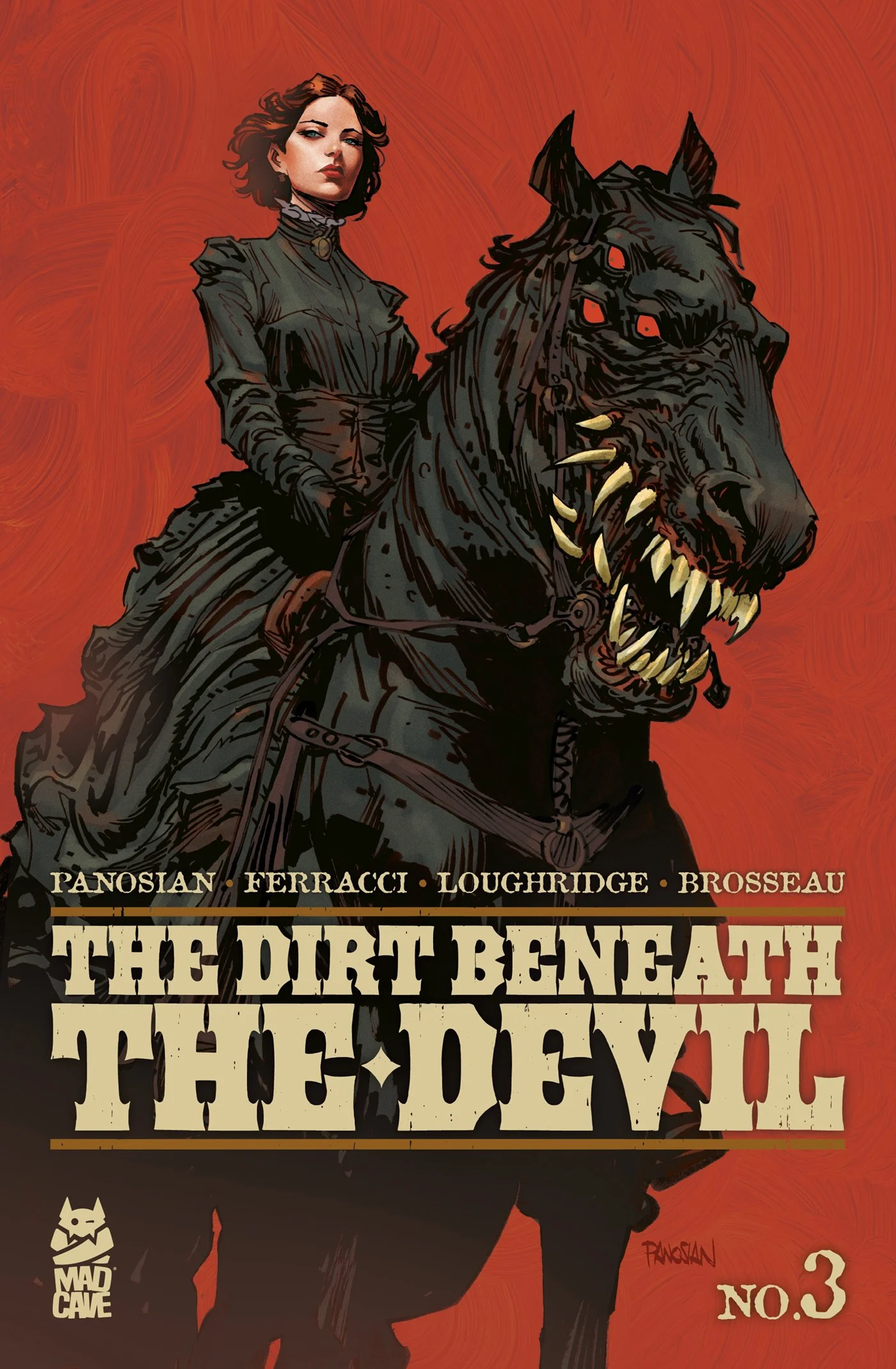
Credit: Mad Cave Studios
*** POSSIBLE SPOILER WARNING ***
WRITING:
As the series progresses, the story becomes increasingly wild without losing the grounded tension that makes its western setting so effective. Dan Panosian continues to build intrigue through an atmosphere of uncertainty, where every new development makes the journey feel more dangerous and the characters less secure. His transition from the shocking death of Hendido directly into the pursuit by the Native American tribe is especially effective. Rather than allowing the group or the reader time to process what has happened, Panosian immediately replaces one threat with another. That sudden escalation creates the sense that the characters are being pushed forward by forces they cannot control. It also exposes the fear, greed, and mistrust already simmering within the group, turning the external chase into an internal crisis as well. The pacing throughout this issue, and across the series as a whole, has been one of its greatest strengths. Quiet moments never overstay their welcome, bursts of violence arrive with real impact, and each scene adds another layer of pressure. The result is an issue that maintains its excitement and momentum while steadily raising the stakes for everyone involved.
One of Panosian’s biggest successes in this issue is the way he continues to shroud the larger story in mystery while still giving the reader enough information to remain invested. There is a growing sense that the group is not simply enduring a difficult journey to attend the reading of Mr. Buckley’s will. The elaborate obstacles, suspicious circumstances, and escalating danger suggest that someone or something may be testing them, punishing them, or guiding them toward an outcome they do not yet understand. Panosian repeatedly encourages the reader to form a theory, only to introduce another detail that makes that explanation feel incomplete. Is a supernatural force influencing the journey? Are these simply terrible people suffering the consequences of their own selfish decisions? Could Mr. Buckley have anticipated their behavior and designed the entire ordeal to reveal who they truly are? Or is an even more dangerous presence operating beyond what the characters can see? These questions deepen the suspense because the mystery is tied directly to the group’s behavior. Every accusation, betrayal, and frightened reaction becomes a possible clue. The reader is never allowed to feel fully certain, and that uncertainty makes the issue more engaging. Just when it seems that the story has revealed something important, Panosian provides another reason to question what we have seen and what we think we know.
The cliffhanger that closes this penultimate issue creates tremendous anticipation for the finale because it places the series’ most sympathetic character in immediate danger while leaving the larger mystery unresolved. Readers have been encouraged to root for June throughout the series because she often feels like the only genuinely honest and compassionate person in a group increasingly defined by cruelty, suspicion, and self-interest. Her desire to escape after witnessing Hendido’s death gives the issue an emotional center and reminds us that the violence has consequences beyond simply moving the plot forward. Panosian uses June’s vulnerability to make the ending feel personal rather than merely shocking. The uncertainty surrounding her safety and wellbeing is especially effective because the audience understands how quickly this journey can turn deadly and how little trust remains among the survivors. At the same time, the cliffhanger leaves several important questions hanging over the story: who can still be trusted, what is truly waiting at the reading of the will, and whether anyone will survive long enough to learn Mr. Buckley’s final intentions. By ending at the moment when June’s situation appears most precarious, Panosian ensures that the issue concludes with both emotional weight and narrative urgency. It leaves the reader with the unmistakable feeling that the finale will be violent, revealing, and difficult to predict.
ARTWORK:
The artwork in this issue continues the series’ impressive visual standard. David Ferracci brings the western mystery thriller to life with detailed environments, expressive figures, and compositions that constantly reinforce the danger surrounding the characters. His depiction of the Old West is beautiful and expansive, with open skies, rugged terrain, and distant horizons giving the journey a convincing sense of place. At the same time, that openness creates an unsettling feeling of isolation. The landscape may appear peaceful from a distance, but the lack of shelter and the vast stretches of empty land make the characters seem exposed and vulnerable. Ferracci uses that contrast between natural beauty and hidden danger to strengthen the tone of the story. The setting feels like somewhere a reader would want to explore, yet every shadow, empty trail, and wide-open space suggests that trouble could appear at any moment. This visual tension complements the mystery and makes the environment feel like an active part of the group’s ordeal rather than a simple backdrop.
Ferracci’s character work is equally important, especially in the way he communicates emotion and unspoken tension through body language. The cast members are visually distinct, but their personalities are revealed most clearly through their posture, gestures, and reactions to one another. Thomas Mash is one of the strongest examples. Although his dialogue about Martha and August provides the surface details of the conversation, his demeanor suggests that he may be withholding something more personal. The way he carries himself, where he directs his attention, and the subtle changes in his facial expression invite the reader to question whether there was more between Martha and him than he is willing to admit. Panosian never needs to overstate the implication because the visual performance supplies the necessary subtext. June is handled with the same care. Her uncertainty and fear are visible in the tension of her movements and in the way she responds to the violence unfolding around her. These quieter emotional details give the danger lasting consequences. Rather than treating fear as a temporary reaction, Ferracci shows how the journey is wearing the characters down, making their mistrust and desperation feel increasingly believable.
Although this is not an action-heavy issue, Ferracci makes every burst of movement feel meaningful. The chase involving the Native Americans is the clearest example of his ability to shift from slow-building suspense into immediate danger. Strong panel-to-panel movement gives the sequence speed, while the positioning of the riders and the changing distance between pursuers and targets create a clear sense of geography. The reader can follow the action without losing the frantic energy of the moment. Ferracci also varies perspective effectively, moving between wider views that establish the scale of the chase and tighter images that emphasize the characters’ panic and vulnerability. This combination makes the sequence feel immersive, as though the reader has been pulled into the middle of the pursuit. Because the issue uses action sparingly, the scene lands with greater force and provides a sharp release for the tension that has been building in the quieter exchanges. Making each action beat clear, exciting, and consequential is a testament to Ferracci’s storytelling ability.
The colors by Lee Loughridge elevate Ferracci’s linework and match the story’s uneasy atmosphere. In the nighttime scenes, layered purples and blues give the landscape an eerie beauty while maintaining the sense that danger is concealed just beyond the characters’ vision. These cooler colors slow the visual rhythm and deepen the isolation of the setting, allowing the reader to absorb the silence and uncertainty surrounding the group. When the story reaches a sudden or violent moment, Loughridge introduces brighter yellows and oranges that break sharply from the surrounding palette. Those warmer bursts direct the eye to the most important part of the panel and make each impact feel immediate. The color choices therefore do more than make the pages visually appealing; they guide the reader’s attention, control the emotional temperature of a scene, and help distinguish moments of quiet dread from moments of open danger. Pat Brosseau’s lettering supports that clarity by matching the tension of the story without overwhelming the artwork. Dialogue remains easy to follow through crowded exchanges and faster sequences, while the placement and presentation of the lettering allow each character’s voice to remain distinct. Together, the colors and lettering create a polished visual rhythm that strengthens the mood, preserves readability, and allows every major story beat to land with the intended force.
Check Out My Review of THE DIRT BENEATH THE DEVIL #2
Final Thoughts:
The Dirt Beneath the Devil #3 delivers another tense, atmospheric issue that deepens the mystery and pushes the fractured group closer to disaster. Dan Panosian’s sharp pacing pairs perfectly with David Ferracci’s expressive artwork, Lee Loughridge’s moody colors, and Pat Brosseau’s clear lettering. With June in danger and Mr. Buckley’s true intentions still unknown, this strong penultimate issue leaves the series poised for an unpredictable finale. This series is a must read and if you haven’t been reading it, try and grab all three issues well at the shop this week or on Neon Ichiban.
FINAL GRADE: 9.3/10
Let me know your thoughts on The Dirt Beneath the Devil #3 in the comments below. Thanks for reading!