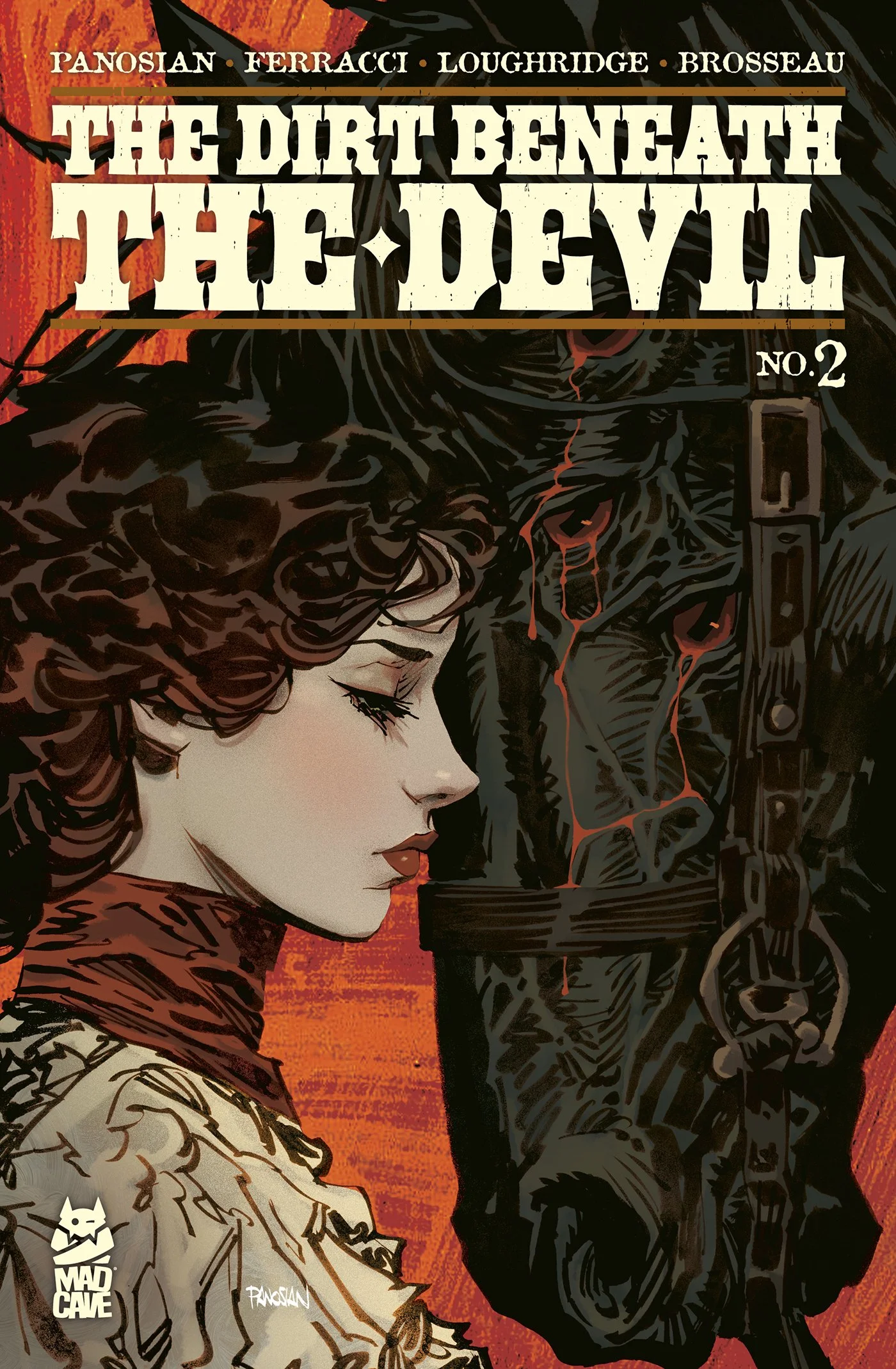
THE DIRT BENEATH THE DEVIL #2 (Mad Cave Studios)
When you mess with the horse you get the hooves. After August’s untimely demise caused by Hendido, the group must regroup and move on. But the infighting and politicking have started to get really ugly as well. Now, June must navigate the mine field of her father’s messy life, well also trying to figure out what is up with this horse that feels more like a supernatural presence than an animal.
The Dirt Beneath the Devil #2 - Written By Dan Panosian – Art By David Ferracci – Colors By Lee Loughridge – Letters By Pat Brosseau - Edited By Jon Moisan - Published By Mad Cave Studios
Credit: Mad Cave Studios
*** POSSIBLE SPOILER WARNING ***
STORY OVERVIEW:
After June and the rest of the group wake up and discover August is missing, they start a search for him. It doesn’t take long before they find him, or what remains of him. This sends Martha into hysterics as that was her only son and now he’s gone. Temple suggests that it was a bear attack, but Mash and Bickers don’t think it was necessarily a bear, but they do believe that Kima had put a native curse on August and that’s what got him killed. The group votes on whether to keep Kima and her son on this trip to Wichita, with Temple and June being out voted and Kima and her son expelled from the group. As the rest of the group stops for the night, they discover that their food provisions are short, so they need to be rationed. But they also saw other travelers, so they need to be extra vigilant. Well keeping watch on her shift, June has a run in with Pete, but Hendido is there and something strange and violent will happen once again.
WRITING:
This second issue picks right up where the first one left off, and Dan Panosian wastes very little time pulling the reader back into the danger and uncertainty surrounding Hendido. The opening discovery of what happened to August immediately sets the tone for the issue. On the surface, the damage looks like something a bear could have done, and that explanation gives the group an easy answer to cling to. But because we already know Hendido was involved, the scene becomes much more unsettling. A horse should not be capable of that kind of violence, which makes every detail of August’s death feel like another warning that Hendido is not simply an animal. Panosian uses that gap between what the characters can explain and what the reader suspects to build a very effective sense of dread.
What makes the mystery work so well is that Panosian does not rush to define Hendido too clearly. The horse remains frightening because the story keeps him just out of reach. He is present enough to shape the issue, but not explained enough to take away the fear. The later scene involving June and Pete pushes that idea even further, giving readers another glimpse at the violence and strangeness attached to Hendido without fully revealing what he is or why he acts the way he does. That restraint is one of the strongest parts of the writing. Panosian understands that the series is more compelling when the supernatural element feels connected to the characters’ sins, secrets, and history rather than functioning as a simple monster in the wilderness.
The more the issue reveals about Mr. Buckley, the more Hendido’s presence starts to feel tied to something larger than random horror. Buckley’s past mistreatment of so many people hangs over the entire group, and Panosian does a strong job showing how that history continues to poison everyone even after his death. This journey is not just about reaching Wichita or collecting an inheritance. It is about a group of people carrying years of resentment, greed, fear, and unresolved damage into one confined and dangerous situation. Because of that, Hendido feels almost like a physical manifestation of the rot that Buckley left behind. Whether that is literally true or not, the writing makes the connection feel intentional and meaningful.
Panosian also does an incredible job with the group dynamics. Every decision feels loaded with self-interest, and every conversation seems to contain another attempt by one character to gain an advantage over someone else. The vote to expel Kima and her son is especially effective because it shows how quickly grief, prejudice, paranoia, and greed can combine into cruelty. Temple and June may push back, but they are outnumbered by people who are eager to turn fear into justification. Mash and Bickers are dishonest and opportunistic, which makes them easy to distrust from the moment they begin shaping the group’s thinking. Martha, meanwhile, is more complicated. She has just lost her son, but Panosian writes her grief in a way that also exposes her ambition. Her accusation that June is only after the inheritance, along with her claim that August’s death gives her an extra vote, makes her feel like someone who is mourning and calculating at the same time.
That is where the writing really shines. Panosian does not present the supporting cast as a group of obvious villains. Instead, he gives them motives that are ugly but understandable within the pressure of the situation. These are people who were mistreated by Buckley, but many of them still endured that treatment because they believed there would eventually be a reward. Now that the inheritance is within reach, they are not only fighting the danger around them but also looking for ways to remove one another from contention. That makes the human tension just as important as the supernatural tension. Hendido may be the most frightening presence in the issue, but the people traveling with June may be just as dangerous in their own way.
June remains the character who gives the issue its clearest emotional center. She is surrounded by people who know more about her father than she does and who are all trying to pull her into their own version of events. Panosian uses her position well because she is not simply reacting to the horror around her; she is also trying to understand the kind of man her father really was. That makes her investigation personal. Every new detail about Buckley forces June to reconsider her own connection to him, and every new act of violence makes the inheritance feel less like a prize and more like a curse. Her presence also helps keep the story grounded, since she is one of the few characters who seems genuinely interested in truth rather than power.
Temple may be Panosian’s most intriguing piece on the board right now. As executor of the will, he claims to be carrying out Buckley’s wishes, and on one level that explanation makes sense. He has a duty, and he clearly feels tied to the man who helped put him through school. However, Panosian keeps adding small details that suggest Temple may be hiding far more than he admits. His willingness to smooth over violence, keep the group moving, and withhold certain truths makes him difficult to read. He could be a loyal servant trying to fulfill an ugly responsibility, or he could be a much darker and more compromised figure. The fact that both possibilities feel believable is what makes him so interesting. Panosian blurs the line just enough to keep readers questioning how much Temple knows, what he is protecting, and whether he is guiding the group toward safety or deeper into Buckley’s trap.
Overall, the writing in this issue succeeds because it balances mystery, horror, and character conflict without letting any one element overpower the others. The supernatural threat surrounding Hendido creates suspense, but the political maneuvering within the group gives the issue its sharpest edge. Panosian understands that the scariest part of this story is not only what Hendido might be, but what these people are willing to do to one another when fear and greed take over. By the end of the issue, the reader is left with more questions, but they are the right kind of questions. They make the series feel layered, carefully planned, and full of secrets that are slowly tightening around June and everyone else on this journey.
ARTWORK:
The artwork in this issue really stands out because David Ferracci does more than simply illustrate the events of the story. He gives the issue a rough, dusty, and dangerous atmosphere that makes the world feel lived in and hostile. The western setting never feels clean or romanticized. Instead, the environments have a harsh emptiness to them, as if the characters are traveling through a place that does not care whether they survive. The wide-open spaces, barren terrain, and worn-down details all help sell the idea that this group is isolated from real safety. That isolation matters because every argument, every strange noise, and every act of violence feels bigger when there is nowhere for anyone to run.
Ferracci’s backgrounds and set pieces do a lot of heavy lifting throughout the issue. The landscapes feel dry, aged, and unforgiving, which fits perfectly with the story’s blend of western drama and supernatural horror. There is a strong sense that danger could be hiding just outside the panel, and that gives even quieter scenes a tense quality. When the group is gathered together, the empty space around them makes them look exposed. When they move through the wilderness, the land itself feels like part of the threat. That visual approach helps the issue maintain a steady feeling of unease even before Hendido or any direct violence appears on the page.
The character designs are one of the strongest parts of Ferracci’s work here. Each person has a clear visual identity that tells the reader something about them before they even speak. Mash and Bickers look dirty, rough, and untrustworthy, which immediately supports their outlaw energy and makes their role in stirring up suspicion feel believable. Martha’s design communicates wealth, entitlement, and theatrical grief, making her feel like someone who is used to being listened to even when she is being cruel. Temple looks polished and professional, but Ferracci also gives him enough restraint and distance in his expressions to make him feel difficult to fully read. June, by contrast, has a more open and sympathetic appearance, which helps keep the reader connected to her as the surrounding cast becomes more selfish and dangerous.
What makes those designs work even better is the character acting. Ferracci captures body language and facial expressions in a way that gives the conversations extra tension. The group does not just disagree with one another; they lean, glare, point, recoil, and crowd into scenes in ways that make the power shifts visible. Martha’s grief feels exaggerated but still forceful, Mash and Bickers carry themselves with a clear sense of menace, and Temple often appears composed in a way that makes him seem either controlled or calculating. These visual choices make the dialogue feel sharper because the artwork shows the emotional pressure building under every exchange.
Hendido remains the visual centerpiece of the issue. Ferracci draws the horse with a massive, imposing presence that immediately separates him from the rest of the world. Even when Hendido is not doing anything overtly supernatural, there is something wrong about the way he occupies the page. His size, darkness, and stillness all make him feel less like an animal and more like an omen. When the issue hints that he may be something far more sinister, the design supports that turn perfectly. Ferracci does not need to over-explain Hendido visually because the unease is already there in the way the horse is staged. Every appearance suggests power, menace, and secrets the reader has not fully been allowed to understand yet.
The horror moments also benefit from Ferracci’s control of pacing and composition. The violence is shocking, but it works because the issue builds toward those moments visually instead of simply throwing gore at the reader. The panels create anticipation by holding on reactions, shadows, distance, and sudden shifts in movement. That approach makes the horror elements feel unpredictable. The reader is constantly waiting for something to happen, and when it does, the impact lands harder because the art has already created the anxiety. Ferracci understands that dread often comes from what is implied before it is fully shown.
Lee Loughridge’s colors are a huge part of why the issue feels so distinctive. The oranges, yellows, browns, and muted earth tones give the pages an aged western quality, almost like the story is being pulled from an old, sunburned memory. Those colors make the heat, dust, and distance feel tangible. At the same time, Loughridge knows when to shift the palette darker. When the story moves into stranger or more violent territory, the use of deep blacks, heavy shadows, and flashes of red changes the emotional temperature of the page. Those darker colors signal that the story has crossed from grounded western tension into something more nightmarish.
The color work also helps separate the human drama from the supernatural terror without making the book feel visually inconsistent. The warmer earthy tones ground the story in its western setting, while the darker reds and blacks suggest that something unnatural is pressing in on that world. That contrast makes Hendido feel even more threatening because he seems to belong to the darkness creeping into the story. Loughridge’s palette gives the issue a strong identity and helps the reader feel the shift whenever the danger becomes more immediate.
Overall, the artwork is a major reason this issue works as well as it does. Ferracci gives the story the grit, atmosphere, and character detail it needs, while Loughridge’s colors push the tone further into western horror. The art makes the world feel dangerous, the characters feel distinct, and Hendido feel genuinely unsettling. It is not just strong visual storytelling; it is artwork that deepens the mystery and makes the dread surrounding this journey feel impossible to escape.
Check Out My Review of THE DIRT BENEATH THE DEVIL #1
Final Thoughts:
The Dirt Beneath the Devil #2 is a strong follow-up that deepens the mystery, sharpens the group conflict, and makes Hendido feel even more dangerous. Dan Panosian keeps the story tense and character-driven, while David Ferracci and Lee Loughridge give the issue a gritty western horror atmosphere that feels distinct and unsettling. This issue proves the series has more going on than a simple supernatural mystery, and it remains an easy recommendation for readers who want a strange, violent, and compelling western horror story. It’s not too late to jump into this series as you can grab the first two issues at the LCS this week and then add this series to your Pull List as well.
FINAL GRADE: 9.6/10
Let me know your thoughts on The Dirt Beneath the Devil #2 in the comments below. Thanks for reading!