THE BIG SHAKEDOWN #1 (Dark horse comics)
After years of predicting it, the Big One finally hits California and splits up the state. However, the President of the United States sites that what happened was a punishment by God and that the U.S will not help and kicks California out of the union. So now California is controlled by gangs, cartels, and the crazy trends that were always a staple there. And this is just the world that Dark Horse Comics new series The Big Shakedown is set in!
The Big Shakedown #1 - Written By Jordan Blum & Tim Seeley – Art By Scott Koblish - Colors By Hi-Fi - Letters By Nate Piekos - Edited By Daniel Chabon - Published By Dark Horse Comics
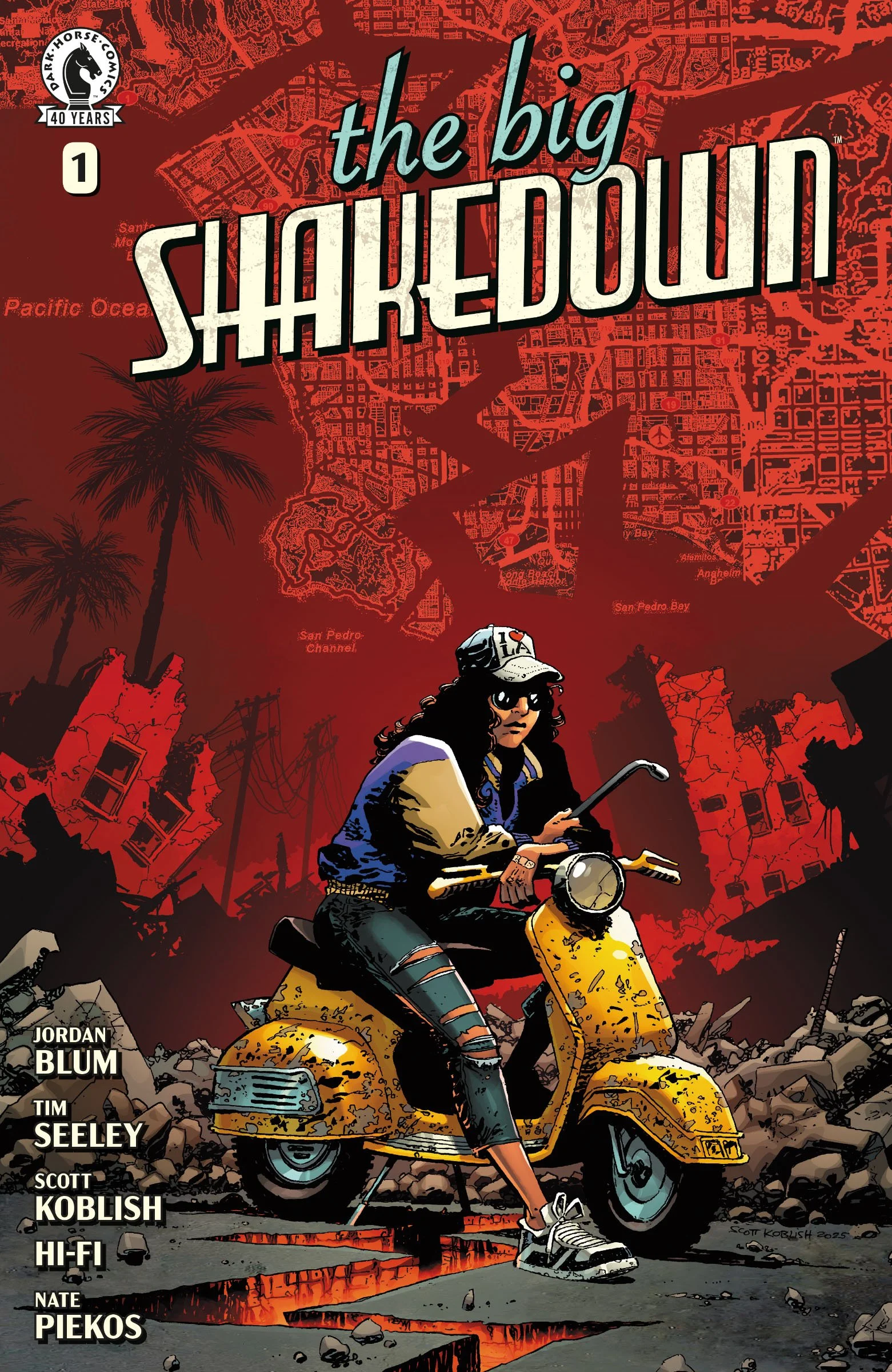
Credit: Dark Horse Comics
*** POSSIBLE SPOILER WARNING ***
STORY OVERVIEW:
After the big earthquake hit California, it split much of the land up, creating islands essentially. Most services and infrastructure were destroyed and in need of some serious repairs. Unfortunately, for the people of California, the President of the United States cut aide and kicked California out of the union citing God’s punishment. Now the cartels and gangs’ control different sections of the state. Most residents left, but those who stayed behind still keep that California originality and trend setting. Five years after this disater we catch up with Ester Blanco, a former detective, PI, and screen coach, who now teaches yoga and sells items she finds to survive. She wants out, but needs money to make her escape. What makes this harder is she owes rent for her place and protection to her local “landlords”. However one day her world changes a bit, as a stranger visits her home and offers her a job to find a missing girl. At first she isn’t interested, but then the thought of being able to finally leave California pulls her in.
WRITING:
This first issue carries the difficult responsibility of establishing an entire post-disaster society, introducing its lead character, defining her immediate problems, and launching the mystery that will drive the series. Jordan Blum & Tim Seeley handle that considerable amount of setup with impressive control. Rather than presenting the history of this fractured California as a detached block of exposition, they connect the setting’s political, economic, and social collapse directly to Ester Blanco’s daily life. Every detail: scarce resources, damaged infrastructure, territorial control, and the constant pressure of survival helps explain not only where the story takes place, but why Ester thinks and acts the way she does.
The premise begins with an earthquake powerful enough to break California into isolated landmasses. It is an exaggerated disaster, but one that feels grounded in the state’s real geography and seismic anxieties. The sharper and more distinctive idea, however, is the federal government’s response. California is denied aid, blamed for its own destruction, and forced out of the United States. That political abandonment turns a natural disaster into a prolonged human crisis. Blum & Seeley use the decision to create a society where official authority has disappeared and power has shifted toward whoever can control food, transportation, protection, and trade.
The explanation for the rise of gangs and cartels is especially effective because it follows a recognizable logic. These groups do not take over simply because the plot needs colorful villains; they already possess networks, experience moving goods across borders, and the willingness to defend supply routes by force. Once traditional institutions collapse, those criminal systems become the closest thing the region has to functioning infrastructure. Corporations and local power brokers then divide what remains, turning survival into a form of commerce. This careful cause-and-effect construction gives the book’s heightened premise an unsettling plausibility and makes the setting feel like a society that evolved over five difficult years rather than a collection of random post-apocalyptic ideas.
Just as importantly, the writers preserve California’s cultural identity amid the devastation. The state is not reduced to rubble and armed checkpoints; its residents continue to create trends, sell experiences, reinvent themselves, and cling to familiar habits. That contrast gives the world personality and creates room for humor without minimizing the danger. The satire works because the strange new customs grow out of recognizable attitudes. It allows the issue to be funny, cynical, and threatening at the same time, which makes this version of California more memorable than a conventional wasteland.
A setting this complicated needs a protagonist who feels equally layered, and Ester Blanco provides that focus. Her history as a detective, private investigator, screen coach, yoga teacher, and scavenger could have seemed like an arbitrary list of occupations, but the issue turns it into evidence of adaptability. Even before the disaster, Ester knew how to read people, shift between social circles, and survive unstable work. Those experiences now combine into a practical skill set: investigative instincts help her recognize danger, performance knowledge helps her understand appearances and deception, and scavenging keeps her alive from one day to the next. Her current life therefore feels like a believable extension of the person she was before California collapsed.
Ester’s contradictions also make her compelling. She is capable but financially trapped, independent but forced to answer to local “landlords” and determined to leave while still emotionally tied to something she has not recovered from her former home. Her desire to excavate that location introduces a personal mystery beneath the larger missing person case. The writers wisely avoid explaining it too soon. By withholding exactly what Ester hopes to find, they create a question that is intimate rather than merely procedural: readers are not only wondering whether she can escape, but also what unfinished business is powerful enough to keep her risking money, security, and physical safety.
The arrival of a David A. asking Ester to locate his missing daughter, Callie, gives all of this character and worldbuilding a clear direction. The request reveals more of Ester’s past without requiring a lengthy résumé scene, because the very fact that someone seeks her out confirms that her former investigative work still matters. Her initial refusal is equally important. Ester does not immediately accept the case out of heroism, sympathy, or professional pride. She changes her mind because the payment could fund the excavation of her old property and help her leave California. That motivation is practical, self-interested, and entirely consistent with the survivalist personality the issue has established.
This choice says more about Ester than a direct explanation could. She may not view herself as a rescuer, yet accepting the case places her in a position where she will have to confront other people’s desperation alongside her own. That tension creates space for meaningful development. The story can test whether her emotional distance is genuine, whether her detective instincts still carry a sense of responsibility, and whether finding Callie will force her to reconsider what she owes to the place she wants to abandon. Her financial motive starts the plot, but the unresolved pieces of her past suggest that money will not remain the only thing at stake.
Despite the density of the material, the issue never feels confusing or overloaded. Blum & Seeley introduce information in a purposeful sequence: the disaster explains the new California, the new California explains Ester’s circumstances, her circumstances explain her need for money, and that need explains why she accepts the case. Each element pushes naturally into the next, so exposition becomes part of the story’s momentum rather than an interruption. The humor and the reveal of a hidden threat add still more layers, suggesting that Ester’s investigation will be complicated by forces she does not yet understand. By the end of the issue, the world feels expansive, the lead feels fully motivated, and the central mystery has enough personal and external danger to make the next issue immediately appealing.
ARTWORK:
The artwork in this first issue does more than illustrate the story; it gives the shattered version of California a clear history, physical weight, and distinct personality. Scott Koblish immediately communicates the enormous scale of the earthquake through fractured landscapes, damaged structures, scattered debris, and communities forced to build around what remains. The destruction never feels like generic background scenery. Instead, every broken street, improvised shelter, and repurposed object suggests how people have adapted during the five years since the disaster. That attention to environmental storytelling makes the setting feel like a character, because readers can see both what was lost and the inventive ways survivors have transformed the ruins into something useful.
Koblish’s strongest visual choice is the way he treats rubble as part of the culture rather than as a constant reminder of death. Residents use damaged spaces and salvaged materials to recreate familiar activities, establish businesses, and maintain the eccentric trends that defined California before the earthquake. These visual details support the comic’s humor while also reinforcing its central survival theme. The world may be broken, but the people living in it continue to improvise, socialize, sell things, and create new routines. As a result, the setting feels active instead of frozen in the immediate aftermath of catastrophe.
The layouts also help the issue balance worldbuilding with the forward movement of the mystery. Wider images can establish the fractured geography and scale of the devastation, while closer character focused moments keep the story centered on Ester. Koblish provides enough background detail to reward careful reading without allowing the scenery to overwhelm the characters or dialogue. That clarity is especially important in an opening issue with so much information to introduce. Even when the surroundings are crowded with wreckage, people, or unusual remnants of the old California, the visual focus remains easy to follow.
Ester’s character design is equally effective because it communicates her history before the script explains all of it. Her clothing is practical, layered, and suited to someone who moves through dangerous territory, searches through abandoned places, and needs to carry the tools of several different jobs. Nothing about her appearance feels ornamental; every part of the design suggests function, experience, and limited resources. At the same time, Koblish avoids making her look like a standard armored post-apocalyptic hero. Ester still appears individual and recognizable, which helps separate her from the familiar visual clichés of the genre.
Her posture, facial expressions, and physical presence reveal even more. Ester carries herself like someone who has endured years of pressure and learned not to display vulnerability unnecessarily. She often appears guarded, tired, and alert, with a demeanor that suggests she is constantly assessing the people and spaces around her. Small visual choices make her seem capable without making her invincible. She looks like someone who has survived through intelligence, flexibility, and stubbornness rather than brute strength. In that sense, Koblish’s depiction adds another layer to Blum and Seeley’s characterization. The writing explains what Ester has done, while the artwork shows what those experiences have cost her.
Koblish also gives the supporting characters and different areas of the new California enough variety to make the world feel divided among competing groups and lifestyles. Clothing, body language, surroundings, and improvised symbols of status help indicate who possesses power, who is struggling, and who may be dangerous. These distinctions allow readers to understand the social hierarchy of a scene quickly, often before the dialogue confirms it. The visual storytelling therefore strengthens the issue’s political and economic ideas by showing how control and scarcity affect ordinary life.
Hi-Fi’s colors bring energy and cohesion to all of these elements. The palette is vivid enough to preserve the book’s strange California personality, but it also supports the harsher aspects of the setting. Bright accents and saturated tones draw attention to characters, signs, clothing, and unusual details, while dustier and more restrained colors ground the damaged environments. This contrast prevents the ruined landscape from becoming visually monotonous. It also reinforces the story’s blend of danger, satire, and eccentricity. The world is devastated, but it has not become colorless.
The color work is particularly valuable in guiding the eye through Koblish’s detailed pages. Changes in brightness, temperature, and contrast help separate figures from complicated backgrounds and establish the atmosphere of each location. Warmer tones can make exposed spaces feel dry and punishing, while darker or cooler passages create unease and suggest hidden danger. Together, Koblish and Hi-Fi produce artwork that is clear, expressive, and packed with narrative information. Their visual approach makes the new California believable not simply because it looks destroyed, but because it looks inhabited, adapted to, and changed by the people who refused or were unable to leave.
Check Out MY REVIEW OF FML #8
Final Thoughts:
The Big Shakedown #1 is a confident debut that pairs imaginative post-disaster worldbuilding with a compelling lead and a strong central mystery. Jordan Blum and Tim Seeley establish a fractured California that feels dangerous, satirical, and lived in, while Scott Koblish and Hi-Fi give the setting vivid visual character. With Ester’s personal goals tied directly to the missing-person case, the issue delivers an engaging start and plenty of reasons to return. This should be a strong contender when deciding what to pick up at the shop this week. Trust me once you read this first issue you will definitely want to add this series to your Pull List.
FINAL GRADE: 9.3/10
Let me know your thoughts on The Big Shakedown #1 in the comments below. Thanks for reading!