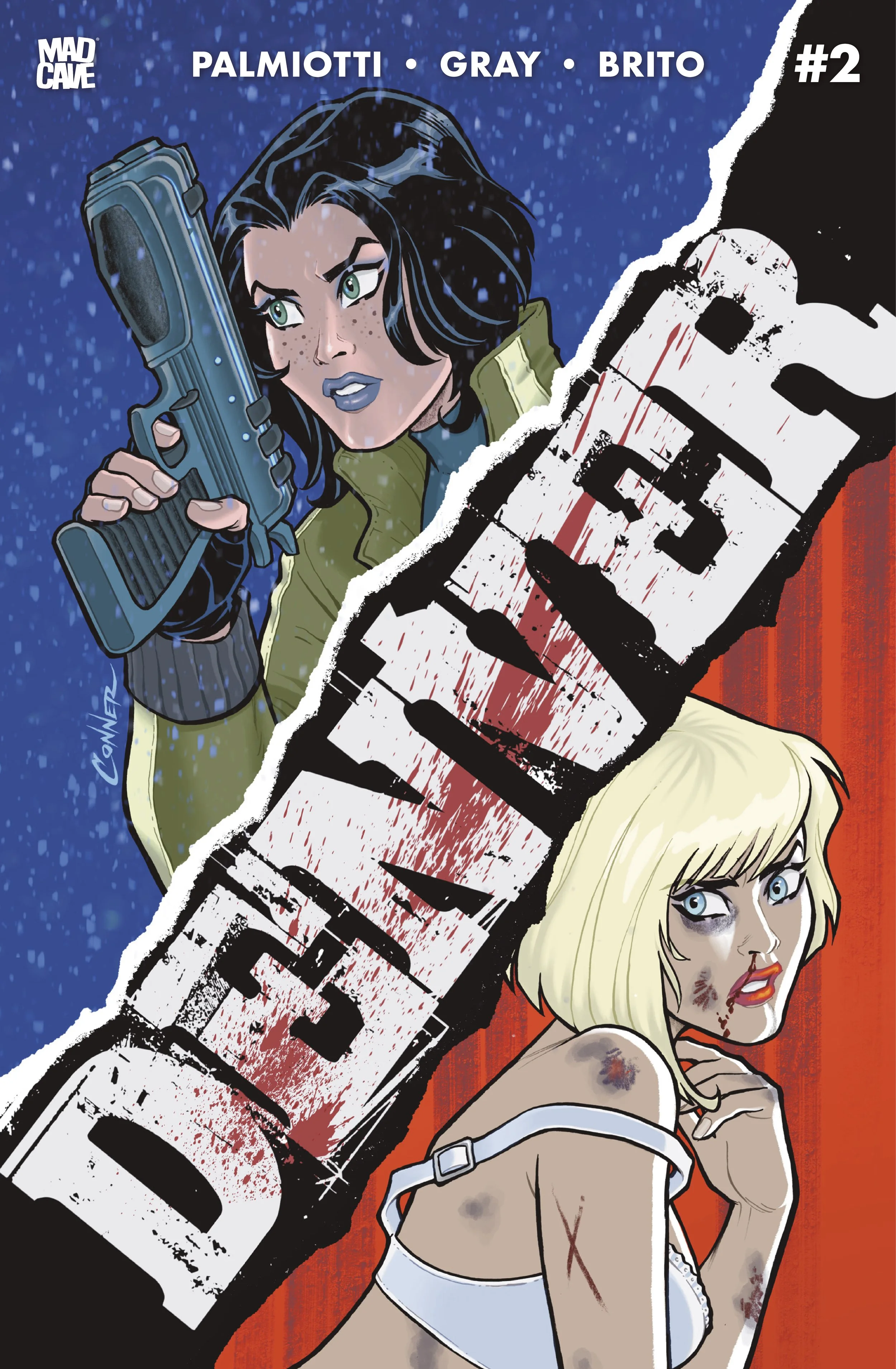
DENVER #2 (Mad Cave Studios)
Now that Max Flynn’s wife has been taken, it’s time to find out what the ransom is. But when faced with having to give up a bit of his integrity to get his wife back, what will Max do? Unfortunately for those who took his wife, Max has a certain set of skills that they were not counting on.
Denver #2 - Written By Jimmy Palmiotti & Justin Gray – Art By Pier Brito – Letters By Bill Tortolini – Edited By Joanne Starer -Published By Mad Cave Studios
Credit: Mad Cave Studios
*** POSSIBLE SPOILER WARNING ***
STORY OVERVIEW:
After taking his wife, the kidnappers finally contact Max for their ransom. But they have a different kind of ransom than what Max had anticipated. They want him to allow ships that are smuggling in contraband to get into the ports of Denver. If he plays along, his wife lives, but if he doesn’t, they will kill her and his daughter is next. Put in between a rock and a hard place, Max makes the only decision he can, help the kidnappers. The toll it takes on him to give up some of his integrity is massive. But what’s worse is when crime starts to get worse because of the weapons that are being smuggled in, Max can only blame himself. Finally, he decides he needs to take different actions and reach out for help from the people he can trust the most. Pushed to his breaking point, how far is Max willing to go to protect the ones he loves and the city he made an oath to protect?
WRITING:
This second issue raises the stakes while giving the series a much clearer direction. Jimmy Palmiotti and Justin Gray continue developing this unique world by filling it with intrigue, personal drama, moral compromise, and the promise of revenge. Rather than relying only on the kidnapping to create tension, the writers focus on the psychological damage the situation inflicts on Max Flynn. His wife has been taken, her abductors are hurting her, and Max is forced to confront a demand designed to destroy the very principles that define him. The kidnappers do not simply want money. They want him to betray his oath, misuse his authority, and allow ships carrying contraband to enter Denver’s ports. That choice makes the conflict far more personal because every concession he makes to save his family also threatens the city he has sworn to protect.
Max’s deteriorating mental state becomes the issue’s emotional center. He understands that helping the smugglers will have consequences, yet refusing them could cost his wife her life and place his daughter in danger. Palmiotti and Gray make that impossible position feel heavy by showing how each decision compounds the next. Once the contraband begins moving through the city, violence increases, innocent people are killed, and vulnerable citizens are blamed for crimes they did not commit. Max cannot separate himself from that suffering because he knows his cooperation helped make it possible. His guilt is therefore layered: he feels responsible for failing his wife, for compromising his integrity, and for allowing Denver to become more dangerous. The pressure builds until his fear and shame begin turning into anger.
The writers also make Max’s isolation an important part of his decline. He keeps Jane and Jimmy at a distance even though they are capable, loyal, and willing to help. On one level, that decision comes from the kidnappers’ threat and his fear that involving anyone else will lead to his wife’s murder. On another level, it reflects a stubborn belief that he should be able to fix the situation himself. That mixture of fear, pride, and desperation is painfully believable. Max is not making bad decisions because he is careless; he is making them because he is terrified, exhausted, and convinced that carrying the burden alone is the only way to protect everyone else. Unfortunately, every attempt to maintain control pushes him further toward collapse and creates new problems he can no longer contain. This vulnerability makes Max more relatable. Many readers will recognize the impulse to withdraw when circumstances become overwhelming or to refuse help because asking for it feels like admitting failure. Palmiotti and Gray take that familiar instinct and place it inside a high-stakes crime story, allowing Max’s emotional mistakes to drive the plot as much as the kidnappers’ actions do.
When he finally reaches out to Jane and Jimmy, the moment feels meaningful because it marks the first time he stops reacting alone. Their immediate willingness to stand beside him reinforces the trust between these characters and gives Max something he has been missing throughout the issue: allies who can share the danger and challenge his increasingly reckless choices. That decision also changes the shape of the story. What begins as a kidnapping and coercion plot starts transforming into a revenge thriller reminiscent of Taken or Man on Fire. Max is no longer willing to follow the criminals’ rules or wait for them to dictate the next move. Capturing a smuggler and torturing him for information reveals both the practical skills Max has kept hidden and the frightening distance he is now prepared to travel. The scene works because it is not presented as a sudden transformation into an unstoppable action hero. It feels like the culmination of everything he has endured: fear for his wife, guilt over the city’s suffering, rage at being manipulated, and frustration with his own earlier compliance. His violence is disturbing precisely because readers understand how he arrived at that point.
Most importantly, Palmiotti and Gray never lose sight of the emotions driving Max’s actions. His choices are fueled by anger and revenge, but those feelings grow out of his love for his family and his responsibility to Denver. That distinction gives the darker material weight. The violence is not included simply for spectacle; it represents Max crossing lines he once believed were absolute because he sees no other way to protect the people who depend on him. The issue leaves readers with an unsettling question: even if Max succeeds in rescuing his wife and stopping the smugglers, how much of himself will he sacrifice in the process? By grounding the revenge plot in guilt, loyalty, and moral compromise, Palmiotti and Gray create a more emotionally complex story and make it clear that Max’s greatest battle may be preserving the person he was before the kidnapping began.
ARTWORK:
The artwork in this issue captures every important emotion and decision with striking detail, drawing the reader deeper into both Max’s personal crisis and the dangerous world around him. Pier Brito does more than illustrate the events described in the script; he adds visual information that reveals what the characters are trying to conceal. Through facial expressions, posture, staging, and shifts in atmosphere, Brito makes the emotional consequences of the kidnapping feel immediate. Even when Max says very little, the strain in his face and body language communicates the fear, guilt, exhaustion, and anger building inside him. This visual storytelling gives the quieter scenes as much weight as the violent ones because the reader can see how every new development pushes Max closer to his breaking point.
Max is normally presented as controlled and stoic, so the changes in his expression are especially effective. His usual composure gives way to flashes of concern, helplessness, frustration, and rage, allowing readers to understand that he is losing the emotional balance that once defined him. Brito avoids making these reactions feel exaggerated. Instead, small details in Max’s eyes, clenched jaw, and physical tension show how hard he is working to maintain control. That restraint makes his trauma more believable and creates sympathy for him without excusing the increasingly violent choices he makes. The artwork allows readers to feel the conflict between the disciplined protector Max wants to be and the desperate husband and father the kidnappers are forcing him to become.
Brito brings the same attention to the supporting cast and the criminals. Jane and Jimmy appear grounded and dependable, visually reinforcing why Max eventually turns to them for help. The kidnappers, by contrast, carry themselves with confidence and arrogance. Their relaxed expressions and self-satisfied body language suggest that they believe they have complete control over Max and the situation. They look like the cat that ate the canary, convinced that their leverage makes them untouchable. As the story progresses and one of them is captured, however, that confidence begins to disappear. The change in expression and posture signals a reversal of power before the dialogue fully explains it. Seeing that arrogance replaced by fear creates a satisfying sense that the people tormenting Max may eventually face the same terror they inflicted on his family.
The violent scenes are handled with similar control. Brito makes them intense without turning them into excessive spectacle. He shows enough to establish the brutality of Max’s actions, but he also leaves carefully chosen moments outside the frame, allowing readers to imagine what happens between panels. That restraint makes the violence more unsettling because the audience participates in completing the scene rather than simply observing every detail. It also keeps the focus on why the violence is happening and what it reveals about Max’s transformation. The action is therefore not just visually exciting; it becomes part of the character development, showing how far Max is willing to go and how much of his former restraint he is beginning to abandon.
The design of Denver continues to be one of the book’s strongest visual elements. Although the setting is a sprawling island city, Brito often frames streets, rooms, docks, and corridors in ways that make the environment feel enclosed and increasingly claustrophobic. That approach mirrors Max’s situation. The city may be physically large, but his options are narrowing, danger is moving closer to home, and every location seems to offer less room to escape. Background details keep Denver feeling functional while also reminding readers that crime and instability are spreading through it. The setting is not merely a backdrop; it reflects the pressure closing in on Max and reinforces the sense that the consequences of his decisions are affecting an entire community.
The darker color palette strengthens this mood of despair and uncertainty. Heavy shadows and muted tones create a world that feels cold, tense, and morally uncertain, while changes in contrast help guide the reader toward important expressions and actions. The visual darkness also complements the story’s central conflict, as Max is forced into choices with no clean or heroic outcome. Even moments of apparent calm carry an underlying sense of danger because the colors never allow the atmosphere to become fully comfortable. This consistency helps unite the personal drama, criminal conspiracy, and action into a single visual tone.
Bill Tortolini’s lettering supports the artwork by keeping conversations, threats, and action easy to follow without overwhelming the panels. The placement of dialogue creates a natural reading path and preserves the impact of Brito’s expressions and backgrounds. During quieter scenes, the lettering gives the characters room to breathe, while tense exchanges move with enough urgency to maintain the issue’s momentum. This balance is especially valuable in a story where so much meaning is communicated visually.
Overall, the art team adds emotional depth, atmosphere, and narrative information without requiring additional exposition. Brito’s expressive character work, controlled violence, and immersive city design combine with Tortolini’s clear lettering to make the issue feel tense and cinematic while keeping the reader focused on Max’s deteriorating state and the danger closing in around him.
Check Out My Review of DENVER #1
Final Thoughts:
Denver #2 builds successfully on the debut by raising the stakes and giving Max Flynn’s struggle greater emotional weight. Jimmy Palmiotti and Justin Gray deliver a tense story of loyalty, guilt, and revenge, while Pier Brito and Bill Tortolini keep the issue visually gripping and easy to follow. With strong character work, escalating danger, and a compelling cliffhanger, this remains an easy recommendation for action and science-fiction fans. If the ramp up of issue two is any indication this series should be on top of everyone’s list when they hit the comic shop this week.
FINAL GRADE: 10/10
Let me know your thoughts on Denver #2 in the comments below. Thanks for reading!