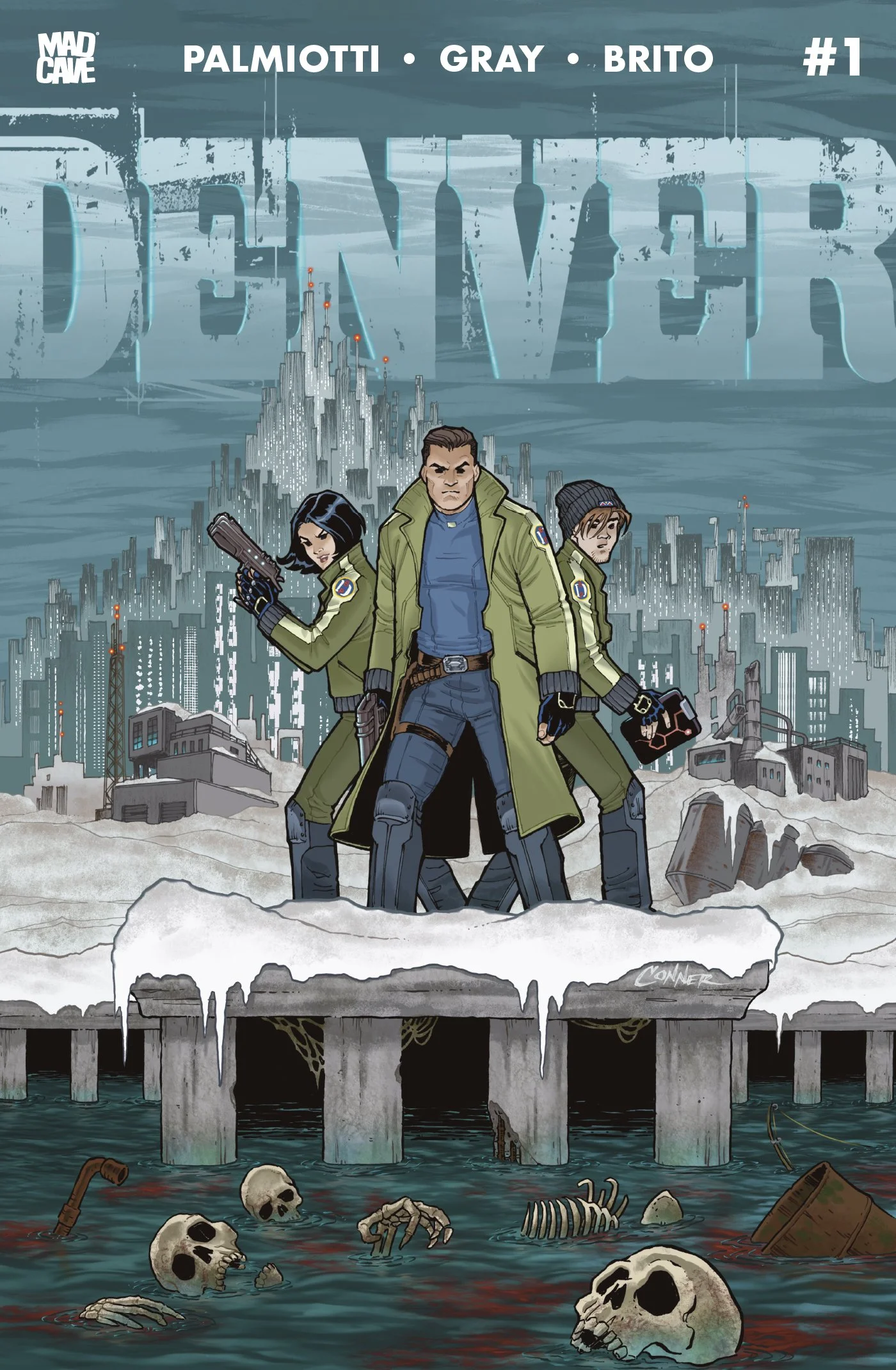
DENVER #1 (Mad Cave Studios)
This marks a new series from Mad Cave Studios that is a Sci-Fi version of Taken, for lack of a more concise equivalent. Denver is a story set in the future where the planet was devastated by an asteroid strike on the moon. The new geography of the world has created islands where massive mountains once were. We are following Coastal Border Guards in Denver as they protect the ports and ensure the city island doesn’t become overcrowded. But the story takes a darker and more sinister turn quickly.
Denver #1 - Written By Jimmy Palmiotti & Justin Gray – Art By Pier Brito – Letters By Bill Tortolini – Edited By Joanne Starer -Published By Mad Cave Studios
Credit: Mad Cave Studios
*** POSSIBLE SPOILER WARNING ***
STORY OVERVIEW:
In the future the moon is hit by a good-sized asteroid. Debris rained down on the Earth, but this was least of the problems that this moon strike would cause. The biggest threat to the planet was that it caused the moon’s gravitational pull to change. This caused massive storms and unpredictable currents and tides. These factors led to biblical levels of flooding, only leaving land in places that were 5,000 feet above sea level before the event took place. Now all that is left are these island cities that were once mountains. This story takes place in Denver, one of the few places left in what was known as North America.
We follow Coastal Border Guard Officer Jimmy Flynn, as he and his team protect the coasts of Denver. Because of the limited space and resources only so many people can be accepted on the island. It is the job of the Coastal Border Guard to make sure any people coming into the island have been sponsored, vetted, and given passage to enter the city island. On this cold and snowy night Officer Flynn and his partner Jane are processing a family coming in, when things take a turn. They are firstly trying to smuggle in a baby, that’s the least of the worries as they are also trying to smuggle in contraband. They say they were forced to smuggle the payload in by Marauders, and the husband takes Jane hostage. This of course doesn’t work, and it leads to the man be unceremoniously killed by some locals in the Ten Down Territory as he tried to flee. We then meet Jimmy’s family and see what kind of amazing family man he is. This makes how the issue ends even worse, as his family is now in danger from some outside forces that appear to be tied to the smuggling marauders.
WRITING:
The first issue of Denver succeeds because Jimmy Palmiotti and Justin Gray understand that a high-concept science fiction story only works if the reader can quickly understand the rules of the world and emotionally invest in the people living inside it. The issue gives us the essential backstory about the asteroid strike, the damaged moon, the flooding of the planet, and the creation of island cities without making the opening feel like a history lesson. Instead of burying the reader under exposition, the writers make the disaster feel directly connected to the present-day tension. Every detail about the changed geography, limited resources, and strict border policies explains why Denver operates the way it does. The worldbuilding is not just decoration. It is the engine that drives the conflict, because without this catastrophe there would be no desperate migration, no overcrowding crisis, no marauders, and no need for the Coastal Border Guard to exist.
What makes that setup even stronger is how naturally the writers use Officer Jimmy Flynn’s job to introduce the audience to the moral pressure of this world. Jimmy is not simply standing at a border because the plot needs someone in uniform. His position places him directly at the center of the city’s most difficult questions. Who gets to come in? Who gets turned away? What happens when compassion clashes with survival? The scene involving the family trying to enter Denver works because it is not treated as a simple good-guy-versus-bad-guy situation at first. There is fear, desperation, deception, and danger all wrapped into one encounter. That complexity gives the issue a sharper edge, because the reader can understand why people would take terrible risks in this world even while also recognizing why the city has become so strict.
Palmiotti and Gray also do an effective job making Jimmy feel like more than just the lead character of a genre story. The issue takes enough time to show his relationship with his family, his sense of duty, and the warmth he has outside of the dangerous work he does. Those moments are important because they give the later threat real emotional weight. If the story only presented Jimmy as a tough border officer, the ending would still function as a plot twist, but it would not hit as hard. By showing him as a husband and father, the writers make the danger feel personal. The reader is not only curious about the conspiracy or the marauders. They are worried about what this attack could cost Jimmy and the people closest to him.
The pacing is another major strength of the writing. The issue moves from broad worldbuilding to a tense border encounter, then into personal family material, and finally into the reveal of the larger threat. That structure gives the book a strong escalation. Each section builds on the one before it, and the story never feels like it is rushing to get to the hook even though a lot of information is being delivered. The writers know when to slow down and let the reader understand the stakes, but they also know when to tighten the tension and push the story forward. By the time the final pages arrive, the issue has already established the world, the rules, the emotional center, and the danger, which makes the cliffhanger feel earned rather than forced.
The mystery at the heart of the issue is handled with the right amount of restraint. The writers reveal enough to make it clear that the smuggling incident is part of something bigger, but they do not explain everything too soon. That restraint creates a strong sense of anticipation. The reader is left with questions about the marauders, the forces targeting Jimmy’s family, and how deep the corruption or outside threat may go. This is especially important for a first issue because it gives the series clear forward momentum. Denver does not end by simply asking the reader to admire its premise. It ends by making the reader want answers.
Most importantly, the ending lands because the emotional reaction is layered. There is intrigue over who is responsible for the assault, anger that Jimmy’s family has been pulled into the violence, sadness for what Jimmy may be facing, and a strong desire to see how he responds. Palmiotti and Gray pull all of those reactions together in a way that makes the issue feel complete while still leaving the larger story wide open. As a debut, this is exactly what the writing needed to do. It introduces a fascinating disaster-shaped world, gives the lead character an immediate emotional foundation, establishes a dangerous social order, and closes with a hook that makes the next issue feel necessary.
ARTWORK:
The artwork in Denver #1 is doing a lot of heavy lifting, and Pier Brito rises to the challenge by making this flooded future feel dangerous, and visually distinct. A story like this needs the reader to immediately believe in the new geography of the world, and the art makes that possible. Denver does not simply look like a generic futuristic city. It feels like a city that has been forced to adapt after the world has been broken apart. The sense of scale is especially important here. The idea that former mountain regions have become island cities could easily feel too abstract, but Brito gives the setting enough visual weight that the reader can understand how isolated, crowded, and fragile this society has become. The cold coastlines, towering structures, guarded ports, and dense urban areas all help communicate that this is a place surviving under pressure.
One of the strongest parts of the visual storytelling is how clearly each location has its own identity. The coastal border area feels exposed and tense, which makes sense because it is the first line of defense between Denver and the outside world. The city streets feel more active and layered, showing how people continue to live their lives even in a world shaped by disaster and scarcity. The high-rise apartments give the story a more personal and domestic atmosphere, which helps Jimmy’s family scenes stand apart from the danger of his work. Then there is Ten Down Territory, which immediately feels rougher, darker, and more unpredictable than the rest of the city. Brito uses these different spaces to show the divisions inside Denver without needing the script to constantly explain them. The reader can see that the city has social layers, dangerous zones, and fragile boundaries.
The character work is also a major strength of the issue’s art. Jimmy Flynn has the presence of someone who is used to danger, but Brito also gives him enough warmth in the quieter family moments that he does not come across as only a hardened officer. That balance matters because the story depends on Jimmy feeling like both a capable protector and a vulnerable family man. The supporting characters are visually distinct as well, which helps the issue remain clear even as it introduces border guards, civilians, smugglers, locals, and threats connected to the marauders. Facial expressions and body language carry a lot of the tension in the border sequence. Fear, suspicion, panic, and authority are all visible before the situation fully erupts, which makes the scene feel more immediate and believable.
Brito’s layouts help the issue move smoothly between exposition, action, and emotional beats. The pages never feel overly cluttered, even though the story is introducing a large amount of information about the world. Wider panels give the reader time to take in the setting and understand the scope of the city, while tighter panels bring attention back to the characters when the tension becomes more personal. This is especially effective during the smuggling scene, where the art narrows the focus as the danger escalates. The shift from environmental scale to close character reactions keeps the sequence tense and easy to follow. The result is an issue that feels cinematic without losing the clarity needed for a first issue.
The color palette adds even more personality to the book. The heavy use of blues, grays, greens, and colder tones gives Denver an ominous atmosphere that fits both the winter setting and the city’s guarded way of life. There is a constant chill to the visuals, which makes the world feel harsh before the story even tells us how difficult survival has become. The colors also help separate the safer spaces from the more threatening ones. When the book moves into darker or more dangerous territory, the palette helps create an uneasy tone that makes it feel as if trouble could appear from any direction. That mood is essential to the issue because the story is not just about a future city. It is about a city surrounded by fear, limited resources, and people willing to do desperate things to get inside.
Overall, the artwork strengthens every part of the issue. It sells the science fiction concept, gives Denver a believable identity, makes the action readable, and gives the quieter family moments the emotional softness they need. Brito’s visuals make the world feel both impressive and unstable, which is exactly the right tone for this story. The art does not just illustrate the script. It expands the world, deepens the atmosphere, and makes the danger surrounding Jimmy Flynn and his family feel more immediate.
Check Out My Review of PRETTY HATE MACHINE #4
Final Thoughts:
Denver #1 is a strong debut that combines a compelling disaster-shaped future with grounded personal stakes. Jimmy Palmiotti and Justin Gray build a world that feels dangerous and believable, while Pier Brito gives the city a cold, lived-in visual identity. The issue delivers enough action, mystery, and emotional weight to make Jimmy Flynn’s story immediately engaging. It is an easy recommendation for science fiction and action fans looking for a new series with strong worldbuilding and a sharp hook. This should be a must-grab at the shop this week and should be an easy add to your Pull List going forward.
FINAL GRADE: 10/10
Let me know your thoughts on Denver #1 in the comments below. Thanks for reading!