WHITE SKY #6 (IMAGE COMICS)
As Violet makes her way towards the end of the tunnel she gets some help from an unlikely source. Meanwhile, David is still trying to find his way to his daughter no matter how many lines he must cross. How will this end to the first story arc of this series play out?
White Sky #6 – Written By William Harms – Art By JP Mavinga - Colors By Lee Loughridge – Letters By Ed Dukeshire - Published By Image Comics
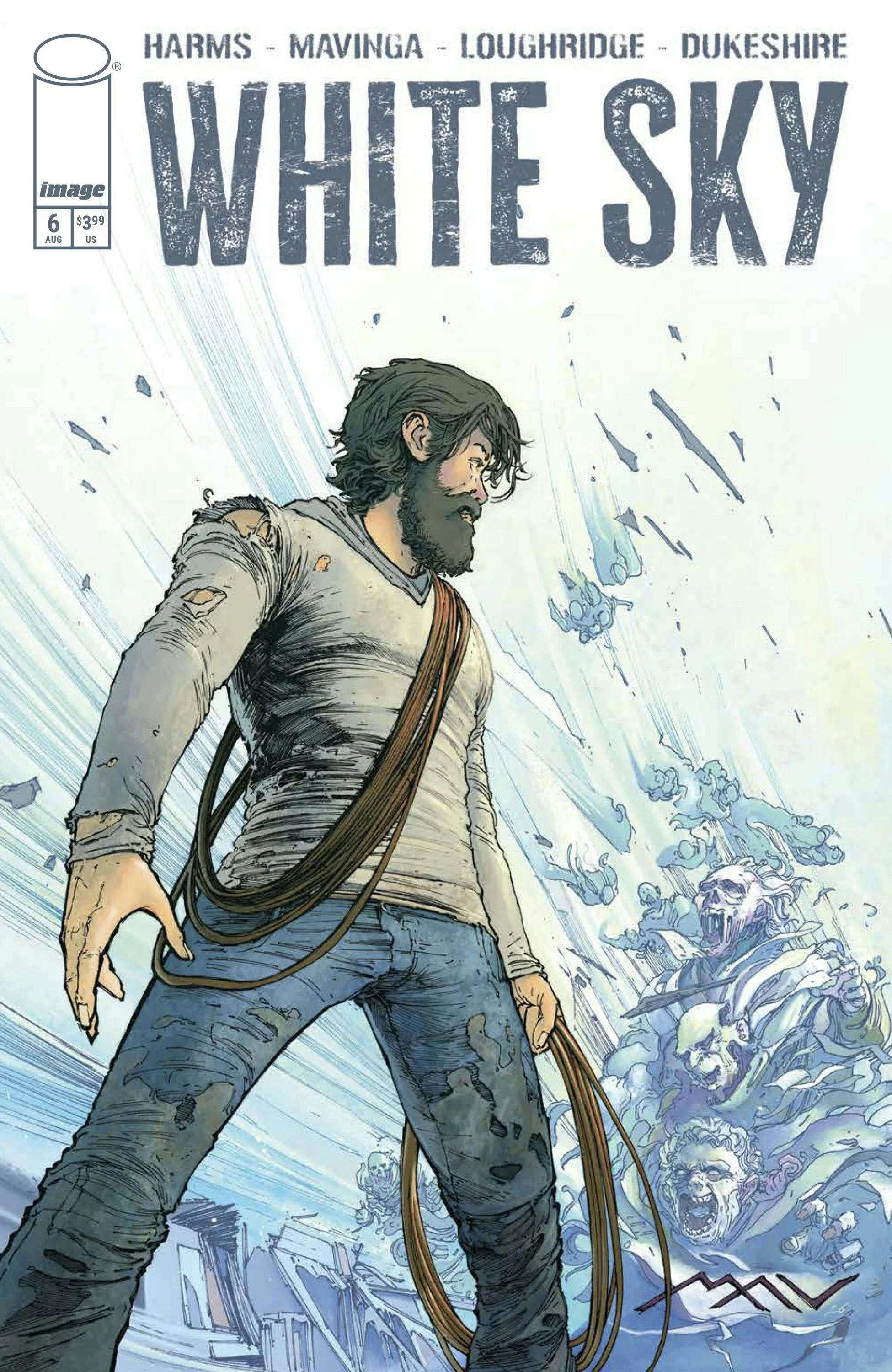
Credit: Image Comics
*** POSSIBLE SPOILER WARNING ***
STORY OVERVIEW:
David makes his way into Pleasanton, which is yet another outpost, walled sanctuary that just like all the others has a darker side. Here one must work to eat but might have to kill to work. David isn’t interested in these politics as he’s only here to look for his daughter and continue on. At the same time, Violet is continuing to make her way through the tunnel by herself. She encounters a ghost named Sally. However, Sally is unlike the other ghosts in this world and reassures Violet that the marked ones are not the only ghosts that walk the Earth. With a new companion in tow, Violet continues her journey to the end of the tunnel.
WRITING:
The final issue of the first arc brings a meaningful sense of closure to several major threads while deliberately leaving enough uncertainty to carry the series forward. William Harms concludes this opening chapter by balancing hope against the harsh reality of a world defined by violence, survival, and moral compromise. Violet’s storyline provides the more hopeful side of that contrast. After enduring isolation, supernatural threats, and a series of increasingly frightening obstacles, she finally reaches the end of the tunnel and completes the first major stage of her journey. What makes this moment effective is not simply that she survives, but that she emerges with her sense of purpose still intact. Considering everything she has witnessed and endured, it would be understandable for her to give in to despair. Instead, she continues to believe that reaching her larger goal is possible. Her encounter with Sally strengthens that idea. Until this point, ghosts have largely represented danger and trauma, but Sally complicates that understanding by showing Violet that not every spirit is hostile. Her kindness gives Violet both companionship and a reason to believe that goodness still exists in this damaged world. In that sense, the light at the end of the tunnel works on two levels: it marks Violet’s physical escape from the darkness, while also suggesting that she may still find emotional and spiritual hope beyond it.
David’s storyline presents the darker side of the issue’s central theme. After repeated betrayals and losses, he has become colder, more calculating, and increasingly willing to cross moral boundaries in the name of survival and finding his daughter. He effectively cons his way into Pleasanton, concealing his true intentions and manipulating the people around him until he can get the information he needs. Pleasanton is clearly not an innocent community, and its inhabitants operate within a brutal system, but David’s actions still reveal how far he has fallen. The most troubling moment comes when he kills someone even after receiving the answer he was seeking. That death is not necessary for his immediate goal, which makes it an important marker of his moral decline rather than a simple act of self-defense. Harms uses the moment to show that David is no longer merely reacting to the cruelty of the world; he is beginning to participate in it. This creates compelling tension for the next chapter because his determination remains understandable, even as his methods become harder to justify. The contrast between Violet and David gives the finale its strongest emotional weight: Violet survives without completely losing her hope, while David survives by surrendering more of his humanity.
Overall, the story resolves the key events of the first chapter in a logical and satisfying way, establishes where both characters stand emotionally, and creates clear paths for their journeys to continue. I would have preferred a little more intensity in the final pages, along with a stronger cliffhanger to build immediate anticipation for the second chapter. Even so, the issue delivers a functional and thematically coherent conclusion that closes the arc while preserving the larger questions that can drive the series forward.
ARTWORK:
The artwork in this issue does an excellent job of giving the supernatural post-apocalyptic world a distinctive visual identity while reinforcing the themes and emotional tension within the story. JP Mavinga continues to expand the scale of the series through environments that feel damaged and shaped by the desperate choices of the people who inhabit them. His attention to background detail makes each location feel like part of a much larger world rather than a temporary setting created only for a single scene. Ruined structures, discarded belongings, confined spaces, and signs of previous human struggle all suggest stories that exist beyond the immediate experiences of Violet and David. This environmental storytelling encourages the reader to pause and consider what happened in these places before the characters arrived, adding a deeper sense of history, loss, and danger to the journey.
Pleasanton is especially effective because its design immediately challenges the idea that it is a true sanctuary. Its walls, barriers, and imposing architecture make it resemble a prison or fortified labor camp rather than a place of safety. That visual harshness prepares the reader for the community’s cruel system, where survival comes with conditions and work can require violence. Before the full nature of Pleasanton is explained through the story, the artwork already communicates that something is deeply wrong. By contrast, the tunnel remains dark, cramped, and claustrophobic, maintaining the oppressive atmosphere established in previous issues. The bodies of those who failed to escape and the personal items left behind turn the setting into a record of past suffering. These details make Violet’s progress feel more dangerous because every abandoned object serves as a reminder that others attempted the same journey and did not survive.
The character designs are equally strong and communicate personality, history, and intention through posture, expression, clothing, and silhouette. David’s increasingly hardened presence reflects the moral compromises he is making, while Violet’s smaller figure within the overwhelming tunnel emphasizes both her vulnerability and her determination to keep moving forward. The introduction of Sally is particularly memorable because she is visually unlike the other ghosts encountered in this universe. Her design immediately signals that she is not one of the threatening marked spirits, allowing the reader to recognize her gentler nature before the story fully explains it. That distinction is important because it makes Sally feel like a genuine source of comfort rather than another danger waiting to reveal itself. Her presence also changes the visual rhythm of the tunnel sequences: after pages dominated by darkness, decay, and isolation, Sally becomes a reassuring focal point and gives Violet’s scenes a renewed sense of movement and companionship.
The colors by Lee Loughridge complement Mavinga’s linework and help define the emotional character of each location. Inside the tunnel, the palette is dark, dirty, and subdued, strengthening the sense of confinement and making the environment feel cold and contaminated. Sally appears as a visual light within that gloom, which reinforces her narrative role as a source of hope for Violet. The contrast enables the color work to communicate meaning without relying entirely on dialogue. Sally does not merely tell Violet that kinder spirits exist; her visual presentation makes that possibility feel believable. The exterior scenes use dusty browns, burnt oranges, and sun-scorched tones that suggest a barren desert landscape reminiscent of Mad Max. Those colors make the outside world feel vast but no less hostile than the tunnel, creating a useful contrast between enclosed terror and exposed danger. Ed Dukeshire completes the presentation with lettering that remains clear, naturally guides the eye through each page, and fits comfortably within the compositions. The dialogue and captions are easy to follow without overwhelming important visual details, while the placement of the balloons supports the pacing of conversations and action. Together, the line art, colors, and lettering create a cohesive visual experience that deepens the atmosphere, clarifies the differences between the story’s locations and supernatural figures, and strengthens the issue’s themes of fear, isolation, brutality, and hope.
CHECK OUT MY REVIEW OF WHITE SKY #4
Final Thoughts:
White Sky #6 delivers a satisfying close to its first arc by balancing Violet’s hope with David’s deepening moral decline. William Harms’s measured storytelling and the art team’s stark, atmospheric visuals keep the supernatural mystery and human cost of survival equally compelling. Although a sharper cliffhanger could have added more urgency, this remains a strong finale that leaves the series well positioned for its next chapter. If you didn’t read along with this opening arc the trade will hit shelves in late October/early November so you can get caught up before Chapter Two.
FINAL GRADE: 8/10
Let me know your thoughts on White Sky #6 in the comments below. Thanks for reading!