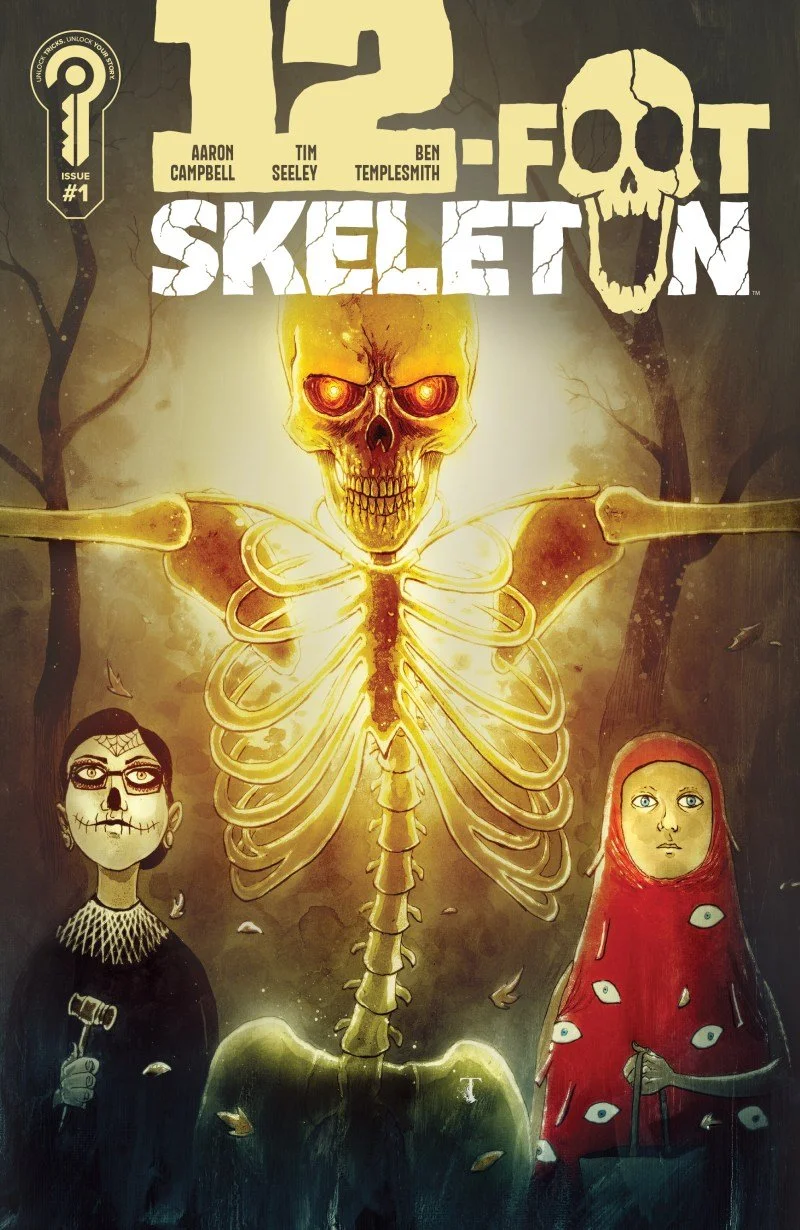
12-FOOT SKELETON #1 (IGNITION PRESS)
Lola is a young girl from a Mexican family; they originally lived in Albuquerque but recently moved. She is having a hard time fitting in, and the only kid she has any real interactions with is Jimmy, who is an outcast himself. Shaun used to be friends with Jimmy, but his dad encourages him to bully Jimmy. It’s almost Dia de Muertos and Lola’s Abuela tells her stories of the Revenants who chose to select vessels of bones. With all the bullying and nonsense from others in the town, Lola & Jimmy could really use some backup. But the backup they get is something they can’t imagine.
12-Foot Skeleton #1 – Written By Aaron Campbell & Tim Seeley – Art By Ben Templesmith – Letters By Andworld Design – Edited By Ian Shaughnessy & Maggie Howell - Published By Ignition Press
Credit: Ignition Press
*** POSSIBLE SPOILER WARNING ***
WRITING:
This first issue packs a wallop, largely because Aaron Campbell and Tim Seeley take the time to establish the story as an intimate drama before revealing its larger supernatural ambitions. At first, Lola and Jimmy simply seem like two children who are misunderstood by the people around them and forced to deal with circumstances that would overwhelm many adults. Lola is struggling to fit into a new town after her family’s move from Albuquerque, and that isolation makes her connection with Jimmy especially meaningful. Even when she feels out of place, however, she still has the stability of a family that cares for her. Her Abuela introduces her to stories and traditions connected to their Mexican heritage, including the approaching Día de Muertos, while Lola’s admiration for her brother shows how strongly she depends on the people closest to her. Campbell and Seeley make that sense of family central to Lola’s character, using it as both a source of comfort and a foundation for the supernatural elements that begin to emerge.
Jimmy’s situation is much harsher. His father has abandoned him and his mother, he has been diagnosed with cancer, and he is being tormented by Shaun, a boy who was once his friend. These details could easily feel manipulative, but the writers present them carefully, allowing Jimmy’s loneliness, fear, and anger to build naturally. By giving both children distinct burdens, Campbell and Seeley create immediate sympathy for them and establish why their friendship matters: each recognizes the isolation in the other, even though their home lives and personal struggles are very different.
From there, the story gradually widens its focus and reveals that the cruelty surrounding Lola and Jimmy is not limited to careless schoolyard behavior. Shaun bullies Jimmy, but Campbell and Seeley complicate that conflict by showing that the abuse is being encouraged by Shaun’s father. Rather than teaching his son empathy, restraint, or responsibility, he treats Jimmy’s suffering as entertainment and gives Shaun permission to become crueler. He even drives Shaun and another boy, Lucas, to Jimmy’s house so they can destroy the 12-foot skeleton displayed outside as a decoration. The scene is disturbing not only because of the vandalism itself, but because an adult actively enables it. That choice reinforces one of the issue’s strongest ideas: the most frightening monsters are sometimes ordinary people who knowingly use their power to humiliate someone vulnerable. It also gives the skeleton greater symbolic importance. What begins as an oversized seasonal decoration becomes tied to Jimmy’s helplessness, the town’s hostility, and the folklore Abuela has shared with Lola. Until this point, the comic reads primarily like a coming-of-age drama about loneliness, illness, family, and friendship. The supernatural material remains at the edges of the story, present in the discussion of Revenants and vessels of bone but restrained enough that the emotional conflicts stay grounded. When the horror finally erupts on the last page, the shift feels surprising without feeling unearned. The reveal connects the earlier folklore, the destroyed decoration, and the children’s desperate need for protection, transforming details that initially seemed atmospheric into essential pieces of the plot. Campbell and Seeley’s slow build makes the final image land with real force, and the issue ends at exactly the right moment. The reader understands that Lola and Jimmy may finally have the backup they need, but the nature of that help and the danger that comes with it remains terrifyingly uncertain.
ARTWORK:
The artwork in this first issue gives the story a convincing sense of place, making its supernatural developments more effective because the world initially feels recognizable. Ben Templesmith depicts the town through weathered buildings, modest family homes, shadowed streets, and imperfect interiors that reflect the economic and emotional circumstances of the people who occupy them. Lola’s family environment carries signs of warmth, cultural identity, and connection, while Jimmy’s surroundings feel more fragile and isolated. Those contrasts reinforce the script’s character work without requiring lengthy explanation. Templesmith also incorporates Mexican imagery and visual influences connected to Día de Muertos in a way that supports the story’s themes of ancestry, memory, death, and the possibility that the dead may remain close to the living. Rather than presenting those elements as decoration, he allows them to become part of the visual language that prepares readers for the Revenants and their vessels of bone.
Templesmith’s visual storytelling is especially powerful during the scenes of bullying. His rough linework, distorted expressions, heavy shadows, and uneven textures make the cruelty directed at Jimmy feel ugly and immediate. The adults and children responsible for that abuse are not transformed into exaggerated monsters; instead, their ordinary appearance makes their behavior more unsettling. Panel composition and shifts in perspective emphasize Jimmy’s vulnerability, often making him seem physically diminished by the figures, spaces, and threats surrounding him. As the story moves toward horror, the artwork changes with it. Familiar environments become less stable, darkness presses further into the panels, and supernatural details begin to feel as though they are intruding upon the everyday world. Templesmith steadily increases the tension rather than revealing everything at once, allowing the final page to function as a visual release. That concluding image removes any uncertainty about the comic’s genre and suggests that the horror introduced here is only the beginning.
The distinctive color palette strengthens that progression. Muted browns, dusty oranges, sickly greens, and other subdued earth tones create a worn, grounded version of everyday life rather than a bright or polished one. Against those restrained colors, Templesmith introduces luminous highlights and hazy glowing effects that draw attention to faces, objects, and supernatural details. The glow makes individual images stand out, but it also creates an eerie sense that something unnatural is present even before the story openly embraces horror. Earthy realism and unnatural illumination would seem to work against each other, yet their contrast becomes one of the issue’s greatest visual strengths. The grounded colors keep the characters’ struggles believable, while the light hints that another world is pressing against their own.
Check Out MY REVIEW OF DINNER DATE #1
Final Thoughts:
12-Foot Skeleton #1 is a compelling debut that grounds its supernatural horror in a heartfelt story about family, friendship, and isolation. Campbell, Seeley, and Templesmith deliver a patient, atmospheric opening that makes its final reveal hit hard and leaves plenty of reason to return for issue two. This is a must get at the shops this week! After you read issue one, I guarantee you will be adding this series to your Pull List.
FINAL GRADE: 9.3/10
Let me know your thoughts on 12-Foot Skeleton #1 in the comments below. Thanks for reading!