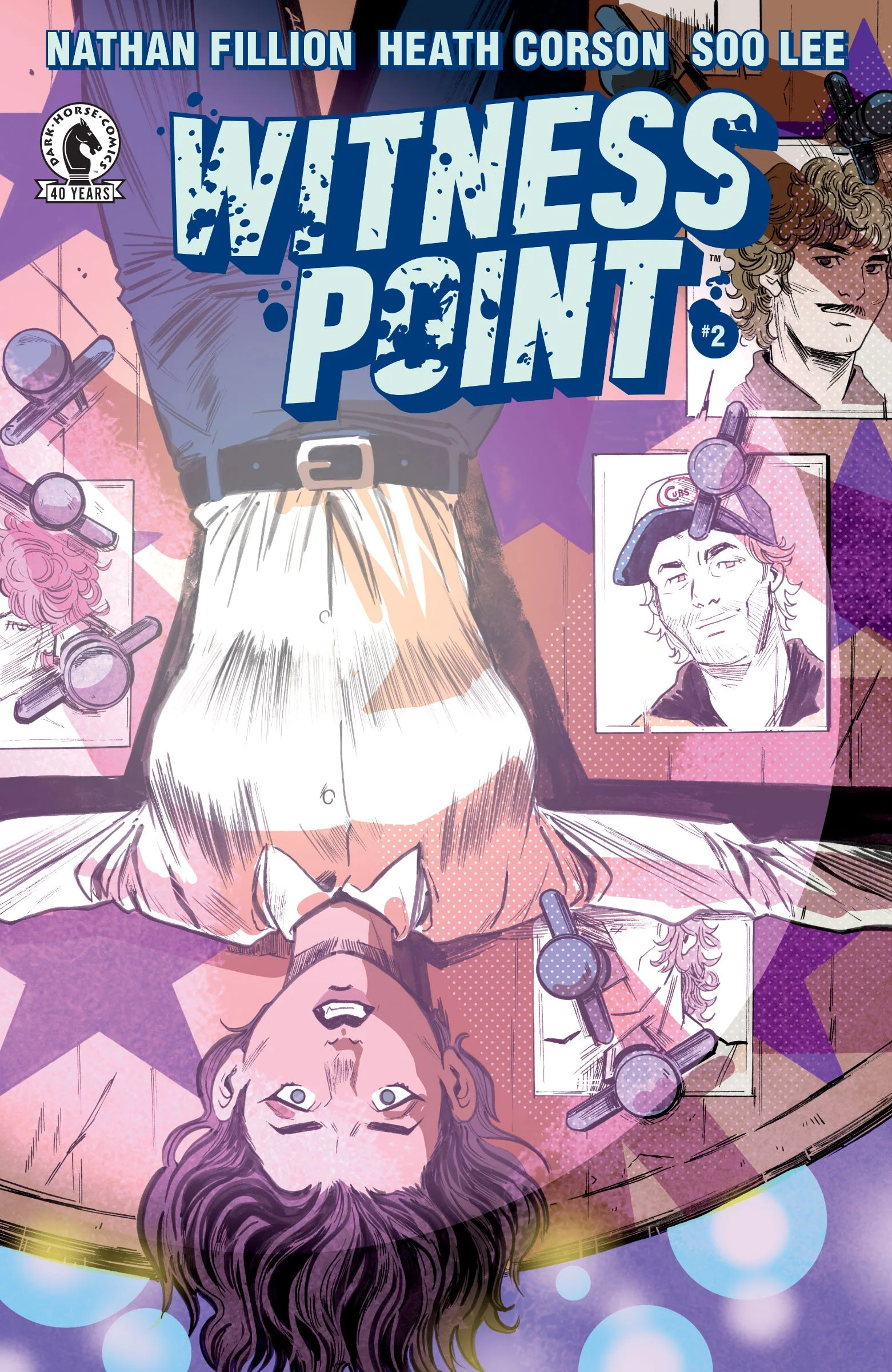
WITNESS POINT #2 (Dark Horse Comics)
Bring on the suspects! As Kite and Khabrani start to go over all the people in Baraboo that are in the witness protection program to find the possible murderer. We get some tales of some of their crimes and also a greater sense of what is going on with this strange Wisconsin town. However, can they find the culprit before the next crime takes place?
Witness Point #2 - Created By Nathan Fillion, Heath Corson, & Soo Lee – Script By Heath Corson – Art & Colors By Soo Lee – Letters By Joshua Reed – Edited By Chuck Howitt-Lease - Published By Dark Horse Comics
Credit: Dark Horse Comics
*** POSSIBLE SPOILER WARNING ***
STORY OVERVIEW:
Kite and Khabrani go over their suspect board and try to figure out who would have a connection to the victim and who possibly would be capable of the murder. We learn of the story of Jimmy the Weasel, who was in the WITSEC program for years and was kicked out because he swindled money from the program. Khabrani notes that this is why she can’t trust any of these criminals, because they never change. This puts them on the trail of Sal the Shotgun, now a resident of Baraboo named Solomon Gallo, a pizza shop owner after entering the program. As Khabrani and Kite go to question him, Khabrani treats him like a perp, which elicits a reaction from Sal. After Kite steps in, Sal agrees to come to the station to answer some questions. Unfortunately, this leads to nothing, so the team heads over to the Copper and Sons Funeral Home to see what the makeshift medical examiner can tell them after the autopsy. The “Medical Examiner” is the local mortician Jane Copper. However, Khabrani instantly recognizes her as Janey 88 the wife of Riley Ross head of the white supremacist group the Patriot Disciples. Once again, Khabrani can’t give the former criminal a pass, which leads to more interrogations. But just when they thought they hit a wall, an arson bags them an unlikely perp with some useful information.
WRITING:
This issue does a strong job continuing to open up the strange world of Baraboo while also deepening the murder mystery at the center of the series. Heath Corson uses the investigation as a way to introduce more of the town’s hidden population, and that approach works because every new person Kite and Khabrani encounter feels like they could be important later. Baraboo is not just a quirky small town with a few secrets; it is a place filled with people who have spent years burying their pasts, rebuilding their identities, and trying to convince everyone around them that they are no longer the dangerous people they once were. That gives the issue a lot of tension, because the reader is constantly being asked to decide whether these former criminals are being judged fairly or whether their old lives are impossible to escape.
The strongest part of Corson’s writing is the contrast between Kite and Khabrani. Khabrani looks at the people in WITSEC through the lens of their crimes, and her suspicion makes sense because she knows these people were not placed in Baraboo for harmless reasons. To her, the fact that many of them cooperated with authorities does not erase what they did; if anything, it reinforces her belief that they acted out of self-preservation rather than real remorse. The story of Jimmy the Weasel gives her argument weight because it shows that the program can be exploited and that some people may never truly change. That detail helps keep Khabrani from feeling one-note, because her harsh attitude is rooted in experience and logic rather than simple prejudice.
Kite, on the other hand, brings a more patient and local perspective to the investigation. He seems more willing to believe that the people living in Baraboo have earned the chance to be seen as who they are now, not only who they used to be. That difference between him and Khabrani gives the issue more than just procedural momentum; it creates a moral debate running underneath the mystery. Sal the Shotgun, now Solomon Gallo, is a good example of this. On paper, his past makes him an obvious suspect, but the life he has built as a pizza shop owner complicates that assumption. Janey 88 offers an even sharper version of the same idea, because her history is ugly and difficult to overlook, yet her current life suggests that transformation may be possible. Corson does not let the reader settle comfortably on either side, and that uncertainty is what makes the character work interesting.
Corson also handles the whodunit structure well by making each lead feel like it could matter, even when it does not immediately produce a clear answer. The suspect board, the interviews, the backstories, and the trip to the funeral home all add pieces to the larger picture of Baraboo. Instead of simply moving from clue to clue, the issue uses each stop in the investigation to reveal another layer of the town’s personality. That makes the mystery feel bigger than one murder. The crime is still the driving force, but the real hook is the realization that Baraboo itself may be the most dangerous element in the story. The town is packed with possible motives, old grudges, hidden loyalties, and people who have good reasons to lie.
The one drawback is that the issue can feel a little scattered in its movement from one suspect or revelation to the next. One moment the story is focused on Jimmy the Weasel and how he damaged the credibility of the program, then it shifts to Sal, then to Jane Copper, and then suddenly the arson becomes the next big development. That rapid movement keeps the energy high, but it can also make the investigation feel somewhat disjointed. Some readers may enjoy that off-balance feeling because it mirrors the confusion of the case, while others may wish the issue spent a little more time letting each lead breathe before jumping to the next one. Even so, the scattered structure is not a dealbreaker because the issue still moves with purpose and keeps building the sense that something larger is hiding beneath the surface.
By the end, Corson manages to turn that restless pacing into an advantage. The cliffhanger works because the issue has spent so much time making the reader question everyone, so the sudden new development feels surprising without feeling random. The mystery remains messy in a good way, and the character conflict between Kite and Khabrani gives the story a stronger emotional and thematic center than a simple suspect hunt would have. Overall, the writing succeeds because it expands the world, complicates the moral questions behind witness protection, and keeps the reader unsure of who can actually be trusted. Even when the issue feels busy, that busyness helps sell the chaos of a town where nearly everyone has a past worth hiding.
ARTWORK:
The artwork in this issue captures the mood and tone of the story very well, and Soo Lee’s work is a major reason Baraboo feels so believable as a setting. What stands out most is how grounded the town feels despite how strange the premise is. This is a murder mystery built around witness protection, former criminals, hidden identities, and the town’s circus history, so the visuals could have easily pushed Baraboo into something exaggerated or cartoonishly odd. Instead, Lee presents it as a recognizable small town first. The streets, shops, interiors, and public spaces all have an everyday quality to them, which makes the stranger details feel more unsettling when they appear. That normalcy is important because it lets the weirdness of the story sit underneath the surface rather than overpowering the mystery. Baraboo looks like a place where people could live quietly for years, and that makes the idea of everyone hiding a dangerous past much more effective.
Lee also does a fantastic job with the character designs, especially with the people living under new identities in the program. Sal and Janey are the clearest examples of this. When the issue shows who they were in their criminal lives, their designs carry more edge, menace, and danger. They look like people who came from violent or destructive pasts. Then, when the story cuts back to who they are now, Lee makes them feel completely different without making the change feel unbelievable. Sal as Solomon Gallo has the visual language of someone who has settled into a quieter routine, while Jane Copper has the controlled, professional appearance of someone who has built a new place for herself in the town. Those contrasts help sell one of the issue’s main ideas: people can change, or at least they can learn how to perform change convincingly. The art does not answer whether that transformation is genuine, but it makes the question visually interesting.
The flashback sequences are another place where the artwork adds a lot to the storytelling. Lee uses those moments to separate the past from the present in a clear and stylish way. The black, white, and gray choices give some of the flashbacks a harsher, more documentary-like feeling, as if the reader is looking at old evidence or pieces of a criminal file. In Sal’s case, the use of colors that fit a 1970’s aesthetic helps place his history in a specific era and gives his past a different texture from the modern scenes. These choices make the backstories feel like more than exposition. They become visual snapshots of who these people used to be, and that makes the contrast with their current lives even stronger.
The action beats in the issue also work well because Lee keeps them clear and energetic without letting them take over the book. This is still primarily a mystery, so the action needs to feel sudden and disruptive rather than constant. When the issue does shift into more physical moments, the paneling and movement give those scenes a burst of tension. The arson sequence, in particular, benefits from that approach because it breaks up the investigation and reminds the reader that the danger in Baraboo is not just theoretical. The visuals make the threat feel immediate, and the stronger colors in those moments help the scene stand out from the quieter investigative material around it.
The color work is especially effective because it helps guide the reader through the emotional rhythm of the issue. During calmer scenes, the colors are more controlled and subtle, which supports the small-town atmosphere and lets the conversations take focus. When the story becomes more intense, the palette gets louder and more eye-catching, giving those scenes an extra push. That shift keeps the book visually engaging while also matching the structure of the story. Lee knows when to let the artwork sit back and create atmosphere, and when to make it jump forward to emphasize danger or revelation. Overall, the art succeeds because it supports the mystery, strengthens the theme of hidden identities, and makes Baraboo feel like a town that is normal on the surface but deeply strange underneath.
Check Out MY REVIEW OF WITNESS POINT #1
Final Thoughts:
Witness Point #2 is a strong follow-up that expands Baraboo’s strange world while keeping the murder mystery moving. The issue works best when it lets Kite and Khabrani’s opposing views of the town’s protected witnesses create tension beyond the case itself. While the story can feel a little busy as it jumps between suspects, the sharp character dynamics, eerie small-town atmosphere, and strong visual storytelling keep it engaging. This remains a mystery series worth following, especially if you enjoy crime stories built around secrets, mistrust, and a town where almost everyone has something to hide.
FINAL GRADE: 8.6/10
Let me know your thoughts on Witness Point #2 in the comments below. Thanks for reading!