SHREDDER #11 (IDW Publishing)
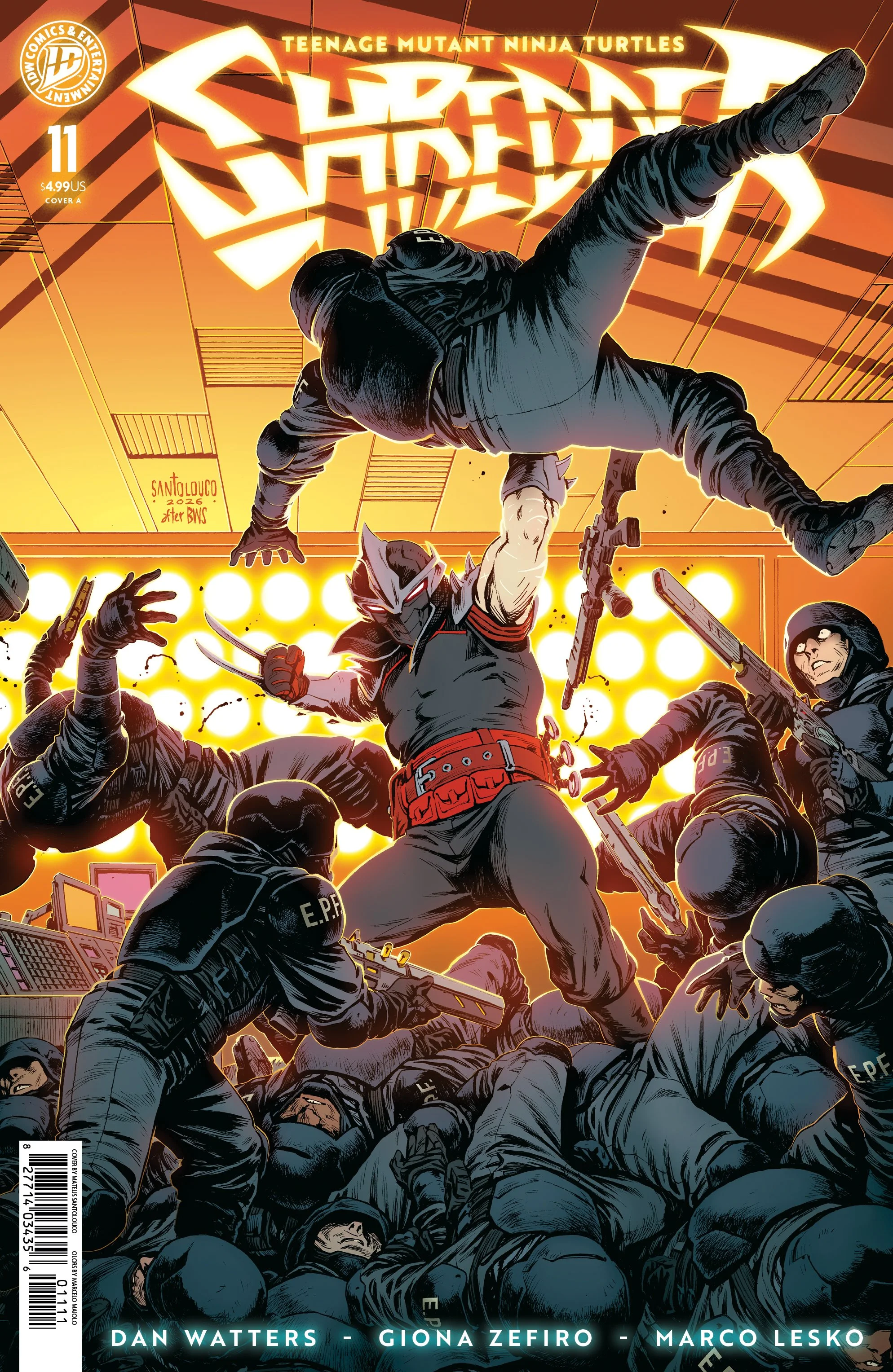
The Shredder has returned to the Big Apple and the E.P.F was waiting for him. But they weren’t there to throw him a homecoming party, instead they want to find out how they can exploit this over 300-year-old man. Unfortunately for them he is still the Shredder after all, so if you don’t get him, he’s definitely going to get you.
Shredder #11 - Written By Dan Watters – Art By Giona Zefiro - Colors By Marco Lesko - Letters By Darran Robinson - Edited By Jake Thomas -Published By IDW Publishing
Credit: IDW Publishing
*** POSSIBLE SPOILER WARNING ***
STORY OVERVIEW:
Director Braunze is retelling what happened when the Shredder returned to New York to the General and the board of the E.P.F. He recounts the Shredder’s arrival in the city as he came back to check on his granddaughter, Karai. They grabbed him up and took him to E.P.F’s Central Control, the most secure fortress they have to ensure the Shredder can’t escape. Once there they plan on cutting him open while he’s still alive to figure out the Shredder’s secrets. Unfortunately for them Shredder always has a trick up his sleeve. Agent Avon, who is his secret agent, is meeting up with the Dog Star Clan to plan his escape. But can the put the plan in action in time to save Shredder or will he finally meet his maker?
WRITING:
This issue smartly builds on the events of the main TMNT title, where the Shredder’s return to New York immediately raised the stakes for everyone around him. The way this series lines up with the larger continuity makes the world feel connected without ever making this issue feel like it is simply filling in gaps. Instead, Dan Watters uses that shared timeline to his advantage, placing Oroku Saki in a situation that feels both dangerous and inevitable. The E.P.F. believes it has finally gotten the upper hand by capturing him and locking him away inside one of its most secure facilities, and for much of the issue Watters allows that tension to sit. The reader understands just how much danger Shredder is in, but there is also that constant awareness that this is still Oroku Saki, a man who always seems to be thinking several moves ahead.
Watters does a strong job showing how the E.P.F. continues to operate in that uncomfortable gray area. Their methods are brutal, clinical, and deeply unsettling, especially once it becomes clear that they are less interested in justice and more interested in exploiting whatever secrets Shredder’s unnaturally long life may hold. That choice makes them feel less like protectors and more like another dangerous force trying to control something they do not fully understand. It also gives the issue an interesting moral tension because the story asks readers to follow a character who has traditionally been a villain while surrounding him with people who may be even more ruthless in this specific moment. By the time the twist is revealed, the issue reinforces exactly why Shredder remains so compelling: he is not just powerful, he is patient, calculating, and terrifyingly prepared, even when everyone around him thinks they have already won.
ARTWORK:
The artwork in this issue is simply phenomenal, continuing the high visual standard that this series has delivered from the beginning. Giona Zefiro captures the essence of the Shredder in every panel, making Oroku Saki feel larger than life even when he is chained, imprisoned, or surrounded by enemies who believe they have control over him. There is a weight to the way Shredder is drawn that immediately commands attention. His posture, expressions, and physical presence all communicate that this is not just another prisoner inside an E.P.F. facility. He still feels like the most dangerous person in the room, and that visual confidence helps sell the tension of the story.
The E.P.F. Central Control setting also stands out because it feels like a perfect blend of prison, laboratory, and military tech facility. The backgrounds have an industrial, fortified look that makes the location feel cold, secure, and almost impossible to escape. That works especially well for this issue because the environment needs to feel intimidating enough for readers to believe that even Shredder might be in real danger. The rooms where he is held feel intentionally bland and lifeless, which gives them a sterile and unsettling quality. Once the story moves toward what the E.P.F. plans to do to him, that visual coldness becomes even more effective. The operating room equipment, knives, and instruments all have a harsh, mechanical look, making them feel less like medical tools and more like weapons designed to take someone apart piece by piece.
The action scenes are also handled extremely well. Zefiro keeps the storytelling clear, so every strike, escape beat, and violent moment has impact without becoming visually confusing. The brutality comes through on the page, but it never feels sloppy or hard to follow. Marco Lesko’s colors are a major part of why the artwork lands so strongly. His palette gives the E.P.F. scenes a cold, dangerous atmosphere while still allowing key details to pop when they need to. The colors complement Zefiro’s line work rather than overpowering it, helping small facial expressions, weapons, lighting choices, and background details stand out as the reader moves through the issue. Together, the art and colors make this chapter feel tense, cinematic, and appropriately brutal for a Shredder-focused story.
Check Out My Review of Shredder #10
Final Thoughts:
Shredder #11 is another strong issue in one of the best spinoff series in comics. Dan Watters keeps Oroku Saki dangerous, unpredictable, and compelling, while Giona Zefiro and Marco Lesko give the issue a tense, brutal visual edge. This issue delivers exactly what a Shredder-focused story should: high stakes, sharp tension, and a reminder that no one should ever think they have truly beaten him. This is a series that everyone should be reading and should be added to your Pull List if it isn’t on it already.
FINAL GRADE: 9.2/10
Let me know your thoughts on Shredder #11 in the comments below. Thanks for reading!