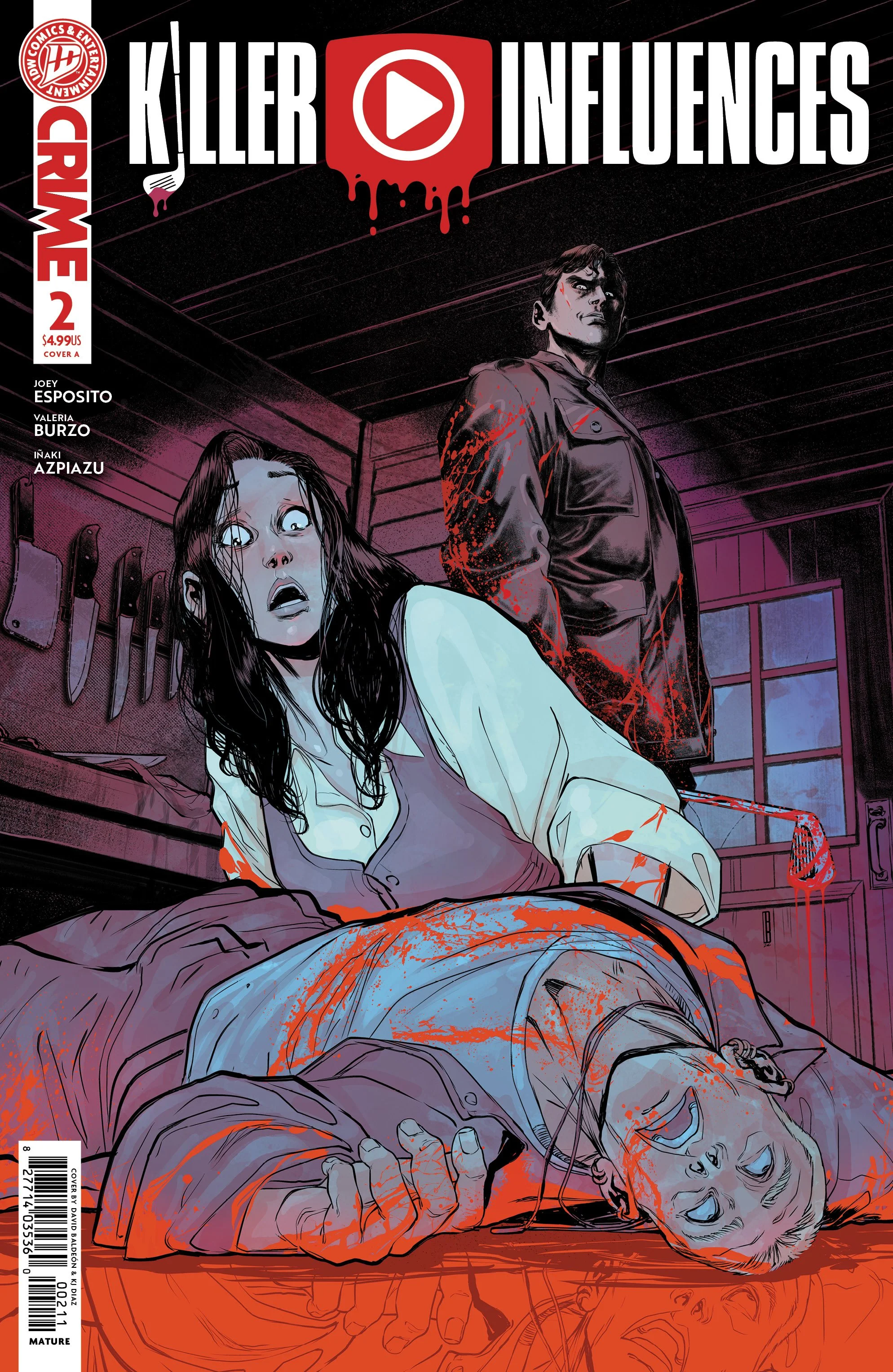
KILLER INFLUENCES #2 (IDW CRIME)
It’s been 14 months since the Caddyshack Killer made his debut and still Melvin is no closer to his goal of being one of the most infamous serial killers of all time. However, Kylie has become the biggest true crime content creator. As fame has rushed to Kylie’s head, she’s forgotten about what got her there, and what the actual arrangement was. But one things for sure, Melvin hasn’t forgotten about it.
Killer Influences #2 - Written By Joey Esposito – Art By Valeria Burzo – Colors By Iñaki Azpiazu – Letters By Alex Ray – Edited By Dave Wielgosz - Published By IDW Publishing
Credit: IDW Crime
STORY OVERVIEW:
14 months ago, Kylie made a deal with Melvin the serial killer to create a brand for him that would make him one of the legends. After 14 months, the Caddyshack Killer as he would become to be known as, is only slightly more known than he was before. However, Kylie has become the biggest true crime content creator, and her show Backwood Detective has become the number serial killer podcast. As Kylie gets invited to SXSW, other shows, and red carpets, Melvin is stuck in his same mundane life. Not only has Kylie seemingly forgotten about her deal with Melvin, but she also started to abandon her family more. Despite the influx of cash that got her a fancy apartment and a nice car. She claims she doesn’t have enough money to help out her brother Evan who has gone back to stealing stuff from their grandmother. Now her grandmother is upset with her, Evan has gone MIA, and worst of all a deranged serial killer is feeling that he was taken advantage of. Sounds about time for her world to start coming down.
WRITING:
This second issue works as an outstanding follow-up to the debut because it does not simply continue the story from the same emotional place. Instead, Joey Esposito uses the 14-month time jump to show how much the balance of power between Kylie and Melvin has shifted. When the first issue ended, their arrangement felt dangerous but mutually beneficial. Kylie needed a story that could make her career, while Melvin wanted the kind of notoriety that would turn him into a name people feared and remembered. By the time this issue begins, that agreement has clearly paid off for Kylie far more than it has for him. Esposito does a great job of making that imbalance the central source of tension, because the reader can immediately feel that Melvin’s resentment has been building for a long time.
One of the most interesting parts of the writing is how Esposito presents Kylie’s success as something that has not made her better, safer, or more self-aware. If anything, it has stripped away many of the qualities that made her sympathetic in the first issue. The Kylie introduced at the beginning of the series was ambitious and flawed, but she still felt tied to her family and to the circumstances that shaped her. Here, fame has clearly taken over. Her podcast, Backwood Detective, has become a massive success, she is getting invited to major events, and she has built a public image off the back of Melvin’s crimes. Yet the people closest to her are being pushed aside. Her already difficult relationship with her grandmother has deteriorated even further, but the more revealing part is what has happened with Evan. Kylie once seemed willing to defend him even when he made terrible choices, so seeing her distance herself from him now says a lot about how much she has changed.
That change in Kylie is where the issue finds a lot of its bite. Esposito is not just writing about fame in a general way; he is showing how quickly a person can justify selfishness once success starts coming in. Kylie has money, attention, and influence now, but she still acts as if she is the one doing all the hard work while everyone else is holding her back. That becomes especially clear when she confronts Melvin and tries to make it seem like his lack of notoriety is his own fault. The scene is effective because Kylie’s argument is both ridiculous and revealing. She is talking to a murderer who helped make her famous, yet she somehow positions herself as the victim of the arrangement. That level of delusion makes her frustrating in the right way, because it shows how completely she has bought into the version of herself that her fame created.
Melvin’s side of the story is just as important because Esposito makes his jealousy feel inevitable. He agreed to let Kylie shape his image because he believed it would turn him into something bigger than himself. Instead, she received the spotlight while he remained stuck in the same ordinary life, only slightly more recognizable because of the Caddyshack Killer name. That contrast makes him even more dangerous. He is not just angry that Kylie benefited from him; he is angry that she failed to turn him into the legend she promised. The writing makes it clear that Melvin’s ego is fragile, and every reminder of Kylie’s rising fame pushes him closer to doing something drastic. His resentment gives the issue a constant sense of unease, because even quieter scenes feel like they are moving toward an explosion.
The issue also does a strong job of layering Kylie’s unraveling piece by piece. Evan going missing immediately brings a personal cost into the story, and the possibility that Melvin may be connected to it makes the threat feel much closer to home. Then Esposito adds another level of pressure by having Kylie’s own audience start turning on her during a livestream. That moment is important because Kylie’s fame has been her shield, her excuse, and her source of power. Once the audience begins questioning her, the image she has carefully built starts to crack in public. It is a smart escalation because it attacks her from multiple sides at once: her family life is collapsing, Melvin is becoming harder to control, and the career she sacrificed so much for is suddenly less stable than she thought.
By the final pages, Esposito has created the feeling that the entire arrangement between Kylie and Melvin was never sustainable. The story is no longer just about a content creator exploiting a killer for fame, or a killer using a media personality to build his brand. It has become a messy collision of ego, ambition, resentment, and consequence. That makes the ending land with real impact, because it feels like the story is shifting into an even darker and more unpredictable phase. Overall, the writing in this issue succeeds because it deepens the central conflict, complicates Kylie’s character, and makes Melvin’s growing anger feel like a ticking clock that is ready to go off at any moment.
ARTWORK:
The artwork in this issue does a fantastic job of visually separating Kylie and Melvin’s worlds, which makes the story’s central conflict even stronger. Valeria Burzo captures the small-town Pacific Northwest setting with a grounded, slightly worn-down feeling that fits the crime tone of the series, but she also contrasts that with the cleaner, brighter, and more polished look of Kylie’s new life. That contrast is one of the strongest visual elements in the issue because it immediately shows how much has changed during the 14-month time jump. Kylie now has the apartment, the car, the wardrobe, and the public-facing image of someone who has successfully escaped the life she came from. She looks more put together, more confident, and more curated than she did in the first issue, which tells the reader a lot before the dialogue even has to say it.
Melvin, on the other hand, feels trapped in place visually. Burzo keeps him connected to the same rundown environment, the same dingy clothing, and the same sense of physical decay that makes his resentment feel even more unsettling. The addition of the sores on his body is especially effective because it gives his frustration a visible, almost grotesque edge. He does not just feel emotionally bitter; he looks like someone rotting in the life he believes Kylie promised to help him escape from. That design choice adds a lot to the story because Melvin’s appearance becomes a constant reminder that, while Kylie has been elevated by their arrangement, he has been left behind. The difference between them is not subtle, and that is exactly why it works so well.
Burzo also makes smart use of composition to emphasize that divide. When Kylie and Melvin’s scenes are placed near each other, the difference between them becomes impossible to ignore. Kylie’s panels often feel more open, stylish, and connected to the world of media attention, while Melvin’s scenes feel tighter, uglier, and more suffocating. That visual rhythm helps the reader understand the power shift without needing the story to over-explain it. Kylie may be the one trying to act like she is still in control, but the way the pages move between her polished public life and Melvin’s deteriorating private world creates a growing sense that these two paths are heading toward a violent collision.
The colors by Iñaki Azpiazu strengthen that storytelling even more. Kylie’s scenes have a brighter, more vibrant quality that reflects the attention, money, and success surrounding her. Those colors make her world feel more glamorous, but they also give it a slightly artificial quality, as if her life has become a performance she is constantly trying to maintain. Melvin’s scenes are more muted, darker, and heavier, which makes his world feel stagnant and oppressive. The color contrast does not just make the pages look good; it reinforces the emotional distance between the characters. Kylie’s life feels like it has been lit for an audience, while Melvin’s life feels hidden away in the shadows.
What makes the art so effective overall is that it does more than simply illustrate the script. It actively helps tell the story of how much Kylie has changed and how deeply Melvin feels cheated by that change. If the writing shows Kylie becoming more self-absorbed and disconnected from the people around her, the art makes that transformation visible in her posture, clothing, surroundings, and the way her scenes are framed. At the same time, Melvin’s design and environment make his anger feel more dangerous because every visual detail suggests a man who has been stewing in failure and humiliation. Burzo and Azpiazu work together to make the contrast between Kylie and Melvin one of the issue’s strongest storytelling tools, and the result is artwork that makes the emotional stakes of the issue feel much sharper.
CHECK OUT MY REVIEW OF KILLER INFLUENCES #1
Final Thoughts:
Killer Influences #2 is a sharp and compelling second issue that builds on the series’ strong debut by pushing Kylie and Melvin’s twisted arrangement into more dangerous territory. The time jump gives the story a stronger sense of consequence, showing how fame has changed Kylie while Melvin’s resentment continues to grow. With tense writing, expressive artwork, and a final stretch that makes it clear things are starting to fall apart, this issue keeps the momentum going and makes the next issue feel impossible to miss.
FINAL GRADE: 9.6/10
Let me know your thoughts on Killer Influences #2 in the comments below. Thanks for reading!