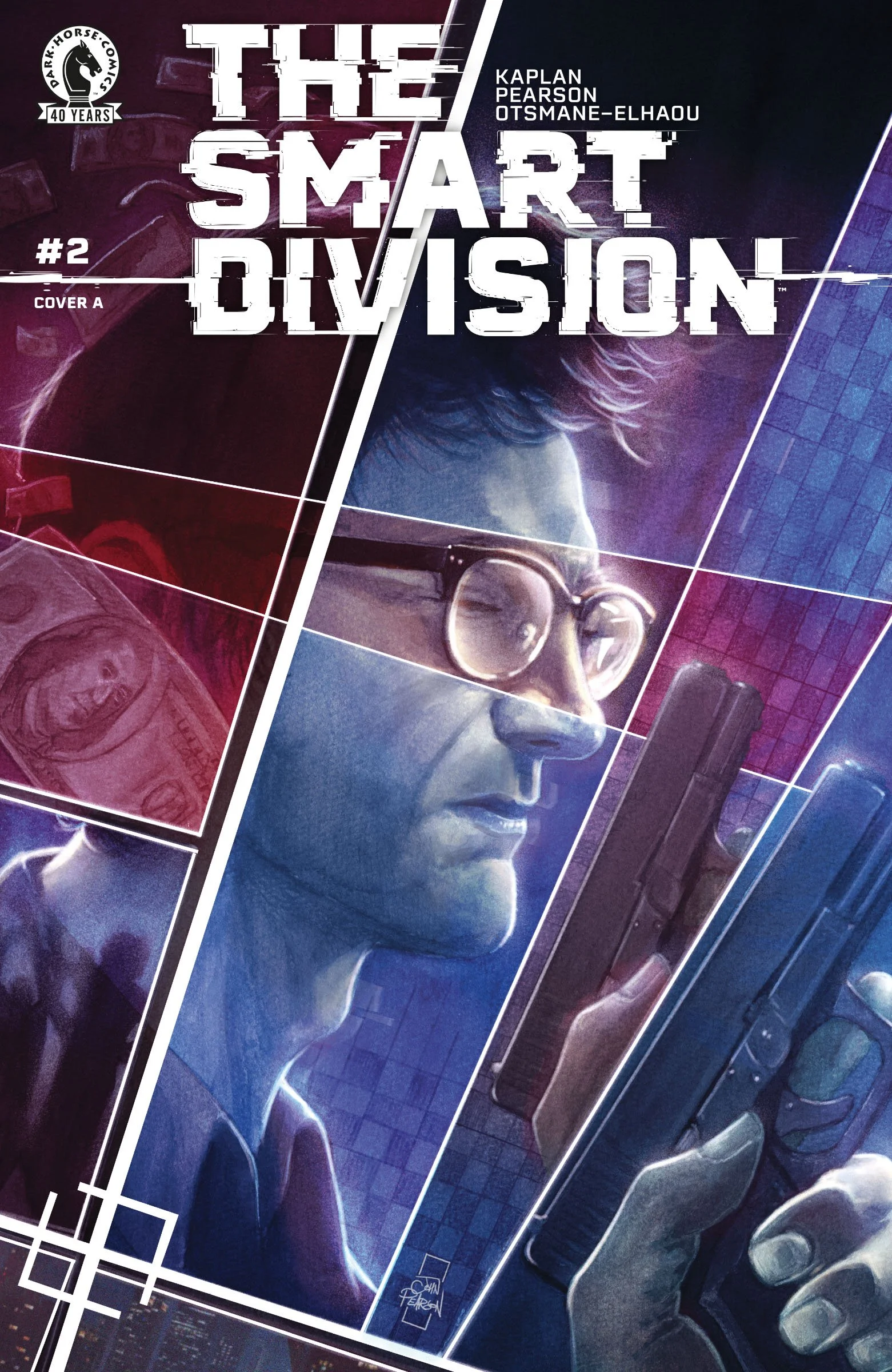
THE SMART DIVISION #2 (Dark horse comics)
Agents Bailey and Larque are trying to get to the bottom of who killed an AI tech whistleblower. But the more they find out, the more roadblocks get put in their way. Unfortunately, they are way over their heads and don’t even realize it yet.
The Smart Divison #2 - Written By Zack Kaplan – Art By John J. Pearson – Letters By Buddy Beaudoin – Series Lettering Designer Hassan Otsmane-Elhaou - Edited By Spencer Cushing - Published By Dark Horse Comics
Credit: Dark Horse Comics
*** POSSIBLE SPOILER WARNING ***
STORY OVERVIEW:
Agents Bailey and Larque visit Fusion well investigating the murders of Mae Santos and Josef Usman. Mae was a whistleblower for the lies Fusion was telling about their crime solving AI program. Well at the headquarters Bailey and Larque get to chat with one of the AI computers named Sherlock, but the computer was unable to help with who the killer was. Also, well they were at Fusion they hit a brick wall while interviewing the CEO Calvin Lee, as even members of their own FBI department are standing in their way of questioning Lee. This leads to some push back from Larque on Bailey as she thinks he is just rolling over and not fighting to find out what the truth is. However, before they can fully hash it out, another murder occurs and this one really throws a wrench into their suspect pool.
WRITING:
This issue adds even more layers to an already complex and exciting story, deepening both the murder investigation and the larger questions surrounding artificial intelligence, corporate power, and institutional control. Zack Kaplan continues to take a frighteningly plausible AI-driven world and make it feel increasingly real, immediate, and dangerous. On the surface, the series presents itself as a science-fiction crime story, complete with federal agents, powerful technology, suspicious executives, and a growing list of victims. Beneath that genre framework, however, the story is rooted in anxieties that already exist in the modern world: the rapid expansion of AI, the lack of transparency surrounding how these systems operate, the influence of major technology companies, and the uncertainty over who should be held accountable when powerful tools are misused. That connection to current concerns makes the story genuinely unsettling because the threat never feels safely contained within a distant future. Kaplan effectively exploits the uncertainty and fear surrounding AI without allowing the technology itself to become the story’s only source of tension.
The investigation is equally shaped by secrecy, bureaucracy, and the possibility that people inside powerful institutions are protecting Fusion from scrutiny. Every obstacle placed in Bailey and Larque’s path raises the stakes and suggests that the murders may be connected to something much larger than a single killer. The partnership between the two agents adds another compelling layer. Larque is more impulsive and confrontational, yet she is also comfortable relying on technology and AI as an investigative tool. Bailey is more traditional and skeptical of those systems, but his experience has taught him that he sometimes has to cooperate with the very institutions blocking him if he hopes to uncover the truth. Their opposing methods create believable friction while also showing why they may ultimately work better together: Larque pushes when Bailey hesitates, while Bailey recognizes dangers and political realities that Larque may underestimate. Both are loners in different ways, and their inability to fully trust one another makes their developing partnership as interesting as the case itself.
One of the strongest storytelling choices remains Bailey’s narration from an interrogation room. That framing immediately tells readers that something has gone seriously wrong and that the events unfolding before them have already led to consequences. Because the audience does not yet know why Bailey is being questioned, every decision, confrontation, and apparent breakthrough carries an additional sense of dread. Kaplan uses that structure to turn even quieter investigative scenes into pieces of a larger mystery, encouraging readers to question not only who committed the murders, but also what happened to the agents and who may now be controlling the official account. The tension created by this unanswered future is palpable, giving the issue a constant undercurrent of danger that should keep even the most jaded reader on the edge of their seat.
ARTWORK:
The artwork in this issue is phenomenal, continuing to command the reader’s attention through its atmosphere, scale, and careful use of visual detail. John J. Pearson brings this unsettling world to life with pages that feel polished and futuristic while still carrying a grim quality. His environments make the world appear enormous, technologically advanced, and filled with possibilities, yet the framing often creates a sense of confinement. Offices, interrogation rooms, and corporate spaces feel controlled and claustrophobic, reinforcing the idea that Bailey and Larque are moving through a system designed to monitor them, restrict them, and keep important information out of reach. That contrast between expansive technology and limited personal freedom gives the issue a persistent air of unpredictability.
Pearson’s character work is equally impressive. Facial expressions and body language communicate frustration, suspicion, hesitation, and distrust even when the dialogue remains restrained. The smallest glances and physical reactions often reveal more than an entire exchange of words, making each conversation feel layered with motives that have not yet been fully explained. Bailey and Larque are also distinguished through the way they occupy a scene: Larque’s sharper, more confrontational presence contrasts with Bailey’s guarded and deliberate manner, visually reinforcing the tension in their partnership. These subtle choices reward readers who slow down and study each panel rather than simply moving from one plot point to the next.
The background details strengthen the storytelling as well. Screens, architecture, technology, and small environmental clues make Fusion and the surrounding world feel functional rather than decorative, while also encouraging keen-eyed readers to search for information that may become important later. The coloring gives the artwork additional depth by balancing the sleek appearance of advanced technology with a darker, dingier palette that keeps the story grounded in danger. Shadows and subdued tones maintain the noir atmosphere, while brighter digital elements draw attention to the growing influence of AI within nearly every space. The lettering generally complements that visual tone and helps distinguish the technological elements from ordinary conversation. Although a few sequences can become momentarily confusing, the overall presentation remains clear, immersive, and well matched to the story’s tense, paranoid mood.
Check Out MY REVIEW OF THE SMART DIVISION #1
Final Thoughts:
The Smart Division #2 builds confidently on the series’ opening mystery with sharper tension, compelling character conflict, and an unsettling exploration of AI and corporate power. Zack Kaplan keeps the investigation unpredictable, while John J. Pearson delivers immersive artwork that strengthens the book’s noir atmosphere. This is a smart, suspenseful second issue that leaves the case more dangerous and more intriguing than ever. If this series isn’t already on your Pull List, reconsider that decision NOW.
FINAL GRADE: 9.8/10
Let me know your thoughts on The Smart Division #2 in the comments below. Thanks for reading!