THE SMART DIVISION (Dark horse comics)
Zack Kaplan is at it again, and this time it’s in the world of AI crime! The Smart Division is a brand-new series from Dark Horse Comics that takes readers on a wild mystery ride as FBI Agents must solve the perfect crime. But what is anyone to do when the criminal has every advantage and isn’t even an organic human being?
The Smart Divison #1 - Written By Zack Kaplan – Art By John J. Pearson – Letters By Hassan Otsmane-Elhaou - Edited By Spencer Cushing - Published By Dark Horse Comics
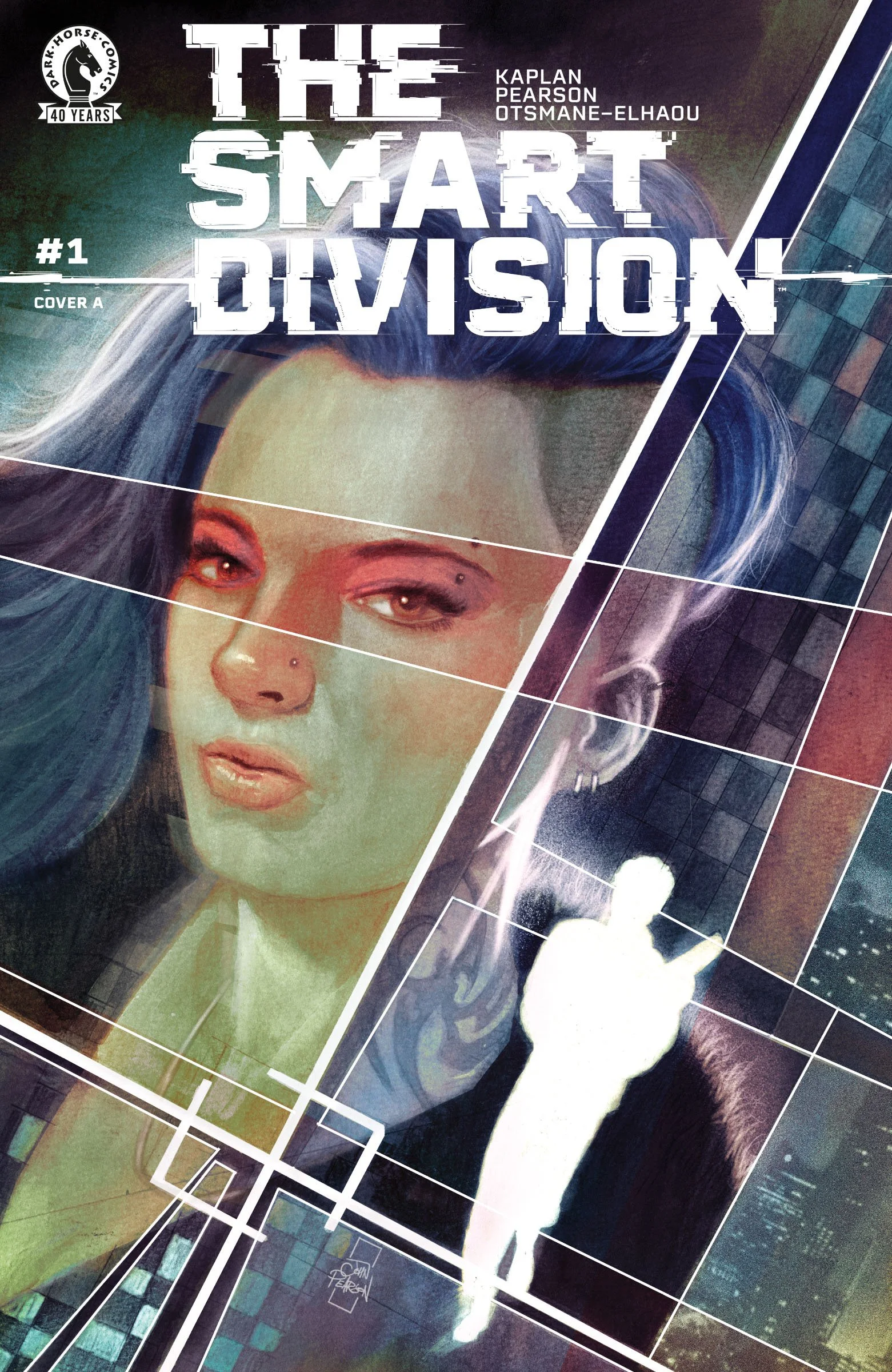
Credit: Dark Horse Comics
*** POSSIBLE SPOILER WARNING ***
STORY OVERVIEW:
Will Bailey is an FBI Agent that is a little down on his luck as a human being. And before this could get better, he finds himself saddled with a new loose cannon for a partner in Agent Stevie Larque. Before they can even really get to know one another, they are put on the case of a recently murdered FBI contracted cyber security specialist Mae Santos. Santos had recently ruffled some feathers as she filed a lawsuit against her former employer, a tech company named Fusion. The legal fight had gotten ugly, but was it ugly enough for someone at Fusion to commit murder? The plot thickens more as the agents meet up with the CEO of Fusion Calvin Lee and find out the project she was working on and suing over was a perfect crime making app.
WRITING:
This first issue thrusts readers into the deep end and never really gives them a chance to come up for air. From the opening pages, Zack Kaplan builds the story with a strong sense of momentum, dropping readers into a future-adjacent crime world that feels close enough to our own reality to be uncomfortable. The technology in the story does not feel far-fetched or overly futuristic. Instead, it feels like a natural extension of the way people already rely on apps, algorithms, and digital shortcuts to move through daily life. That makes the central mystery feel more unsettling, because the danger is not coming from some distant science fiction concept. It is coming from a world that mirrors our own obsession with convenience, automation, and the next big tech breakthrough.
Kaplan also does a strong job establishing the contrast between FBI Agents Will Bailey and Stevie Larque without making their differences feel forced. Bailey comes across as weary, frustrated, and more comfortable trusting his instincts than trusting the systems around him. He feels like someone who has seen enough to know that technology may help an investigation, but it cannot replace human judgment. Stevie, on the other hand, understands the modern world much more naturally. She knows how to move through the digital side of the case, yet she is not written as someone who blindly worships technology either. Her risk-taking and loose-cannon energy suggest that she is just as driven by gut instinct as Bailey, only with a different set of tools at her disposal. That balance makes their partnership immediately engaging because they are not simply opposites. They are two versions of the same investigative mindset shaped by different generations and different relationships with technology.
The murder of Mae Santos gives the issue a strong hook because it connects personal danger, corporate power, and artificial intelligence into one mystery. Santos is not just another victim used to start the plot. Her lawsuit against Fusion and her connection to a so-called perfect-crime app make her death feel loaded with implications. The reader is left questioning whether this is a standard corporate cover-up, a crime committed with the help of advanced technology, or something even stranger. Kaplan uses that uncertainty well, allowing each new piece of information to widen the scope of the case rather than simply answer questions. The idea that technology designed to outthink human investigators could be involved raises the stakes in a smart way. It turns the mystery into more than a search for a killer; it becomes a test of whether traditional detective work can survive in a world where the rules of crime are being rewritten.
What really gives the issue an extra layer is the framing device with Bailey narrating while being interrogated. That choice immediately tells readers that something has gone very wrong, even if the full picture is not clear yet. It creates a sense of tension hanging over every scene because the present-day interrogation suggests that the investigation will spiral into something much larger and more dangerous than a simple murder case. The back-and-forth structure gives the story a crime drama rhythm similar to True Detective: Season One, where the act of recounting the case becomes just as important as the case itself. This approach makes the issue feel layered, with every scene carrying the weight of hindsight and possible consequences. By the end, Kaplan has not only introduced a compelling mystery, but he has also created a larger question about trust, technology, and whether human instinct still matters when the perfect crime may no longer be a fantasy.
ARTWORK:
The artwork in this first issue does a great job bringing this world to life and capturing the uneasy tone of the story. John Pearson creates an environment that feels immediately recognizable, almost like a slightly heightened version of the world outside our own windows. That familiarity is important because it keeps the issue from feeling like a distant science fiction story. Instead, the visual design makes the danger feel close, modern, and believable. The streets, buildings, offices, and investigative spaces all feel grounded in reality, which makes the more technological elements stand out in a sharper and more unsettling way. The world looks lived in, but it also feels watched, processed, and filtered through systems that are bigger than the people moving through them.
The Washington D.C. setting adds another layer of tension to the artwork. On the surface, D.C. carries a sense of prestige, history, and institutional power, but it is also a place readers naturally associate with secrets, corruption, backroom deals, and cover-ups. Pearson leans into that atmosphere by making the city feel polished and official while still leaving room for shadows and unease. That combination works perfectly for a story about an FBI investigation tangled up with corporate technology and possible conspiracy. The setting is not just a backdrop; it becomes part of the mood. Every government building, corporate space, and city street seems to reinforce the idea that power is everywhere, but the truth may be buried under layers of access, influence, and control.
Pearson’s photo-realistic style also gives the issue a distinct edge. The characters and environments have enough realism to make the reader believe in the world, but the layouts and design choices still carry a stylized energy that reminds you this is a comic book operating in a heightened genre space. That balance is one of the strongest visual aspects of the issue. The realism gives the crime scenes and investigative moments weight, while the more graphic and pop-culture-influenced flourishes help communicate the story’s technological futurism. The result is a visual language that feels part police procedural, part techno-thriller, and part near-future nightmare. It is grounded enough to be convincing, but sharp enough to keep the reader slightly unsettled.
The character designs are another strong point because they immediately tell the reader a lot about who these people are before the dialogue even fully defines them. Will Bailey looks worn down in a way that fits his role as an experienced agent carrying frustration and baggage. Stevie Larque has a more unpredictable energy, and Pearson captures that through her expressions, posture, and overall presence on the page. Calvin Lee and the figures connected to Fusion also have a polished, controlled look that fits the corporate side of the mystery. These designs help separate the different corners of the story visually: law enforcement, tech power, victims, and suspects all feel like they belong to the same world, but they carry different visual identities. That makes the cast easy to follow while also reinforcing the larger conflict between human instinct and technological control.
The coloring and visual pacing add even more to the reading experience. Much of the issue uses a restrained and subtle color palette, which helps lull the reader into the procedural rhythm of the story. Then, when moments become more intense or information starts to shift the direction of the case, the colors feel brighter and more urgent. That contrast helps guide the reader’s eye and tells them when the emotional temperature of the page has changed. It is not flashy just for the sake of being flashy. The color choices support the mystery, the pacing, and the tension. By the end of the issue, the artwork has not only supported Kaplan’s story, but it has also helped define the identity of The Smart Division as a slick, eerie, and visually compelling crime-tech thriller.
Check Out MY REVIEW OF ONLY THE SAVAGE ARE LEFT #2
Final Thoughts:
The Smart Division #1 is a strong and confident debut that wastes no time establishing its identity as a gripping AI crime thriller. Zack Kaplan sets up a mystery that feels timely, unsettling, and full of potential, while John Pearson’s artwork gives the issue a slick visual style that perfectly matches the tension of the story. The combination of a murdered cyber security specialist, a powerful tech company, and a possible perfect-crime app gives the book a hook that feels both entertaining and uncomfortably relevant. This first issue answers just enough to pull readers in while leaving plenty of questions about Fusion, Mae Santos, and the larger role artificial intelligence may play in the crimes ahead. If you enjoy crime procedurals, techno-thrillers, or stories that explore the darker side of modern innovation, The Smart Division should absolutely be on your Pull List going forward.
FINAL GRADE: 10/10
Let me know your thoughts on The Smart Division #1 in the comments below. Thanks for reading!