OPERATION: IRON COFFIN #3 (IDW DARK)
Dracula closes in on his children and trying to stop them from releasing the Bloodletter Virus on to the world. But is he strong enough to take them out as well as their monster, The Bell? Well if he wants his eternal rest, he better figure out a way.
Operation: Iron Coffin #3 - Written By Kenny Porter – Art & Colors By Tyrell Cannon – Letters By Shawn Lee – Edited By Dave Wielgosz - Published By IDW Publishing
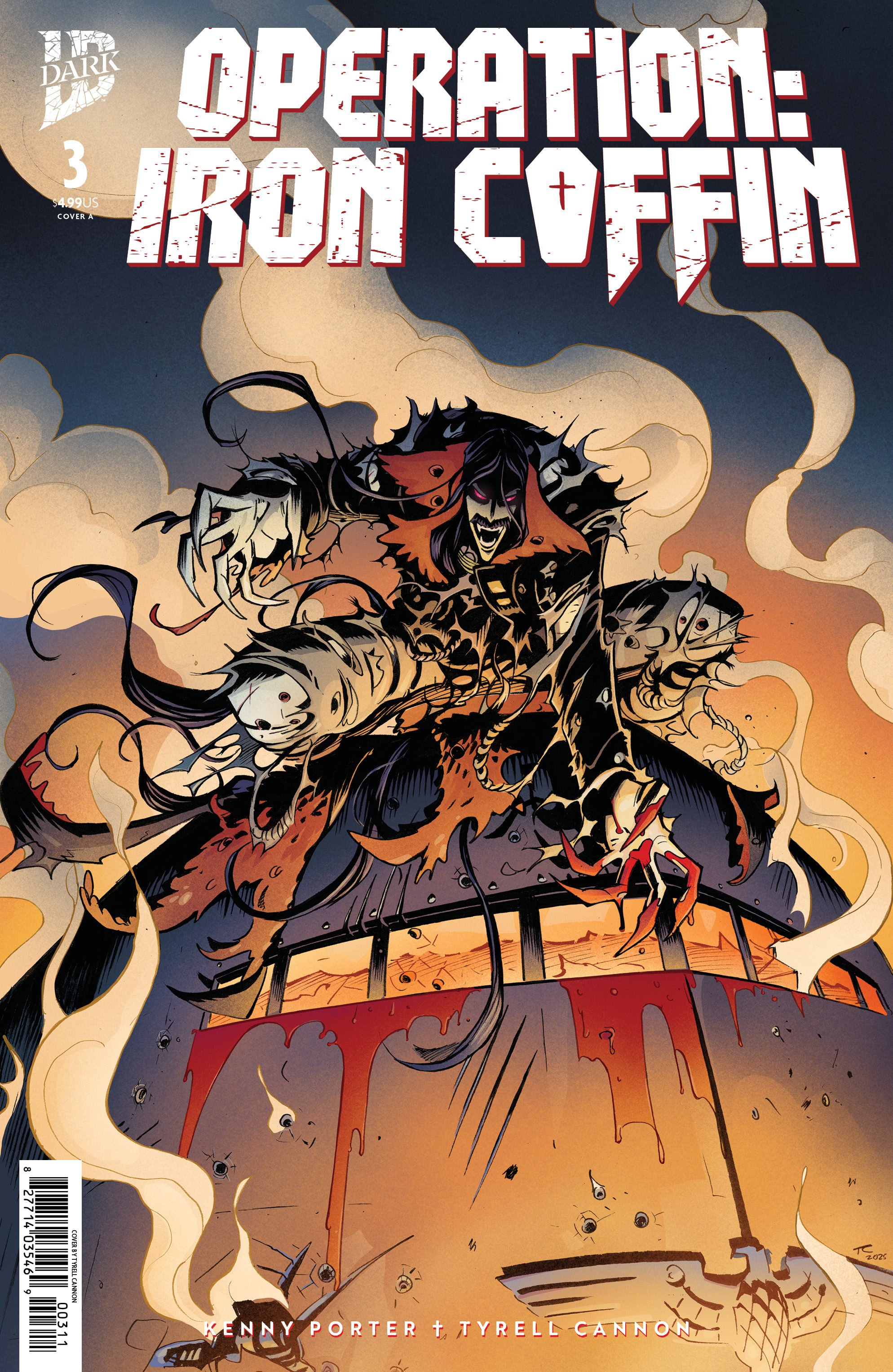
Credit: IDW Dark
*** POSSIBLE SPOILER WARNING ***
STORY OVERVIEW:
Dracula continues his battle with the Bell, the Nazi monster in an iron suit. As the battle intensifies it looks like maybe the Bell is too much for Dracula. But nothing will stop the Count from getting his hands on his children who have orchestrated all of this. Speaking of Hazel and Ivy, they have just been delivered the finalized form of the Bloodletter Virus and are more than ready to use it on the unsuspecting world. Will Dracula be able to stop them in time and earn his eternal rest? Or will Hazel and Ivy finally surpass their dad as the king and queen of the undead?
WRITING:
This is one heck of a strong final issue, delivering the explosive payoff the series has been building toward while still finding room for meaningful character moments. Kenny Porter sticks the landing by resolving the central conflict in a way that feels satisfying, energetic, and true to the outrageous tone established from the beginning. The issue puts a firm period on the immediate story without rushing through the confrontations readers have been waiting to see. Instead, Porter lets the tension rise as Dracula closes in on Hazel and Ivy, ensuring that every obstacle feels like another test of his strength, determination, and willingness to confront the consequences of his past. The series has always been built on fast action, dark humor, and over-the-top gore, and the finale embraces all three without losing sight of the emotional stakes. The train setting is especially effective because it traps every character inside a narrow, constantly moving environment. Its confined compartments and limited escape routes create a natural sense of urgency, while the forward momentum of the train mirrors Dracula’s relentless push toward his children and the final stage of his mission.
The violence and gore in this issue go even further than in previous installments, which feels appropriate for a finale that needs to top everything that came before it. Porter treats each brutal encounter as part of the issue’s escalating spectacle rather than relying on bloodshed simply for shock value. Because the violence is so exaggerated, inventive, and knowingly excessive, it creates excitement and dark humor instead of becoming genuinely disturbing. That tonal control is important: the reader understands the danger and brutality of the fight, but the presentation remains pulpy, fast-moving, and entertaining. Dracula’s method of disposing of the Bell may be the most outrageously graphic sequence in the entire series, and that is saying something considering how much mayhem the earlier issues delivered. The scene works not only because of its scale, but also because it provides a satisfying payoff to a confrontation that has pushed Dracula close to his limits. Every savage blow, sudden reversal, and elaborate kill reinforces the unpredictable energy that has defined the book. These action sequences ultimately serve as more than visual spectacle; they drive the story forward, demonstrate Dracula’s refusal to surrender, and remind readers why the series has been such a gleefully chaotic ride.
Yet neither this issue nor the series is defined only by blood, guts, and outrageous set pieces. Beneath the spectacle is a surprisingly powerful dramatic thread about family, abandonment, and the damage that can spread across generations. Hazel and Ivy may be monsters responsible for terrible choices, but their anger is rooted in the absence of a father who was never there when they needed him. That motivation does not excuse their plan or erase the harm they cause, but it gives their actions emotional context and prevents them from feeling like one-dimensional villains. Their resentment toward Dracula turns the central conflict into something more personal than a simple battle between good and evil. It becomes a confrontation between a father and his children, all of whom have been shaped by years of neglect, bitterness, and unresolved pain. That added depth makes it possible to understand Hazel and Ivy even while condemning what they intend to do. Dracula’s arc carries equal dramatic weight as he finally confronts the possibility that his mission may be ending and that the eternal rest he has desired for so long could actually be within reach. The idea should bring him peace, yet it also forces him to consider what remains unfinished and whether he can accept the cost of completing his purpose. After spending so long driven by a single goal, Dracula must face an unsettling question: if he finally gets what he wants, will he be ready to let go?
The ending ties together both the physical conflict and the emotional questions that have followed the characters throughout the series. The major confrontations receive clear payoffs, while the complicated bond between Dracula, Hazel, and Ivy is addressed in a way that gives the finale genuine weight. Readers are not left with the sense that the story simply stopped once the action ended; instead, the conclusion allows the consequences of those final choices to settle and provides the closure the larger narrative deserves. At the same time, Porter wisely avoids sealing every door. A final tease suggests that the Count’s story may not be completely finished, creating hope for another appearance without weakening the resolution of this chapter. That balance can be difficult to achieve, but it works here because the central journey feels complete even as the wider world remains open to future possibilities. Ending on an emotional high note while leaving one last spark of uncertainty is the perfect choice for a series that has consistently blended horror, action, humor, and heart. It gives readers a satisfying farewell while also making the prospect of Dracula’s return impossible to ignore.
ARTWORK:
The artwork in this final issue, much like the visuals throughout the rest of the series, is simply outstanding. Tyrell Cannon captures every aspect of this bloody, action-packed, darkly humorous world with a style that feels energetic, detailed, and completely suited to the story. His panels match the frantic pace of Porter’s script without becoming difficult to follow, giving each impact, reaction, and sudden burst of violence a clear visual rhythm. Even when several characters are moving through the same sequence, Cannon guides the reader’s eye naturally from one beat to the next. The train remains an especially effective setting because its narrow corridors, cramped compartments, metal surfaces, and repeating structural details create a constant sense of confinement. Cannon makes that claustrophobia work to the story’s advantage, using tight framing and carefully placed background elements to reinforce how little room the characters have to escape. At the same time, he varies angles and compositions enough to keep the location from feeling visually repetitive as the confrontation races toward its conclusion.
The fight scenes are presented in all their gory, violent glory, yet the action remains readable and purposeful rather than collapsing into visual chaos. Cannon does not shy away from the brutality of Dracula’s battle with the Bell, emphasizing the force behind every strike and the physical damage created by each clash. His use of exaggerated poses, sharp perspective changes, and explosive moments of impact gives the combat a larger-than-life quality that perfectly fits the book’s pulpy tone. Just as importantly, he knows when to slow the action down for a reaction shot or a particularly outrageous reveal, allowing the humor to land alongside the horror. The gore is graphic, but the stylized presentation keeps it from becoming so grim or realistic that readers want to look away. Instead, Cannon finds a strange but effective sense of fun inside the carnage. Even the Bell’s spectacularly gruesome death is staged with such excess, invention, and visual confidence that it reads as an outrageous punch line to the battle rather than a purely revolting image. It may sound strange to describe such a violent sequence as entertaining, but Cannon’s command of tone makes that balance work perfectly in practice.
The final showdown between Dracula and his children carries all the emotion described in Porter’s writing because Cannon gives the characters’ faces and body language as much attention as the surrounding action. Hazel and Ivy’s expressions communicate more than simple anger; their looks toward their father suggest years of resentment, disappointment, and unresolved hurt behind their violent choices. Small changes in their eyes, mouths, and posture give the confrontation an emotional history that does not need to be explained in every line of dialogue. Dracula is handled with similar nuance. Beneath his power and determination, Cannon allows a trace of pain and regret to surface as the Count recognizes that his absence helped shape what his children became. That subtle vulnerability makes the scene more affecting because Dracula never stops looking dangerous, yet he also appears burdened by the consequences of his failures as a father. Cannon’s ability to move from wild action and graphic gore into quieter, emotionally charged close-ups is one of the issue’s greatest strengths. The transitions never feel abrupt; instead, the spectacle and character drama reinforce one another, demonstrating Cannon’s impressive range and his understanding of what the story needs from moment to moment.
Cannon’s color choices are equally spectacular and play a major role in establishing the series’ distinctive personality. A story filled with monsters, death, and grim wartime imagery could easily have relied on a muted or overwhelmingly dark palette. Instead, Cannon uses brighter, more vivid colors to keep the pages lively and to preserve the sense of fun running beneath the horror. The contrast between colorful environments, deep shadows, sickly supernatural tones, and sudden splashes of blood gives the action greater visual impact while helping important figures stand out within the train’s crowded interiors. The palette also changes the mood from scene to scene without abandoning the book’s overall identity, supporting both the outrageous combat and the more painful family confrontation. Shawn Lee’s lettering strengthens that control of tone. The placement, scale, and design of the dialogue and sound effects add momentum to the fights, emphasize major impacts, and give quieter exchanges enough space to breathe. Rather than competing with Cannon’s artwork, the lettering directs attention and helps determine how quickly each moment should be read. Together, Cannon and Lee create a cohesive visual experience that is energetic, expressive, and easy to follow. The entire art team has absolutely crushed it with this series, delivering a memorable finale and a comic that deserves to be seen by a much wider audience.
CHECK OUT MY REVIEW OF OPERATION: IRON COFFIN #2
Final Thoughts:
Operation: Iron Coffin #3 delivers a thrilling, blood-soaked finale that balances outrageous action with genuine emotional weight. Kenny Porter brings Dracula’s conflict with his children to a satisfying close, while Tyrell Cannon and Shawn Lee give the issue relentless visual energy. Brutal, heartfelt, and wildly entertaining, this is a fitting conclusion to the series. This has been one of my favorite series of the year and is one of the most entertaining series on the shelves. If for whatever reason you missed this one, try and get the issues at your LCS this week. If you can’t find them, definitely pick up the trade when it drops, so you don’t miss out on one of the best series of the year!
FINAL GRADE: 10/10
Let me know your thoughts on Operation: Iron Coffin #3 in the comments below. Thanks for reading!