SEVEN WIVES #3 (IDW CRIME)
It’s finally time to find out who murdered Matthew Dunn. As Detectives Aguilar & Halwell uncover more disturbing facts about the victim, they finally close in on an actual lead. However, in this cult like world, you can only believe half of what you see, and none of what you hear.
Seven Wives #3 - Written By Zoe Tunnell – Art By Tesslyn Bergin-Dicoi – Colors By Antonio Del Hoyo - Letters By Brian Kolek – Edited By Riley Farmer - Published By IDW Publishing
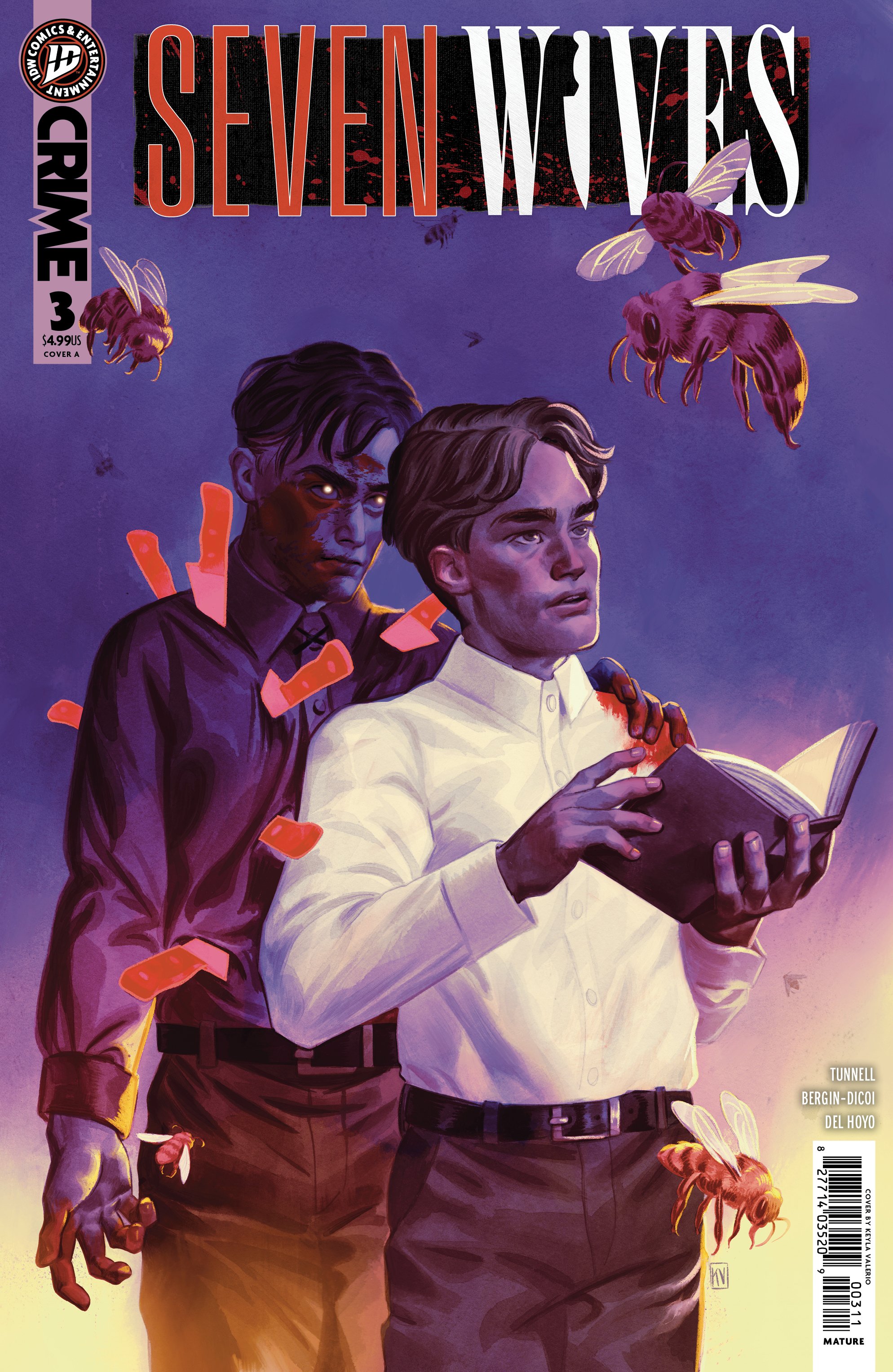
Credit: IDW Crime
***POSSIBLE SPOILER WARNING***
STORY OVERVIEW:
As Detectives Aguilar and Halwell are at a loss for words as they have taken in Matthew’s 13-year-old child bride, who is also his daughter, Danielle. This disgusts the dectectives as well as lights a fire under their asses. Aguilar questions the girl, well Halwell interrogates her mother, and another one of Matthew’s wives, Jenifer. Even though these questionings don’t produce the killer, it does light a fire within the detectives as they need to find the killer quick if they hope to stop Danielle from returning to the compound. As they ramp up, they get an odd anonymous tip that Francis Burns, the head of a different FLDS compound, is the murderer and the murder weapon is in his car. Upon investigation, this is proven to be right, and Burns is taken into custody. Case closed?
WRITING:
With this final issue, the story reaches its conclusion, but the ending left me with more frustration than satisfaction. Zoe Tunnell has spent the series building a strong and uncomfortable mystery around Matthew Dunn’s murder, using the protected world of a religious cult to create tension, suspicion, and a constant feeling that every answer is being filtered through fear or manipulation. That setup works really well for most of the series because the suspect pool feels personal. The wives, the detectives, the other men in power, and even the larger structure of the compound all feel like they could be connected to the crime in some meaningful way. Because of that, the possibilities for where the story could go felt wide open heading into the finale.
The problem is that when it comes time to stick the landing, the issue takes a turn that feels a little too clever for its own good. Having an anonymous caller point the detectives toward Francis Burns as the killer is not a bad idea on its own, especially because it fits the book’s larger theme of people using systems of power to protect themselves and redirect blame. However, Burns has not been built up enough across the series for that reveal to carry the weight it needs. He is evil, and removing him from his own compound is satisfying on a basic level, but as the apparent solution to the central murder mystery, it feels disconnected from the emotional investment the story had created. After three issues of focusing on Matthew’s wives and the rot within his own household, shifting the focus to a character who feels somewhat outside the main suspect pool makes the mystery feel less rewarding in hindsight.
The later reveal of the real killer is where the issue became even more complicated for me. I understand what Tunnell is going for: the idea that justice does not always happen cleanly, that corrupt people can manipulate the truth, and that power often protects itself even when everyone knows something is wrong. That is a valid and realistic direction for a crime story, especially one dealing with abuse, control, and institutional silence. The issue is not that the good guys fail to get a perfect victory. The issue is that the story confirms the truth and then does not give that truth enough dramatic consequence. The real killer does not just avoid punishment; they end the story with more power, more control, and more influence, continuing Matthew Dunn’s horrific legacy rather than being forced to answer for it.
That choice may be meant to feel bleak and true to life, but for me it undercuts the emotional payoff of the series. There is a difference between an ending that is tragic and an ending that feels incomplete. If the goal was to leave the reader unsettled, the book might have been stronger if it only hinted that the real killer was still out there or left the final answer open to interpretation. Confirming the killer while also letting them continue unchecked makes the ending feel less like a haunting final note and more like the story skipped the final step of its own resolution. Some readers may appreciate that cynical edge, and I can see why, but it did not fully work for me because the series had built too much momentum around the detectives trying to uncover the truth.
There are still elements of the writing that work well. Aguilar and Halwell’s anger over Danielle’s situation gives the issue an emotional urgency that makes their investigation feel personal instead of procedural. The book also continues to do a strong job showing how terrifying the compound is, not because of one single villain, but because of the entire culture of silence and control around it. The wives who manage to escape provide one of the few genuinely hopeful notes in the finale, and that moment matters. It gives the issue some sense that all of this pain and investigation led to something meaningful, even if the larger system remains intact.
Still, I kept coming back to the feeling that this ending needed more room to breathe. Maybe the story would have benefited from another two or three issues so the false reveal, the real reveal, and the fallout could all land with more impact. As it stands, the finale feels rushed, especially for a mystery that had done a good job building suspicion. Tunnell had all the pieces for a powerful conclusion, and there are moments here that show why the series was compelling in the first place. Unfortunately, the final answer did not satisfy me as much as the build-up did. I really liked this series overall, which is why the ending disappointed me as much as it did. It is not a complete failure, but it is a miss for me because the story seemed capable of delivering something sharper, more devastating, and more complete.
ARTWORK:
The artwork in this final issue continues to be one of the strongest parts of the series, because it keeps the book visually grounded while still giving the mystery a tense, unsettling atmosphere. Tesslyn Bergin-Dicoi does a fantastic job making this world feel closed-off and controlled. The compound, interrogation rooms, homes, and quieter domestic spaces all have a unique quality, but they also carry a sense of pressure. Nothing feels overly exaggerated, which works in the book’s favor. The horror of the story comes from how normal everything can look on the surface, and Bergin-Dicoi’s art captures that uncomfortable contrast really well.
A lot of the storytelling power comes from the character acting. In a mystery comic, facial expressions and body language matter just as much as dialogue, and Bergin-Dicoi understands that. Small glances, tightened expressions, uncomfortable silences, and the way characters position themselves in a room all help create suspicion. You can often tell when someone is withholding information or when a character is trying to keep control of a situation. Those subtle visual choices give the reader clues, but they also create potential red herrings, which is exactly what the art needs to do in a crime story like this.
The detectives are especially well handled visually. Aguilar and Halwell never come across as detached observers. Their frustration, anger, concern, and exhaustion are easy to read throughout the issue, which helps sell how personal the case has become for them. That emotional clarity is important because so much of the finale depends on the reader believing that these two detectives are not just solving a murder, but responding to the abuse and corruption surrounding it. Their reactions give the issue a human center, even when the plot itself becomes more complicated and morally messy.
The layouts also help keep the pacing steady. The quieter scenes have enough space to let the tension sit, while the investigative beats move quickly without becoming confusing. Bergin-Dicoi does not overload the page with unnecessary detail, but the details that are present matter. Rooms feel deliberately arranged, characters feel trapped within their environments, and the framing often reinforces the imbalance of power in the story. That visual restraint gives the issue a grounded crime-drama feeling instead of pushing it into melodrama.
Of course, the artwork would not land as strongly without Antonio Del Hoyo’s colors. The color work adds a lot to the mood of the issue, shifting between colder investigative scenes and warmer, more oppressive tones connected to the compound and the characters trapped within it. The palette helps separate emotional spaces without feeling too obvious about it. It also supports the mystery by guiding the reader’s eye toward certain details, reactions, or moments of tension. The colors never overwhelm the linework, but they do a lot of the emotional heavy lifting.
Overall, the art team gives this finale a strong sense of identity. Even when the writing choices did not fully satisfy me, the visuals kept me invested in the characters and the danger of the world they were moving through. Bergin-Dicoi’s expressive character work and controlled environments, combined with Del Hoyo’s atmospheric colors, make the issue feel tense, emotional, and visually consistent with the rest of the series. The artwork does not just illustrate the story; it helps carry the parts of the mystery and emotional fallout that the script sometimes leaves underdeveloped.
CHECK OUT MY REVIEW OF SEVEN WIVES #2
Final Thoughts:
Seven Wives #3 is a tense and visually strong finale, but it does not fully deliver on the mystery the series spent its time building. The artwork, atmosphere, and emotional weight of the case remain effective, and the series still stands out as a dark crime story with a compelling premise. However, the rushed resolution and unsatisfying final reveal keep this issue from landing as strongly as it should. I still think the series is worth reading for its mood, characters, and unsettling world, but the ending leaves it feeling more like a missed opportunity than a complete success.
FINAL GRADE: 6/10
Let me know your thoughts on Seven Wives #1 in the comments below. Thanks for reading!