RIPCORD #5 (IGNITION PRESS)
With her sister’s freedom and life on the line Dillon must make her final stand. But as Colebee and her try to save Janelle, Sera and her biker gang have other plans for them. Will Dillon be able to finally save her sister, or will they both day in the Outback?
Ripcord #5 - Written By Cullen Bunn – Art By Aneke – Colors By Patricia Martín - Letters By Andworld Design – Edited By Jamie S. Rich - Published By Ignition Press
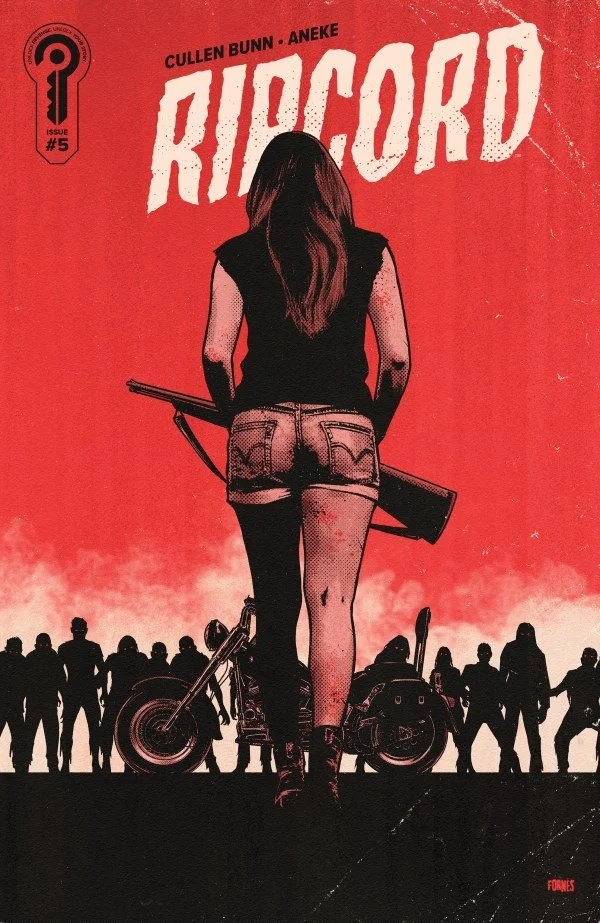
Credit: Ignition Press
*** POSSIBLE SPOILER WARNING ***
STORY OVERVIEW:
As Dillon and Colebee finally make it to Janelle the nightmare is just beginning. Macon doesn’t want to let go of his love Janelle, so he goes to take out the intruders. As it looks like Macon is going to kill Dillon, Colebee tries to help Janelle escape. This enrages Macon who let’s go of Dillon and smashes Colebee’s face into a wall. This buys Dillon enough time to machine gun Macon, which hopefully will allow them to get away. However, Sera and her biker gang now stand in their way, and they are pissed about what she did to Macon. Finally, the sisters appear to be out of options and their fate my be sealed…or is it?
WRITING:
This final issue, much like the rest of the series, is full of twists, turns, and sudden shifts in momentum that keep the reader constantly second guessing where the story is headed. Just when you think the book has settled into one kind of ending, Cullen Bunn changes direction and pushes the finale into a different emotional or violent space. Those misdirection’s are not just cheap surprises either. They work because the series has spent its time building a world where danger can come from anywhere, and where every small victory can immediately turn into another problem. That gives this issue a real sense of instability. The reader never feels completely safe, which is exactly the feeling a finale like this needs.
The brutality of the confrontation with Macon also fits perfectly with the kind of horror Bunn has been crafting throughout the series. The violence is ugly, sudden, and personal, which makes it hit harder than if it were simply there for shock value. Bunn has taken the violent and gory side of horror and pushed it all the way up to 11 in this series, and this final issue absolutely follows suit. There is a nastiness to the action that makes the Outback feel even more hostile, as if the landscape, the villains, and the situation itself are all closing in on Dillon and Janelle at the same time. For readers who have enjoyed the series for its harsh, bloody intensity, this finale gives them plenty to chew on.
But what makes this finale work so well is that it is not only about violence, gore, or survival. Underneath all of that chaos is a surprisingly strong emotional core. At its heart, this story is about what a sister is willing to do to save her sister. Dillon uses her training, toughness, and ability to survive terrible odds not because she wants to prove she is the biggest badass in the room, but because saving Janelle matters more to her than anything else. That distinction gives the character much more depth. Her strength is not presented as empty coolness; it is driven by desperation, loyalty, guilt, and love. That makes every decision she makes feel more urgent, because the reader understands that she is not fighting for pride or revenge. She is fighting because failure would mean losing the person she came all this way to save.
That family element is what elevates the horror. Bunn understands that the most effective stories in this genre are not just about whether someone can survive the monster, the killer, or the impossible situation. They are about what survival costs and what people are willing to become when someone they love is in danger. By centering Dillon’s mission around Janelle, the finale asks the reader to consider how far they would go if they were trapped in the same nightmare. Would they run, would they fight, or would they cross lines they never imagined crossing? Bunn milks that tension to great effect, and it gives the ending more impact than a simple action heavy conclusion would have had. The result is a finale that delivers the blood and brutality fans expect while still making the emotional stakes feel meaningful.
ARTWORK:
The artwork in this final issue matches the frantic energy of the story and does a great job bringing the book’s brutality, weirdness, and grindhouse horror attitude to life. Aneke’s artwork makes this story look like it should be playing as a late-night exploitation horror movie, complete with exaggerated violence, strange character designs, and a dirty visual atmosphere that makes every scene feel dangerous. The trippy settings and grimy look give the world a nasty texture, as if the Outback itself has been stained by all the blood, cruelty, and madness that has taken place there. Nothing in the issue feels clean or safe, and that works perfectly for a finale built around desperation and survival.
The horror scenes are especially effective because the violence is staged in a way that feels sudden and physical. When characters are hurt, crushed, shot, or torn apart, the art does not pull back from the impact. Instead, it leans into the ugly consequences of the action, which reinforces how high the stakes are for Dillon and Janelle. The confrontation with Macon benefits from this approach because his size and visual presence make him feel like more than just another villain. His design has a monstrous weight to it, with a brooding, almost tragic quality that makes him unsettling before the action even begins. He looks like someone who belongs in this twisted world, and that makes him a perfect final obstacle for Dillon.
The creature and gang designs also help separate this series from more familiar survival-horror stories. The Ripper Heads have a monster meets zombie appearance that feels recognizable enough to tap into classic horror imagery, but strange enough that they still feel specific to this book. Their designs make them look feral, damaged, and unpredictable, which adds to the sense that the world around Dillon has completely broken down. Aneke also keeps the action clear, even when the issue gets chaotic. The layouts allow the reader to follow the movement of the fights while still feeling the panic of the moment. That balance is important because the book needs to feel wild without becoming visually confusing.
Patricia Martín’s color work pushes the visuals even further into that trippy 1970s horror space. The heavy use of blues gives many scenes a cold, unnatural feeling, while the hot pink blood makes the violence pop in a way that immediately grabs the eye. That combination gives the issue a distinct visual identity and creates a strong Dawn of the Dead style effect, where the colors are heightened enough to feel unreal but still tied to the ugliness of the horror. The palette makes the gore feel stylish without softening it, which is a difficult balance to pull off.
Overall, the art team absolutely crushes this issue and the series as a whole. Aneke gives the book its rough, dangerous, cinematic edge, while Martín’s colors make the world feel strange, violent, and memorable. Together, they create a finale that does not just tell the reader that the situation is brutal; it makes them feel it on the page. The visuals sell the desperation of Dillon’s last stand, the grotesque nature of the enemies around her, and the wild horror-movie energy that has made Ripcord stand out from start to finish.
Check Out KEN M’S REVIEW OF THE PATRON #1
Final Thoughts:
Ripcord #5 is a brutal, bloody, and satisfying finale that brings Dillon and Janelle’s nightmare in the Outback to a strong close. Cullen Bunn keeps the tension high with desperate choices, nasty violence, and enough twists to make the ending feel unpredictable without losing sight of the emotional core: Dillon’s need to save her sister.
The issue works because it balances over-the-top horror with real personal stakes. The gore, biker-gang chaos, and monster like enemies are entertaining, but Dillon’s loyalty to Janelle gives the finale weight and makes the violence feel personal rather than random.
Aneke’s rough, cinematic art and Patricia Martín’s bold colors give the finale a distinct grindhouse horror feel, making the action stylish, ugly, and memorable. For readers who enjoy survival horror with emotional stakes and wild momentum, Ripcord #5 is absolutely worth picking up. If you missed this series make sure to keep your eyes out for the Trade Paperback when it goes on sale.
FINAL GRADE: 9.5/10
Let me know your thoughts on Ripcord #5 in the comments below. Thanks for reading!