REDCOAT #20 (GHOST MACHINE/IMAGE COMICS)
With nothing left to lose, Simon Pure focuses all of his rage on Bennedict Arnold. After Bennedict took everything from Simon there is nothing left but to take Arnold’s life. But how do you kill an immortal? And can Simon focus his rage enough to accomplish that?
Redcoat #20 - Created By Geoff Johns & Bryan Hitch - Inks By Andrew Currie & Bryan Hitch - Colors By Brad Anderson - Letters By Rob Leigh - Edited By Brian Cunningham - Published By Ghost Machine/Image Comics
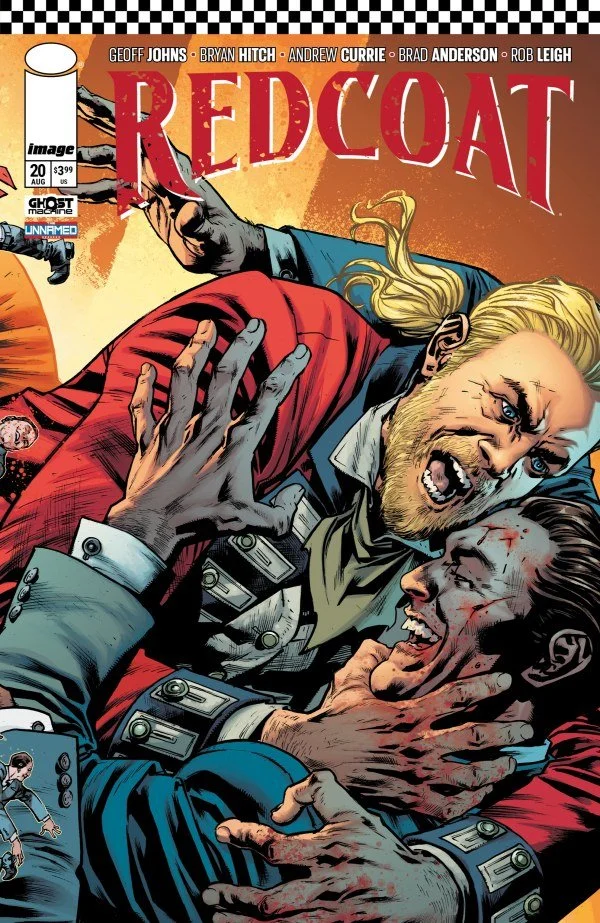
Credit: Ghost Machine/Image Comics
*** POSSIBLE SPOILER WARNING ***
STORY OVERVIEW:
Bennedict Arnold has killed Simon’s wife and children and has the audacity to gloat about it. Unfortunately for him, he has unleashed a fury from inside Simon that no one has ever seen. Simon is now taking the fight to him and intends fully on hurting and then killing Arnold. The only problem is Washington’s Axe, one of the few relics that can kill immortals is in Arnold’s possession. But with the rage Simon is unleashing, Bennedict is going to want to keep ahold of that axe because if Simon gets his hands on it, that will be it for histories most notorious traitor. The bigger question is can Simon keep his rage in check long enough to get his revenge?
WRITING:
This issue is drenched in rage, grief, and relentless action, and I could not get enough of it. Rather than leaning on the layered mysteries and long-term plot developments that have defined much of the series, Geoff Johns narrows the story’s focus to Simon Pure’s immediate emotional crisis. That decision gives the issue a raw, urgent quality. Simon is not thinking about the larger consequences of his actions or the complicated history surrounding the immortals; he is a man who has just lost his wife and children, and every thought is consumed by the need to make Bennedict Arnold suffer for what he has done. The simplicity of that motivation allows the issue to move with tremendous force because the reader understands exactly what Simon wants and why he is willing to risk everything to achieve it.
Johns makes Simon’s fury feel earned by grounding it in recognizable grief. His pain is not presented as generic anger or an excuse for spectacle. It comes from the sudden destruction of the life he had managed to build and the family that gave him a reason to hope. That emotional foundation invites the reader to imagine how they might react in the same situation, even when Simon’s response becomes reckless and violent. The issue never asks the audience to believe that revenge will heal him, but it does make his desire for it understandable. As Simon throws himself into the confrontation, every blow feels connected to his loss, turning the action into an extension of his grief rather than a sequence of violence included only for excitement.
Bennedict Arnold is equally important to making this conflict work. Johns writes him as cold, condescending, and utterly without remorse, making him the perfect target for Simon’s rage. Arnold does not merely admit to murdering Simon’s family; he gloats about it, treating their deaths as another way to prove his superiority and exert control. His cruelty strips away any possibility of sympathy and ensures that the reader shares Simon’s desire to see him defeated. There is no hidden nobility or redeeming quality beneath Arnold’s behavior here. Every taunt and calculated insult reinforces the idea that he understands Simon’s pain and deliberately chooses to deepen it. That makes the confrontation intensely personal and gives the issue a clear emotional center.
The presence of Washington’s Axe adds another layer of tension because it gives the battle a concrete objective. Simon’s strength and fury may allow him to hurt Arnold, but rage alone cannot kill an immortal. The axe represents both Simon’s best chance at revenge and the danger of losing control before he can reach it. Arnold’s possession of the weapon keeps the fight from feeling completely one-sided, while Simon’s determination makes every shift in momentum feel significant. The reader is not simply waiting to see who wins the physical struggle; the real suspense comes from whether Simon can remain focused long enough to seize the one weapon capable of ending Arnold permanently.
Although the issue steps away from the series’ broader mysteries and future-focused storytelling, that choice does not make it feel empty. Replacing complicated revelations with concentrated emotion allows the full reality of Simon’s loss to resonate. The pacing reflects his state of mind: there is little room to pause, process, or plan because Simon himself is incapable of doing those things. His grief drives the rhythm of the issue, and the increasingly brutal action communicates what dialogue alone could not. By keeping the conflict direct and personal, Johns forces the audience to remain inside Simon’s pain rather than looking ahead to the next twist.
What the issue may lack in world-building or setup for future storylines, it more than makes up for through emotional clarity, strong characterization, and justified intensity. Simon’s rage is frightening, but it is also deeply human, while Arnold’s complete lack of compassion makes him one of the most detestable figures in the series. The result is a brutal confrontation that feels like the inevitable release of pressure that has been building since Simon’s family was taken from him. This issue succeeds because the action is never separate from the emotion behind it. Every moment of violence carries the weight of Simon’s loss, making the issue feel less like a simple fight and more like an explosion of grief that has finally become impossible to contain.
ARTWORK:
The artwork continues to deliver on every front, immersing readers in the brutal, emotionally charged world the series has built. Bryan Hitch does more than stage an impressive fight between Simon and Bennedict Arnold; he uses every panel to show how completely grief and rage have taken control of Simon. His posture, expressions, and movements feel increasingly feral, as though instinct has replaced reason. Simon does not simply look angry, he appears physically overwhelmed by the need to punish Arnold, and Hitch makes that loss of control visible in the force behind every strike and the desperation in every advance.
Arnold provides an effective visual contrast. While Simon is explosive and unpredictable, Arnold carries himself with the confidence of someone who believes he remains in command. Hitch captures that arrogance through Arnold’s expressions and body language, allowing his smugness to remain visible even when the fight turns violent. That confidence makes him more infuriating and gives Simon’s attacks additional emotional weight. As Arnold’s control begins to slip, the changes in his stance and reactions help communicate the shifting momentum of the confrontation without requiring lengthy exposition.
The fight choreography is especially strong because each exchange feels heavy, immediate, and purposeful. The combat is not presented as graceful or clean; it is a desperate struggle between two immortals who understand how much punishment the other can endure. Hitch fills the pages with forceful compositions that make blows feel powerful and consequences feel unavoidable. Wider panels establish the scale and destruction of the battle, while tighter close-ups emphasize clenched teeth, blood, bruising, and the characters’ increasingly desperate expressions. The alternation between those perspectives keeps the sequence visually dynamic while ensuring that the emotional stakes never disappear beneath the spectacle.
Hitch also refuses to soften the violence. The damage inflicted on both men is depicted with an appropriate level of brutality, reminding readers that immortality does not prevent pain. Every wound, impact, and moment of physical exhaustion reinforces the intensity of Simon’s revenge-driven assault. The violence never feels disconnected from the story because the composition consistently directs attention back to Simon’s grief and Arnold’s cruelty. Rather than existing simply to shock the audience, the brutality becomes a visual expression of everything Simon cannot put into words.
Andrew Currie’s inks strengthen that impact by giving the figures and environments a firm, textured presence. The heavier shadows add menace to the confrontation and help isolate the characters within the chaos around them. Darker lines emphasize the wear on faces, clothing, and bodies, making the battle feel increasingly exhausting as it continues. The inking also preserves clarity during the most frantic moments, ensuring that the action remains easy to follow even when the page is crowded with movement and destruction.
Brad Anderson’s colors complement the linework with a palette that supports both the violence and the emotional focus of the issue. His colors draw attention to injuries, torn clothing, weapons, and the damage accumulating throughout the fight. The surrounding world often feels subdued compared with the characters, allowing Simon and Arnold to dominate each scene visually. Strategic contrasts guide the eye toward the most important action in each panel, while changes in light and intensity reinforce shifts in momentum. The colors make the conflict feel hot, immediate, and dangerous without overwhelming Hitch’s detailed artwork.
Together, Hitch, Currie, and Anderson transform what could have been a straightforward action sequence into a sustained piece of emotional storytelling. The artwork communicates Simon’s grief, Arnold’s arrogance, the physical cost of immortality, and the escalating danger surrounding Washington’s Axe. Every visual choice from the character acting to the panel composition, shadows, and color contrasts keeps the reader focused on the personal hatred driving the battle. The result is artwork that is not only impressive in scale and detail but also essential to the issue’s emotional power.
Check Out My Review of REDCOAT #19
Final Thoughts:
Redcoat #20 is a raw, relentless issue that turns Simon’s grief into a deeply personal battle for revenge. Geoff Johns keeps the story emotionally focused, while the art team makes every blow feel brutal and consequential. The result is a visually powerful, emotionally charged issue that delivers one of the series’ most intense confrontations. If you are looking for an emotional, action-packed ride this is the issue for you. Grab a copy at your LCS this week and enjoy the violence.
FINAL GRADE: 9/10
Let me know your thoughts on Redcoat #20 in the comments below. Thanks for reading!