REDCOAT #19 (GHOST MACHINE/IMAGE COMICS)
Simon Pure has seemingly lost far too much and it looks like he stands to lose more. With Benedict Arnold taken by the Men in Hoods, this leaves Albert and Simon to find Washington’s Axe before the Hooded Men can. But the question isn’t can they find it, it’s what will happen after, and what will it cost?
Redcoat #19 - Created By Geoff Johns & Bryan Hitch - Inks By Andrew Currie & Bryan Hitch - Colors By Brad Anderson - Letters By Rob Leigh - Edited By Brian Cunningham - Published By Ghost Machine/Image Comics
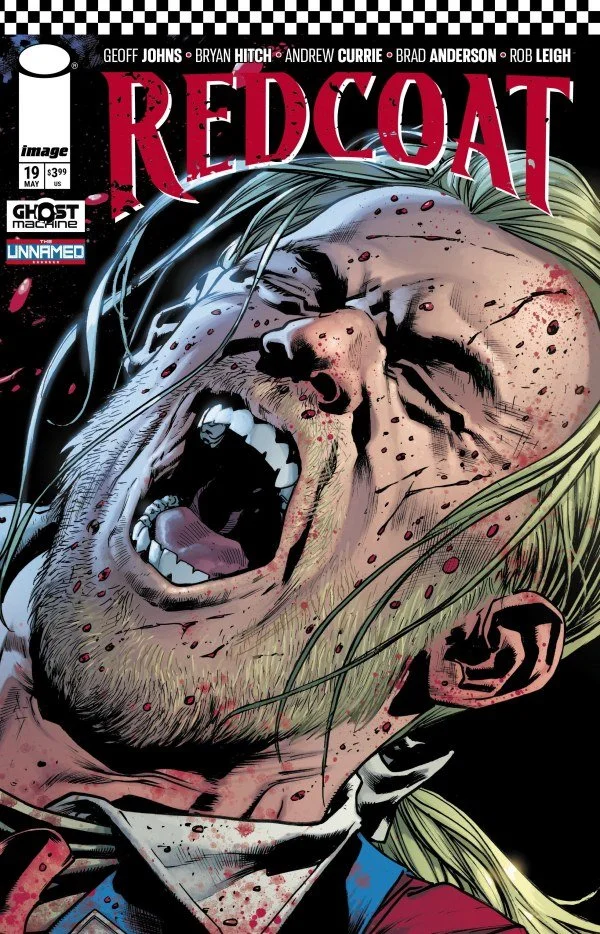
Credit: Ghost Machine/Image Comics
*** POSSIBLE SPOILER WARNING ***
STORY OVERVIEW:
After revealing his true identity and story to his wife, Simon’s family has left him, so he is all alone again. Well not quite all alone as he still has Albert Einstein by his side. Now they must go find Washington’s Axe before the Hooded Men who took Benedict Arnold can get their hands on it. But before they can start their journey, Margaret returns home with the children and tells Simon that she doesn’t care about the truth, that they can work everything out as they have love on their side. After this, Simon and Albert take off to find the axe and hopefully save Benedict Arnold as well. They make their way to the Old State House in search of the Axe of Lies that Arnold must have hidden there. They stop to talk to Ginny the flower lady before stopping by Mr. Sullivan’s so Simon can retrieve his six shooter. Once at the State House they break in and begin to search but are interrupted by a massive explosion. As they run out to find out what happened, the dread starts to set in.
WRITING:
This issue is one heck of an emotional ride, and what makes it work so well is how deliberately Geoff Johns controls the reader’s feelings from the opening pages all the way through the devastating ending. The story begins with Simon Pure in one of the most vulnerable places he has been in throughout the series. After finally revealing the truth about who he is and what his life has really been, it looks like his family has walked away from him, leaving him with the crushing thought that he is truly alone again. That loneliness has always been one of the most painful parts of Simon’s immortality, and Johns uses that history to make the opening hit harder. Simon may joke, drink, fight, and act like nothing can touch him, but the idea of losing the family he has built cuts through all of that bravado.
Johns then quickly turns that sadness into hope when Margaret returns with the children and tells Simon that the truth does not have to destroy them. That moment gives the issue its emotional lift, because it allows both Simon and the reader to believe that maybe things can be repaired. It is a warm, sincere moment that makes the issue feel like it is moving toward healing rather than tragedy. The optimism coming out of Margaret’s return feels huge, almost like the story is letting Simon have something good for once. Because of that, the reader is pulled into the same sense of relief that Simon feels. You want to believe that love really can overcome the secrets, the fear, and the impossible history weighing on this family.
That hopeful feeling continues as Simon and Albert head out to find Washington’s Axe and hopefully save Benedict Arnold. Johns gives the middle of the issue a lighter, more adventurous rhythm, which makes the eventual turn even more brutal. The interactions with Ginny and Mr. Sullivan help make the world around Simon feel emotionally important. These are not just random side characters filling space; they are people Simon knows, people who add warmth and personality to his strange life. Ginny’s kindness and Mr. Sullivan’s familiarity give the issue a comfortable feeling, and that comfort matters because Johns is quietly reminding the reader that Simon has roots here. He is not just fighting for some mythical object or historical secret. He is fighting for a life, a home, and the people who have become part of that life.
The humor between Simon and Albert also works extremely well. The sequence at the Old State House, where Simon crashes through a window while Albert simply picks the lock, is a great example of the dynamic between them. Simon is impulsive, loud, and dramatic, while Albert is calm, practical, and quietly funny. That contrast gives the issue some much-needed levity, but it never feels like Johns is undercutting the stakes. Instead, the humor makes the characters more endearing, which only makes the emotional blow that follows hit with more force. Even when they do not find the axe, there is still this sense that things might work out. The issue has built enough warmth and momentum that the reader is lulled into a feeling of safety.
That is exactly why the explosion is so effective. It comes crashing into the story with the same sudden violence that Simon and Albert experience in the moment. The tone shifts instantly from adventure and humor to panic and dread. Johns does an excellent job of making the reader feel the change before the characters even fully understand what has happened. As Simon and Albert race back toward Mr. Sullivan’s, the issue starts tightening around them. The sense of urgency builds with every step, and the reader knows that something awful is waiting. Johns takes all the good feeling he carefully built in the first half and starts pulling it apart piece by piece.
The reveal that Mr. Sullivan’s shop has been destroyed with him inside is already heartbreaking, but Johns does not stop there. The discovery that Ginny has also been murdered makes the violence feel crueler and more personal. These deaths are not just plot points meant to raise the stakes; they feel like an attack on the small pieces of community Simon had around him. That is what makes the dread so overwhelming as Simon races home. At that point, the reader is thinking the worst right alongside him. Every hopeful feeling from earlier in the issue has been turned into fear, and the possibility that Margaret and the children could be in danger becomes almost unbearable.
By the time the final pages arrive, Johns has taken the reader from happiness and relief all the way down to sadness, fear, and anger. The reveal of who is responsible lands with tremendous impact because the issue has earned that reaction. It is not shocking just for the sake of being shocking. It works because the emotional setup is so strong. Johns understands that tragedy hits harder when the reader has been allowed to feel hope first, and that is exactly what makes this issue one of the strongest in the series. It is a painful, powerful issue that shows how much Simon has to lose, how dangerous the Hooded Men truly are, and how easily a moment of happiness can be ripped away. This is the kind of issue that stays with you after you finish reading it, and it will tug at even the most hardened reader’s heart.
ARTWORK:
The artwork vividly captures the early 20th century, with Bryan Hitch creating an immersive world that pulls readers directly into the story’s historical setting. What works so well is that Hitch does not just rely on costumes or background details to sell the period. He fills the pages with architecture, streets, interiors, and everyday objects that make the world feel alive. The Old State House, Mr. Sullivan’s shop, and the surrounding city streets all have a strong sense of place, which helps ground the more fantastical elements of the story. Because of that, the alternate-history backdrop feels believable instead of decorative. It looks like a real world Simon has been stumbling through for years, and that gives the emotional moments more weight.
Hitch’s character work is just as important as the setting. Simon’s emotions are easy to read throughout the issue, and that matters because this chapter depends so heavily on the audience feeling every rise and fall with him. During the happier and more hopeful scenes, Simon’s face and body language loosen up. There is a sense of relief in him when Margaret returns with the children, and Hitch makes that moment feel sincere rather than overly sentimental. You can see how badly Simon wants to believe that things might finally be okay, and that visual softness makes the later tragedy hurt even more.
When the story turns darker, Hitch shifts the visual energy immediately. Simon’s panic, fear, and anger come through in his expressions and movement, especially once the explosion happens and he begins racing back through the city. The pages feel more frantic without becoming confusing, and that balance is important. The reader understands the geography of the scene while still feeling the chaos of the moment. Hitch’s ability to move from quiet emotional beats to sudden disaster gives the issue a strong visual rhythm, mirroring the way Geoff Johns builds the story from hope into dread.
The smaller details also add a lot to the issue. The humor of Simon crashing through the window while Albert simply picks the lock works because Hitch understands the contrast between the two characters visually. Simon is all big gestures and reckless momentum, while Albert is controlled, practical, and almost understated. That kind of visual comedy helps keep the issue entertaining before the mood changes. It also shows how well Hitch handles personality on the page. The characters do not need to explain who they are in every scene because their actions, posture, and expressions already tell the reader so much.
Brad Anderson strengthens the art with a thoughtful color palette that reinforces both the era and the emotional tone of the issue. His use of brown tones and muted colors gives the visuals a weathered, aged quality that enhances the early 20th century atmosphere. The colors make the city feel dusty, worn, and historical without draining the pages of life. During the warmer scenes, Anderson allows enough light and softness into the palette to make Simon’s family moments feel comforting. Then, when the explosion and deaths arrive, the colors help push the issue into a harsher, heavier mood.
Together, Hitch, Anderson, the inks by Andrew Currie and Hitch, and Rob Leigh’s lettering give the issue a polished and emotionally clear presentation. The visuals never feel separate from the writing; they are working alongside it at every step. The art builds the hope, sells the humor, captures the terror, and makes the heartbreak land with force. This is a strong-looking issue from beginning to end, and the art team consistently brings the world of Redcoat to life in a way that makes the story feel bigger, richer, and more painful when everything falls apart.
Check Out My Review of REDCOAT #18
Final Thoughts:
Redcoat #19 is a powerful and emotional issue that brings the heart of the series back to the forefront. Geoff Johns delivers a story that starts with hope, builds genuine warmth around Simon’s family and community, and then rips it all away with a brutal ending that lands hard. The art team makes every emotional turn feel clear and impactful, giving the issue a strong sense of place, mood, and urgency. It may not be the most action-heavy chapter, but the drama, heartbreak, and final reveal make it one of the most memorable installments so far. This issue leaves Simon in a devastating place and makes the wait for the next issue feel even harder.
FINAL GRADE: 9.5/10
Let me know your thoughts on Redcoat #19 in the comments below. Thanks for reading!