LAND OF NEVER #3 (Mad Cave Studios)
Sometimes families don’t see eye to eye, and sometimes that leads to death. As Peter continues to build his Neverland family, there is uncertainty and apprehension from some. Wendy is put in a position to keep the family together. Meanwhile, Hoke and Smith are getting closer to putting together who the Floating Man actually is.
Land of Never #3 - Written By Steve Orlando – Art By Miguel Mora – Colors By Fares Maese – Letters By Micah Myers -Edited By Jon Moisan - Published By Mad Cave Studios
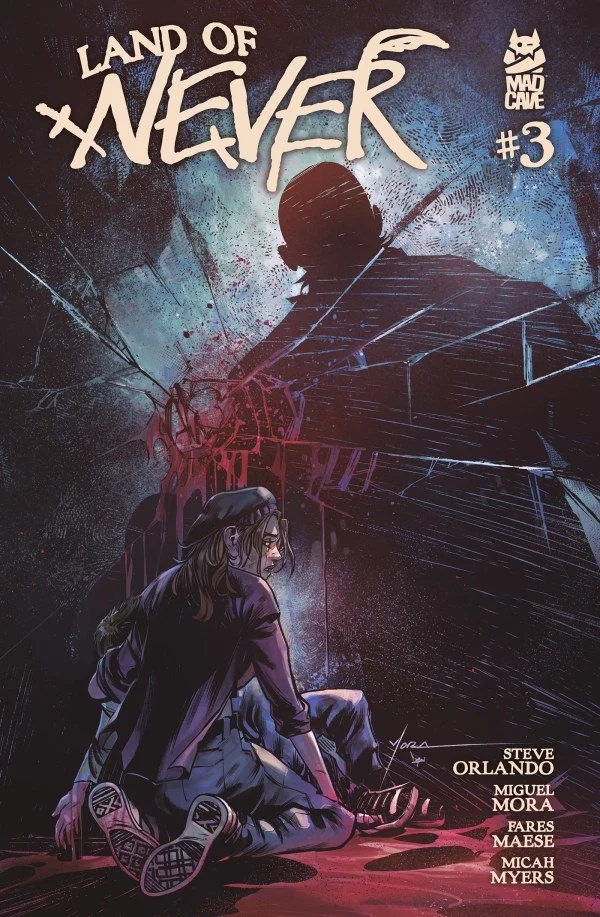
Credit: Mad Cave Studios
*** POSSIBLE SPOILER WARNING ***
STORY OVERVIEW:
Wendy takes over the big sister role of this group of reluctant lost kids that Peter has been forming into his family. As she puts together and serves dinner, Peter gets upset as not everyone is there. Graham is not at dinner, and this irritates Peter who accuses Wendy of not being able to count, but Wendy tells him Graham is in his room and that she didn’t miscount. When Peter goes to get Graham, he discovers that Grahams trying to escape. This infuriates Peter and that means Graham needs to be punished and punished severely he is. Meanwhile, Hoke and Smith have found the orphanage where Peter became the Floating Man. They then start to hunt down anyone that may have worked there and knows his actual identity. After discovering most of them are dead, they discover that only Doctor Lily Williams is left. But when they visit her, they realize that the threat of the Floating Man has her on extreme guard.
WRITING:
This issue gives Steve Orlando more room to dig into the horror behind Peter’s idea of family, and that is where the writing becomes especially effective. Peter keeps presenting Neverland as a place where the abducted children can belong, but Orlando makes it clear that his version of family is built on control, fear, and obedience rather than love. The dinner scene is a strong example of this because something as simple as one child not being present immediately exposes how unstable Peter really is. His reaction to Graham’s absence is not just anger; it is a complete unraveling of the fantasy he is trying to force everyone else to accept. Once Peter discovers that Graham is trying to escape, the punishment becomes a brutal reminder that the children are not free members of a family but prisoners inside Peter’s delusion.
What makes this sequence work is that Orlando does not rely only on the shock of Peter’s violence. The scene also gives the reader a clearer understanding of how fragile Peter’s mind is and how dangerous that makes him. He needs everyone around him to play along with the role he has assigned them, and the moment someone challenges that illusion, he responds with cruelty. Graham’s punishment is horrifying on its own, but it also serves as a warning to the rest of the children. It tells them that survival in Neverland depends on knowing when to stay quiet, when to obey, and when to pretend that Peter’s fantasy is real.
Wendy becomes the emotional center of the issue because she is forced to manage the damage Peter causes. Orlando writes her as someone who is scared, observant, and protective all at once. She understands that openly challenging Peter could put the other children in even more danger, so she tries to calm the group and explain away his behavior enough to keep everyone safe. That makes her role complicated in an interesting way. She is not simply accepting Peter’s world, but she is also not in a position where she can reject it outright. Her attempts to protect the others make her easy to root for, while the possibility that she may be starting to internalize Peter’s twisted version of family adds an uneasy layer to her character. If Orlando is hinting at Wendy developing a form of Stockholm Syndrome, then that makes her future choices even more unpredictable.
The investigation side of the issue also continues to strengthen the overall tension. Hoke and Smith are not just waiting for answers to come to them; they are actively chasing every lead connected to the Floating Man. Their search through the orphanage history gives the story a larger mystery while also making Peter feel more rooted in something tragic and disturbing. The detail that most of the people connected to the orphanage are already dead immediately raises the stakes because it suggests Peter’s reach extends far beyond the children currently trapped in Neverland. When Hoke and Smith track down Doctor Lily Williams, Orlando uses her intense security and fear to communicate just how dangerous Peter is without needing to show him in that moment.
That balance between the children trapped inside Peter’s fantasy and the fathers pushing closer to the truth gives the issue a strong sense of momentum. Orlando keeps both sides of the story connected through fear, desperation, and the growing realization that Peter is worse than anyone first understood. The writing succeeds because it deepens the threat while still keeping the emotional stakes clear. Wendy’s need to protect the children, Graham’s attempt to escape, and the fathers’ refusal to stop searching all show different responses to the same nightmare. By the end of the issue, Peter feels more dangerous, Neverland feels more unstable, and the mystery surrounding the Floating Man becomes even more compelling.
ARTWORK:
The artwork in this issue does an amazing job of matching the disturbing tone of the story and making Peter’s Neverland feel like a place the children may never escape from. Miguel Mora avoids giving this world the usual sense of fantasy, wonder, or adventure that readers might associate with Neverland. Instead, he presents it as a bleak, enclosed, and threatening environment. The setting feels less like a magical refuge and more like a prison built out of Peter’s broken imagination. That visual choice is important because it immediately supports the horror of the story. The children are not wandering through a dream world; they are trapped inside a place that reflects Peter’s control, instability, and warped need for family.
Mora really shows the scale of this version of Neverland during Graham’s attempt to escape. Before this point, the issue gives the impression that the children are trapped, but the escape sequence gives that feeling a much clearer visual shape. The open space around Graham, the distance he has to cross, and the way the environment seems to stretch beyond him make Neverland feel far bigger and more impossible to escape. That sense of scale adds a lot to the horror because it suggests that even if one of the children manages to run, there may be nowhere safe to go. Mora turns the setting itself into part of the threat, making the landscape feel just as oppressive as Peter.
Graham’s punishment is where the art becomes especially brutal. Mora does not soften the violence or cut away from the consequences of Peter losing control. The damage done to Graham is shown in a way that feels shocking, painful, and intentionally uncomfortable. It is not violence for spectacle alone; it shows exactly how dangerous Peter becomes when someone refuses to play by his rules. Mora captures the physical horror of the moment, but he also captures Peter’s emotional unraveling. Peter’s expressions and body language make him feel completely unhinged, which makes the scene even more frightening. By the time Wendy sees what Peter has done, the visual impact is not only in the gore but also in her reaction to it. Her horror makes the reader feel the weight of the moment from the perspective of someone who still has to protect the rest of the children.
That contrast becomes one of the strongest parts of the issue visually. When Wendy is shown with the other children, Mora gives those scenes a calmer, softer presence. The children can still look uncertain, but there is also a sense of comfort around Wendy that Peter never provides. She comes across visually as a protective and motherly figure, someone trying to hold the group together in the middle of a nightmare. This makes her stand apart from Peter in a meaningful way. Peter also wants to build a family, but Mora presents his version of family through fear and domination, while Wendy’s presence suggests care, patience, and emotional stability. The difference between the two characters is clear without needing the dialogue to explain it.
Mora also makes the orphanage material feel deeply unsettling. The scenes tied to Peter’s past have a different kind of horror than the violence in Neverland. They feel colder, quieter, and more haunted. The room beneath the floor immediately stands out because it looks like something pulled from a nightmare, and it gives the reader a strong visual clue that Peter’s history is rooted in trauma and confinement. This does not excuse what Peter is doing, but it adds another layer to him visually. He is not presented as only a monster roaming through a fantasy world. The art suggests that there is a tragic and disturbing backstory behind the monster he has become, which makes the mystery around the Floating Man more compelling.
The color work by Fares Maese strengthens everything Mora is doing on the page. The darker earth tones, muted shadows, and grimy textures make Neverland feel damp, dirty, and decayed instead of bright or magical. Those choices help push the book further into horror because the world never feels safe or inviting. When the violence erupts, the blood stands out sharply against the dingier palette, making Graham’s punishment feel even more severe. Maese’s colors also help separate the emotional tones of the issue. The quieter moments with Wendy and the children feel warmer and more controlled, while the scenes involving Peter, the orphanage, and the aftermath of violence feel heavier and more oppressive. Together, Mora and Maese create a version of Neverland that feels visually memorable, unsettling, and completely in line with the dark direction of the story.
Check Out My Review of LAND OF NEVER #2
Final Thoughts:
Land of Never #3 is a tense and disturbing chapter that pushes Peter’s twisted version of Neverland into even darker territory. Steve Orlando deepens the threat around Peter while giving Wendy a stronger emotional role, and Miguel Mora’s artwork makes the horror feel brutal, bleak, and unforgettable. With the fathers getting closer to the truth and the children facing even greater danger, this issue keeps the mystery moving and leaves plenty of reason to come back for what happens next.
FINAL GRADE: 9.3/10
Let me know your thoughts on Land of Never #3 in the comments below. Thanks for reading!