KINGDOM OF EARTH #2 (Dark Horse Comics)
The power struggle amongst the monsters continues to grow as the survival of a young human is in the paws of Virago. Orpheus is trying to gain power and seize control of the Northern Territory, but the Grand Leader tires of her grandstanding. Meanwhile, the young human is being protected by Virago, but how much longer can Virago keep this human hidden and alive? Also, why is Virago protecting this human in the first place?
Kingdom of Earth #2 – Story By David Dastmalchian & Leah Kilpatrick – Art By Soo Lee - Letters By Frank Cvetkovic – Edited By Patrick Thorpe - Published By Dark Horse Comics
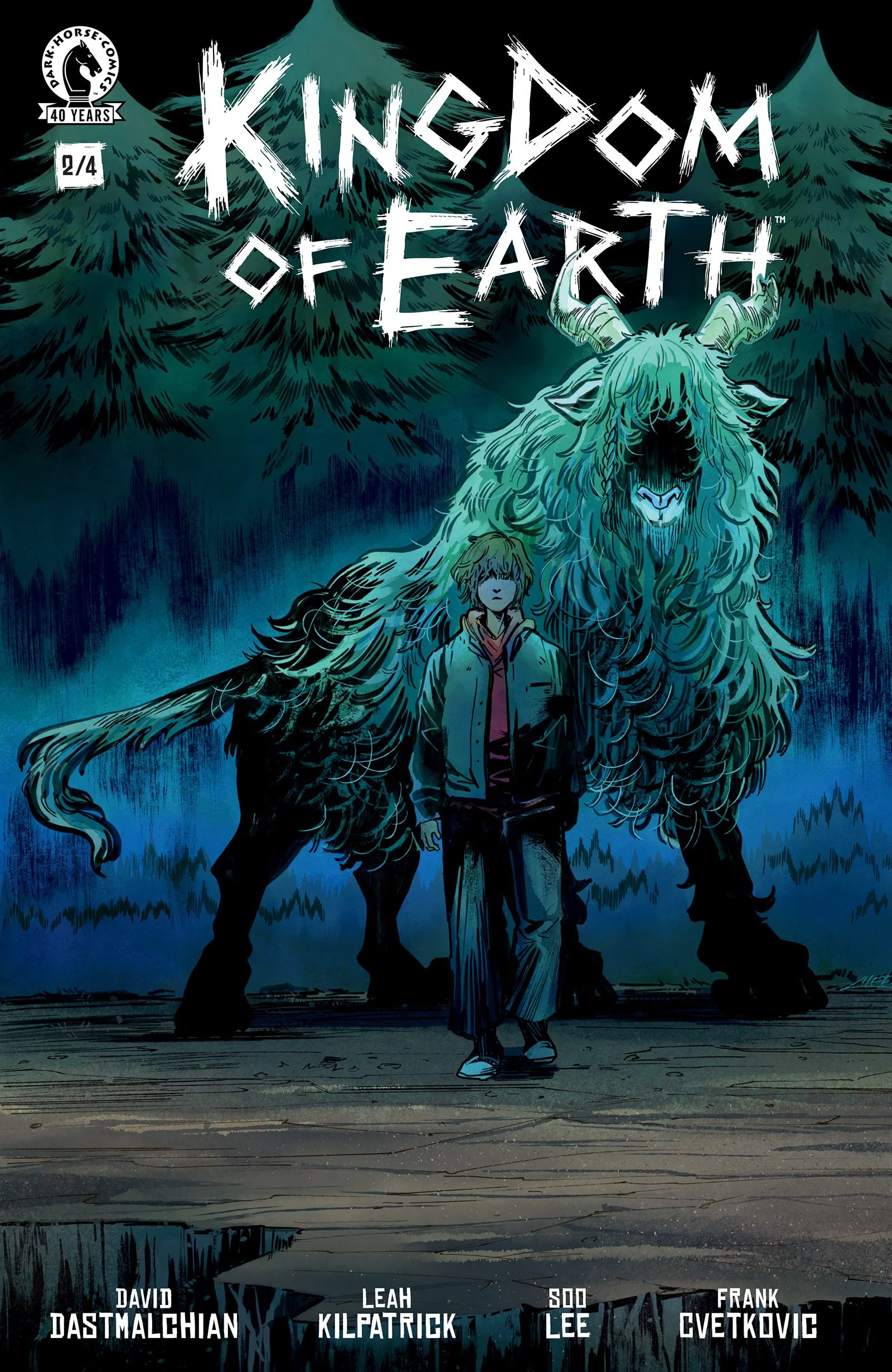
Credit: Dark Horse Comics
*** POSSIBLE SPOILER WARNING ***
STORY OVERVIEW:
Orpheus stands in front of the Northern Territories council and proposes how she would make the territory stronger. She suggests that they need to make their transportation better, while at the same time keeping their thumb on the humans as they are secretly trying to rebel. The Grand Leader quiets her and berates her for wasting his and the councils’ time with her fantastic lies. He proclaims that the Northern Territory is stronger than it’s ever been and that the humans know their place due to fear. He is so unhappy with her that he has some hard decisions to make in her regards. At the same time, Virago is still trying to protect the young human. However, she is in even more danger as there are some Bray Road Beasts that are hot on the scent of the human. Will Virago be able to out wit the beasts and keep the human safe?
WRITING:
This second issue does a good job of building on what the first issue introduced while also adding several new wrinkles that make the larger conflict feel more layered. David Dastmalchian and Leah Kilpatrick continue to flesh out this monster-run, post-apocalyptic world in a way that makes it feel more complicated than a simple humans-versus-monsters survival story. The council sequence in the Northern Territory is especially effective because it shows how unstable the power structure really is. On the surface, the monsters appear to be organized under one ruling order, but the debate quickly reveals cracks in that image. Orpheus presents herself as someone with a vision for strengthening the territory, pointing to transportation, human rebellion, and the need for tighter control. That immediately makes her feel dangerous because she is not just challenging the current system through brute force; she is trying to prove she has a smarter plan for ruling it.
The Grand Leader’s response adds another interesting layer to the issue. His dismissal of Orpheus shows that he still believes fear is enough to keep humans and other monsters in line. That arrogance makes him intimidating, but it also makes him seem vulnerable. Dastmalchian and Kilpatrick use that tension well, because the Grand Leader’s authority is obvious, but so is the possibility that his control may not be as absolute as he thinks. Orpheus comes across as a growing threat because she understands that the territory’s problems cannot simply be shouted down. The writing makes it clear that the real danger is not just a future rebellion from the humans, but the internal fracture forming among the monsters themselves.
That political power struggle is balanced well with Virago’s more immediate survival story. The scenes with Virago protecting the young human give the issue a stronger sense of urgency because the danger is not theoretical. The Bray Road Beasts being on the human’s trail creates a chase-driven tension that keeps the issue moving, while also showing how difficult Virago’s mission really is. What works best is that Virago does not simply overpower every threat in front of her. The writing allows her to rely on instinct, timing, and quick thinking, which makes her feel capable without making the danger feel too easy to overcome. Each escape feels like it costs something, and that helps the reader believe the human could still be taken at any moment.
The most compelling part of the issue is how Dastmalchian and Kilpatrick continue to hold back just enough information about Virago’s motivation. There are hints that her decision to protect the human is personal, or at least rooted in something deeper than simple pity, but the story does not reveal the full reason yet. That restraint works in the issue’s favor because it keeps Virago unpredictable. She is clearly putting herself at risk, but the reader is still left wondering what she sees in this human and why saving them matters so much. By keeping that answer mostly veiled, the writers create a mystery that gives the emotional side of the book more weight.
Overall, the writing in this issue succeeds because it expands the world in two directions at once. The council scenes develop the larger political landscape, while Virago’s scenes keep the story grounded in immediate danger and emotional mystery. The result is an issue that feels bigger than the first without losing focus. It deepens the monster hierarchy, sharpens the conflict between Orpheus and the Grand Leader, and gives Virago’s side of the story enough tension and intrigue to make the next issue feel important.
ARTWORK:
The artwork in this issue builds perfectly on what the story is trying to communicate. Soo Lee gives the book a visual identity that feels strange, and dangerous, which is exactly what this type of monster-dominated world needs. The art does not simply show a harsh post-apocalyptic setting; it makes the reader feel the weight of that world through crowded spaces, heavy shadows, and characters who look like they have been shaped by violence and survival. Lee’s linework gives the issue a rough, uneasy texture that fits the tone of the story, while still keeping the characters clear and expressive from panel to panel.
The council scenes are especially strong because Lee makes the monsters feel organized and chaotic at the same time. The staging gives the council chamber a sense of scale, making the space feel important without letting it become too clean or polished. The crowd reactions are a major part of why those pages work. Lee captures the way the council seems to shift depending on who is speaking, which visually reinforces the idea that power in the Northern Territory is unstable. Orpheus feels commanding because of the way she is framed, but the Grand Leader’s presence still dominates the room whenever he takes control of the conversation. That contrast helps the political tension land visually, not just through the dialogue.
The monster designs continue to be one of the strongest parts of the visual presentation. Lee gives each creature a distinct shape, posture, and personality, which keeps the world from feeling repetitive. Some monsters look regal, some look feral, and others feel strange in a way that makes them harder to read. That variety is important because it shows that this society has its own hierarchy and culture instead of feeling like a collection of random creatures standing around. Even in panels where a monster is not the main focus, the designs help fill out the background and make the reader believe there is a larger world beyond the immediate story.
The action scenes also hit the way they need to because Lee changes the energy depending on the situation. The attack on Orpheus is staged so the reader understands the ambush before seeing how quickly she can overcome it, which makes her feel powerful without slowing down the pacing. In contrast, the chase sequence with Virago and the young human has a more anxious rhythm. The pursuit feels tighter and more dangerous because the focus is not on a clean fight, but on movement, escape, and the constant threat of being caught. That difference in visual pacing helps separate Orpheus’s confidence from Virago’s desperation, giving each storyline its own visual feel.
Virago’s dwelling is another area where the artwork does a lot of storytelling. The backgrounds give the reader more information about who Virago is without needing the script to explain everything directly. The small details in the space make it feel personal and hidden away, which adds to the mystery of why Virago is protecting the human. Those quieter panels are just as important as the bigger monster scenes because they give the issue a sense of intimacy. They suggest history, secrecy, and emotional weight, making Virago’s side of the story feel more grounded.
The color choices match the tone and mood of the story very well. The darker palette gives the world a feeling of hopelessness and danger, but it does not flatten the visuals or make the pages hard to follow. Instead, the shadows and muted colors help create atmosphere while still letting key characters and moments stand out. Overall, Lee’s art strengthens the issue by making the world feel grand, threatening, and emotionally charged. The visuals support both the political side of the story and the more personal survival story, which makes the issue feel more complete.
Check Out MY REVIEW OF KINGDOM OF EARTH #1
Final Thoughts:
Kingdom of Earth #2 is a strong follow-up that expands the world while keeping the story focused on danger, mystery, and shifting power. The writing deepens the conflict between Orpheus and the Grand Leader, while Virago’s mission gives the issue a more personal sense of urgency. The artwork strengthens the book with striking monster designs, tense action, and a dark atmosphere that fits the story well. Overall, this issue builds momentum and makes the next issue feel worth following. If you didn’t pick up issue one think about grabbing both issues when you are at the shop this week.
FINAL GRADE: 9/10
Let me know your thoughts on Kingdom of Earth #2 in the comments below. Thanks for reading!