GAMBIT: WANTED #2 (MARVEL COMICS)
Not every hero feels like a hero right away. This is highlighted in this pre-X-Men story of Gambit, as we continue to follow Remy as he is a thief with a group of bandit kids he cares for. As Suzerain closes in on him and Elodie we get to see the qualities that will make him an X-Man in the future. But first he must beat the rough streets of New Orleans and the psychotic Bullseye.
Gambit: Wanted #2 - Written By Chris Claremont - Art By Robert Gill – Colors By Bryan Valenza - Letters By VC’S Ariana Maher-Edited By Mark Basso - Published By Marvel Comics
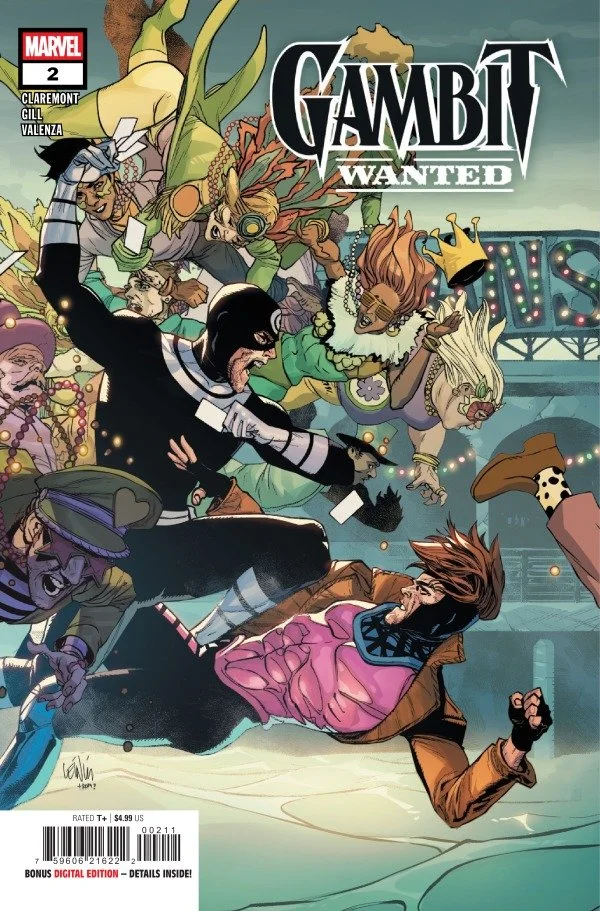
Credit: Marvel Comics
*** POSSIBLE SPOILER WARNING ***
STORY OVERVIEW:
This issue starts with Remy remembering back when he was training Elodie and Li’l Ro and the listens he was trying to teach them. We instantly get thrusted into the stories present as Bullseye has the street kids cornered and is ready for a fight with Elodie. Even though she puts up a valiant effort, she still ends up captured by Bullseye and delivered to Suzerain. As the kids find Remy to tell him that Elodie has been taken, Bullseye shows up to challenge Remy again and tries to capture him. As they start to battle again, a changed Elodie shows up and enters the battle to take out Bullseye, but to also capture Gambit. It’s revealed that Suzerain has a spell on her and she is not the only one from Remy’s past she has possessed. How will Remy get himself out of this well also saving the family he loves?
WRITING:
The second issue builds on the emotional stakes introduced in the first issue while raising the danger in a way that feels personal to Remy rather than simply bigger for the sake of spectacle. Chris Claremont leans into the heart of who Remy LeBeau is before he becomes the Gambit readers know from the X-Men, showing that his charm, confidence, and quick thinking have always been tied to a much deeper need for connection. The flashback to Remy training Elodie and Li’l Ro works well because it shows him not just as a thief teaching survival skills, but as someone trying to pass on lessons to kids he sees as family. That gives the present-day conflict more weight, because when Elodie is taken, it is not just another threat on the board. It is an attack on one of the few meaningful bonds Remy has built for himself.
Claremont does a strong job using this younger version of Remy to highlight the qualities that will eventually make him fit so naturally with the X-Men. Remy is still living in the gray areas of the Marvel Universe, surviving through theft, instinct, and street-level connections, but the issue makes it clear that he is not motivated only by self-interest. His loyalty to the street kids, his protective instincts, and the way he carries guilt and responsibility all point toward the hero he will become later. That is where the writing is most effective: it does not try to force Remy into being a polished hero too early. Instead, it lets readers see the raw pieces of his future self already forming beneath the swagger.
Bullseye’s presence adds a sharp edge to the issue because he brings a kind of chaos that Remy cannot simply talk or charm his way around. Claremont uses him as more than a recognizable villain guest star; Bullseye functions as a direct threat to the fragile family Remy has built. His unpredictability makes every confrontation feel dangerous, especially because he seems to enjoy pushing situations further than they need to go. That energy helps keep the issue moving and gives the action scenes a sense of menace, even when the larger mystery around Suzerain is still unfolding in the background.
Suzerain’s role also becomes more compelling in this issue because her plans begin to feel both larger and more emotionally invasive. Her obsession with controlling Remy gives the story a sinister quality, especially once it becomes clear that she is willing to manipulate people from his past in order to get to him. The possession element raises the stakes in a way that fits the theme of Remy’s chosen family being used against him. It also makes the conflict more painful than a simple physical fight, because Remy is being forced to face enemies who are connected to the life he has tried to protect.
What makes the writing work best is that the action never fully overtakes the emotional core of the issue. The fight scenes are entertaining and have plenty of momentum, but they matter because they are tied to Remy’s fear of losing the people closest to him. Claremont continues to expand Remy’s personal lore while still keeping him recognizable, balancing the larger superhero stakes with the street-level drama that makes this pre-X-Men period feel distinct. By the end of the issue, the danger around Remy feels more complicated, the emotional stakes feel sharper, and the series has a clearer sense of why this chapter of his life matters.
ARTWORK:
The artwork in this issue is one of its biggest strengths because it captures both the energy of a classic X-Men adventure and the street-level grit that makes this chapter of Remy’s life feel personal. Robert Gill gives the book a visual style that feels familiar without looking stale, leaning into recognizable designs for Gambit and Bullseye while still giving the issue enough detail and expression to stand on its own. Remy has the right balance of confidence, movement, and danger in his body language, which helps sell him as someone who is still rough around the edges but already carries the natural charisma that will define him later. Bullseye, meanwhile, is drawn with an intensity that makes him feel unpredictable from panel to panel, giving his scenes a sharp sense of menace.
Gill’s character expressions are especially important in this issue because so much of the story depends on emotional tension. The scenes with Remy, Elodie, and the younger street kids work because the art gives their relationships a sense of history. Even in quieter moments, the characters do not feel static; their posture, reactions, and glances help communicate the trust and worry between them. That becomes even more effective once Elodie is taken and later returns changed, since the visual shift makes her feel familiar but unsettling. The art makes it clear that something is wrong before the story has to over-explain it.
The New Orleans setting also benefits from the added visual personality. The backgrounds give Remy’s world a lived-in feeling, helping the city feel like more than just a backdrop for the action. The streets, shadows, and local atmosphere all support the Cajun flavor associated with Gambit, reinforcing the idea that this is his home turf and that the people here matter to him. That sense of place is important because the issue is not just about Remy fighting villains; it is about Remy trying to protect a world that shaped him.
The action sequences are paced with a strong sense of motion, which is essential for a character like Gambit. Gill keeps the fights clear and energetic, allowing the reader to follow the movement without losing the impact of each clash. The battles with Bullseye feel fast and dangerous because the layouts emphasize striking poses, quick reactions, and sudden bursts of violence. That gives the issue the kind of kinetic excitement readers expect from a Gambit story while still leaving room for the more emotional beats to breathe.
Bryan Valenza’s colors bring all of these elements together by giving the issue warmth, atmosphere, and superhero energy. The color work helps separate the street-level scenes from the more heightened villain moments, making the book feel visually varied without becoming inconsistent. The brighter flashes of action contrast nicely with the moodier surroundings, and that balance helps the issue maintain its classic comic book feel. Together, Gill and Valenza create artwork that feels expressive, nostalgic, and exciting, making the visuals a strong match for a story that wants to honor Gambit’s past while deepening the emotional stakes around him.
Check Out My Review of GAMBIT: WANTED #1
Final Thoughts:
Gambit: Wanted #2 is a strong continuation that deepens Remy’s emotional stakes while keeping the action sharp and entertaining. Chris Claremont shows why Remy’s loyalty and heart matter just as much as his charm, while Bullseye and Suzerain give the issue a dangerous edge. With expressive artwork from Robert Gill and energetic colors by Bryan Valenza, this issue delivers a solid mix of character drama, street-level tension, and classic Marvel action. If you are a fan of the X-Men, this is definitely a book you should pick up at the LCS this week.
FINAL GRADE: 9.2/10
Let me know your thoughts on Gambit: Wanted #2 in the comments below. Thanks for reading!