DOG TAG #4 (Mad Cave Studios)
As the Allies move in on Berlin, they must take over every small town, village, and hamlet on the way. Tom Fuller and his men are the group that goes in, clears out the remaining foes, and prepares for the larger forces to move in. However, there is more of an emotional and materialistic nature to what is going on, which totally takes Tom by surprise.
Dog Tag #4 - Written By Mark Russell – Art By PJ Holden - Colors By JP Jordan - Letters By Buddy Beaudoin -Edited By Jon Moisan - Published By Mad Cave Studios
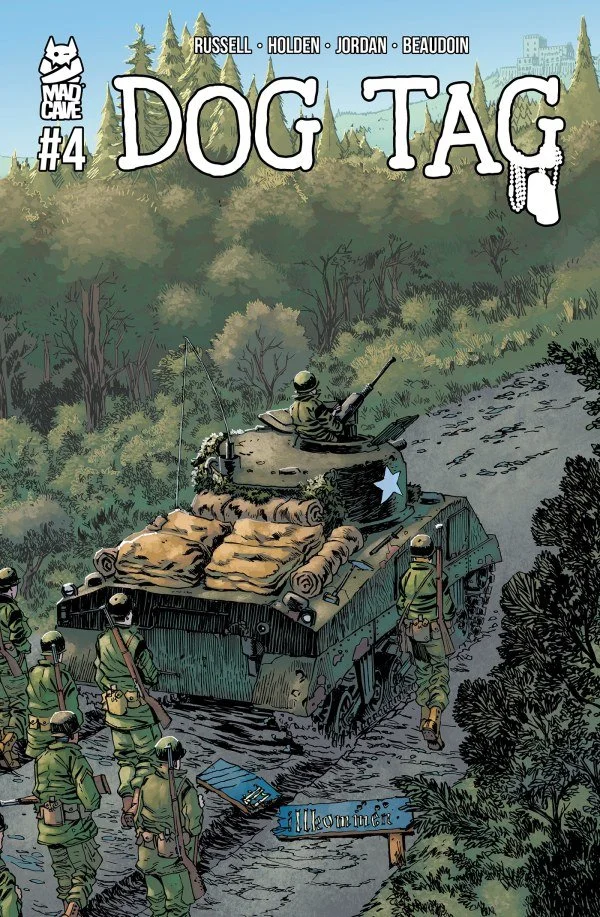
Credit: Mad Cave Studios
*** POSSIBLE SPOILER WARNING ***
STORY OVERVIEW:
Tom Fuller and his men are moving into Kaiserbrucken, Germany to clear out the town of any remaining Nazi loyalists. This is how the Allies are clearing their way to Berlin and the eventual overthrowing of the Third Reich. As they enter the town in the cover of night, they find three SS Officers. They end up killing one and taking the other two into custody. After they do this the townspeople feel free and thank them with treats and beverages. Tom can’t help but feel like there is something underlying that makes him slightly uneasy. But that feeling gets put on hold as the captain shows up just in time to take credit for taking another town. He sets up his HQ at the towns Rathaus, but that night the Rathaus is set on fire. The captain believes that there must be more loyalists, but the truth is even more sinister than that.
WRITING:
This issue continues to show why Dog Tag works so well as a World War II story, because Mark Russell is not interested in presenting war as something simple, clean, or purely heroic. The official setup of the issue has Tom’s unit pushing deeper into Germany while dealing with the SS loyalest left behind to stop locals from surrendering to American forces, and Russell uses that idea to build a story that feels part military mission, part mystery, and part moral reckoning. Instead of making the town’s liberation feel like an easy victory, he lets unease settle over the issue from the moment Tom and his men arrive. The townspeople seem grateful, but the mood never feels fully safe, and that tension gives the story a strong sense of suspicion before the darker truth comes out.
Russell does a strong job using Tom Fuller’s point of view to guide the reader through that discomfort. Tom understands the job in front of him on a basic level: sweep the town, find the remaining Nazi loyalists, secure the area, and allow the larger Allied force to keep moving. What makes the writing more interesting is that Tom can feel there is something wrong even before he has the facts. His instincts become one of the issue’s strongest narrative tools. The reader is placed in the same position as Tom, recognizing that the cheers, gifts, and relief from the townspeople may not be telling the whole story. That slow build of apprehension gives the payoff much more impact when the situation moves beyond a simple search for SS holdouts.
The burning of the Rathaus is a smart turning point because it initially appears to confirm the captain’s assumption that more loyalists must still be hiding in the town. Russell then twists that expectation by revealing a more complicated and uglier motivation. The issue is not just about Nazi resistance; it is also about the way ordinary people can become complicit when they benefit from stolen property, violence, and persecution. The land deeds give the story a sharp moral edge, because they show that the town’s desire to be liberated may be tied less to guilt or justice and more to protecting what they gained from the crimes committed around them. That revelation makes the issue feel heavier than a standard war comic, because it forces the reader to sit with the uncomfortable idea that evil is not always limited to the uniformed enemy.
What also stands out is Russell’s restraint. He does not over-explain the theme or turn the story into a lecture. Instead, he lets the facts of the situation speak through character reactions, small moments of unease, and the gradual uncovering of what the townspeople are really protecting. The use of the local woman as the person who explains the truth to Tom is especially effective because it makes the reveal feel personal rather than procedural. It is not delivered like a historical footnote; it lands like a confession, a warning, and an accusation all at once. That keeps the issue emotionally grounded while still connecting it to the larger historical realities the series has been exploring.
By the end of the section, Russell has expanded the definition of what Tom and the Allies are fighting against. The issue is still about the final push toward Berlin, but it is also about memory, accountability, and the hidden crimes that survive after the shooting slows down. That is what makes the writing so effective. Russell captures the mechanics of a wartime operation while also examining the human cost of what those operations uncover. Dog Tag #4 uses its historical fiction framework to ask hard questions about survival, guilt, and the price of looking too closely at what people would rather leave buried.
ARTWORK:
The artwork in this issue does a lot of heavy lifting because the story depends so much on atmosphere, suspicion, and the slow realization that something is wrong beneath the surface. PJ Holdencaptures Kaiserbrucken as a place that feels both historically grounded and emotionally uneasy. The buildings, streets, interiors, and nighttime staging give the town a realistic quality without making it feel overly polished or romanticized. It looks like a real place that has been worn down by war, occupation, and fear, which helps the reader understand why the Allied soldiers cannot simply walk in and treat the town’s welcome as a clean victory.
Holden’s character work is especially important to how the issue plays. The soldiers have a tired, focused physicality that sells the routine danger of clearing one more town on the road to Berlin. Tom’s expressions carry a lot of the storytelling, because the reader can see his discomfort building even when the dialogue has not fully explained why he feels uneasy. The townspeople are drawn with just enough warmth to make their gratitude believable, but there is also a stiffness and guarded quality to many of them that keeps the reader from fully trusting the moment. That balance is what makes the visual storytelling so effective: the art supports the mystery without giving everything away too early.
The action and suspense are also handled with strong clarity. The opening movement through the town, the confrontation with the SS officers, and the later fire at the Rathaus all have a grounded sense of movement. Holden does not make the violence flashy or exaggerated. Instead, the panels keep the focus on procedure, reaction, and consequence, which fits the tone of the story perfectly. When the Rathaus burns, the imagery becomes more urgent and chaotic, but it still feels connected to the larger mystery rather than turning into a spectacle. The fire works visually because it marks a shift in the story: the threat is no longer just the obvious enemy hiding in the town, but the hidden truth the town is trying to destroy.
JP Jordan’s colors add a lot to that feeling. The palette gives the issue an aged, muted quality that suits the period setting and keeps the world from feeling too bright or clean. The use of darker tones, smoky shadows, and restrained warmth helps separate moments of false comfort from moments of danger. When the story moves into its harsher revelations, the colors help pull the reader into a heavier emotional space. They make the town feel cold, weathered, and morally compromised, which strengthens the impact of the writing without overpowering it.
Buddy Beaudoin’s lettering keeps the issue easy to follow while matching the serious tone of the book. The dialogue and narration are clear, controlled, and never get in the way of the art. That matters in an issue like this, where the quiet exchanges are just as important as the more dramatic moments. Together, the art, colors, and lettering create a visual experience that is restrained but powerful. The issue looks like a war comic, but more importantly, it feels like a story about what war uncovers after the fighting moves from the battlefield into the lives of ordinary people.
Check Out My Review of DOG TAG #3
Final Thoughts:
Dog Tag #4 is another strong issue that proves this series is not interested in easy heroics or simple answers. The creative team delivers a tense, morally complicated war story that uses a small town’s liberation to reveal something much darker underneath. It is grim, thoughtful, and sharply executed, making this one of the more compelling entries in the series so far. This book should absolutely be on your Pull List, and if it’s not pick up a copy of this issue to see what you’ve been missing.
FINAL GRADE: 9.3/10
Let me know your thoughts on Dog Tag #4 in the comments below. Thanks for reading!