THE INFERNAL HULK #8 (MARVEL COMICS)
Bruce Banner and the rest of the heroes are trying to figure out how to stop Hulk and the Age of Monsters. This will take them on a journey to an ancient world that is deep inside of the Earth. Once there they will learn some truths that they could never have imagined.
The Infernal Hulk #8 - Written By Phillip Kennedy Johnson - Art By Adam Gorham - Colors By Matthew Wilson - Letters By Cory Petit - Edited By Jordan D. White - Published By Marvel Comics
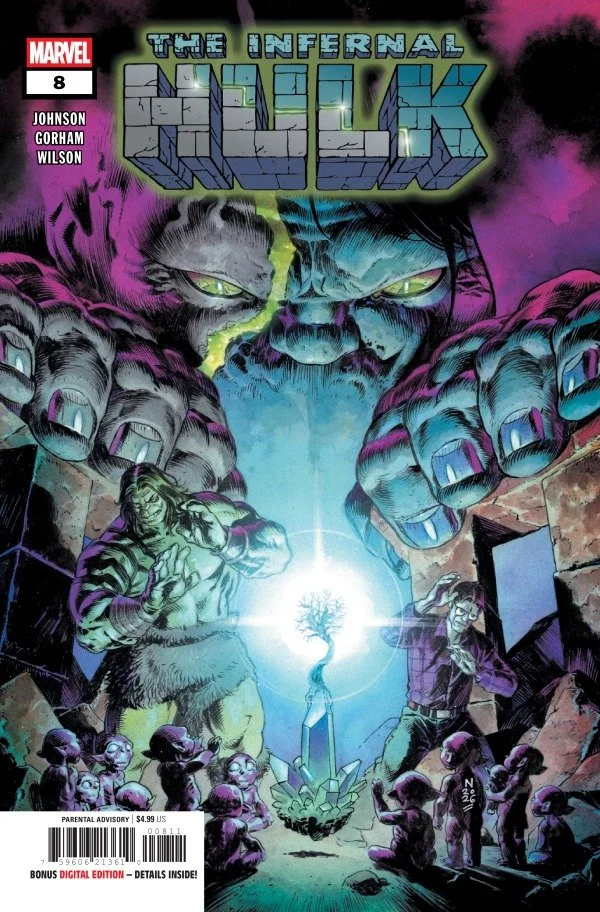
Credit: Marvel Comics
*** POSSIBLE SPOILER WARNING ***
STORY OVERVIEW:
As Bruce and the Avengers try and find a way to the stop the Hulk. The Hulk is growing his monster army, so that the Age of Monsters can take full hold of our world. The Avengers learn that Bruce may not be able to become the Hulk again. This throws a wrench into their plans of fighting back. Bruce however remembers a place underground where there is nothing but death, he thinks they may be able to find something there. Once they arrive, they discover there is life and it is Skaar and he’s not happy to see them. The reason why is because he is protecting these creatures, the Rutlings who live in this ancient world and protect a tree of light that has healing powers. Is this tree what the heroes need to stop Hulk?
WRITING:
This issue continues to build on the storylines that have been intertwining throughout the series, and Phillip Kennedy Johnson makes it feel like each thread is now being pulled closer to the center of one massive event. What has worked so well about this arc is that it has not been focused on one simple conflict. Instead, Johnson has layered Bruce Banner’s desperation, Hulk’s growing influence, Betty Ross’ emotional turmoil, and the larger threat of the Age of Monsters into a story that feels bigger with every issue. Here, those pieces begin to echo one another in interesting ways. Hulk is growing his army through a grotesque tree of monsters, while Bruce and the heroes discover a tree of life hidden in the ancient world beneath the Earth. That contrast immediately stands out. It gives the issue a strong sense of symmetry, as if the story is setting up two opposing forces that are destined to collide. Whether this turns out to be a major revelation or an elaborate misdirection, it is an effective plot point because it deepens the mythology of the series while also giving the heroes a possible path forward.
Betty Ross’ role in the issue is also important because Johnson continues to use her as more than just a supporting presence in Bruce’s orbit. She is clearly still dealing with the emotional weight of everything that has happened, and her decision to visit her father adds another personal complication to an already dangerous situation. On the surface, it may seem like a quieter subplot compared to the monster army and underground fantasy elements, but it carries a lot of potential consequences. With Hulk becoming more desperate to keep Banner and the Avengers away from his plans, Betty putting herself back into that family history feels like the kind of choice that could change the direction of the story. Johnson has kept her slightly to the side for much of this arc, which may have made readers think she was less central to the endgame. This issue suggests the opposite. Betty may end up being one of the emotional pressure points that determines where the story goes next.
The strongest writing in the issue comes from how Johnson handles Bruce Banner’s state of mind. Bruce says and does things that can be understood as heroic because he wants to stop Hulk and save the world from the Age of Monsters. At the same time, there is an uncomfortable edge to his desperation. His need to become the Hulk again is not presented as a clean, noble objective. It feels obsessive, almost like he cannot separate the mission from his own need to reclaim the power and identity that have defined him for so long. That makes Bruce more complicated and keeps the issue from becoming a straightforward heroes-versus-monsters story. Johnson makes the reader question whether Banner wants the Hulk back because it is the only way to win, or because some part of him cannot function without that connection. That uncertainty gives the issue a stronger psychological hook and keeps the tension high even when the story slows down to explore its mythology.
ARTWORK:
The artwork gives this issue a strong sense of atmosphere, with Adam Gorham leaning fully into the strange blend of fantasy, horror, and superhero spectacle that defines this arc. The ancient world beneath the Earth feels alive in a way that immediately separates it from the surface-level destruction usually associated with a Hulk story. There is an eerie beauty to the setting, especially in the way the environment is filled with unusual creatures, massive natural structures, and details that make the underground world feel both ancient and dangerous. Gorham’s designs help sell the idea that this is a place with its own history and rules, which makes the arrival of Bruce and the Avengers feel like an intrusion into something much larger than them.
The character work is also effective because the figures carry the emotional weight of the story without losing the larger-than-life energy of the action. Skaar’s presence has a raw physical power to it, and his connection to the world he is protecting comes through in the way he is staged against the landscape. The Rutlings have a memorable design that gives them personality while still keeping them connected to the unsettling mythology of this world. On the other side of the story, the monstrous imagery tied to Hulk continues to feel grotesque and overwhelming, making his growing army look less like a normal threat and more like something spreading through the world like an infection. That visual contrast between the tree of light and the tree of monsters helps reinforce the issue’s central conflict before the characters even explain it.
Matthew Wilson’s colors add a lot to that impact by giving the issue a rich, dreamlike quality. The darker tones create the horror mood, while the brighter bursts of color make the ancient world and the tree of light stand out even more. That balance keeps the book from looking visually flat or overly grim. Instead, the pages have a strange vibrancy that makes the fantasy elements feel wondrous while still maintaining the sense that something terrible is waiting beneath the surface. Together, the art and colors make the issue feel like a vivid nightmare, one where beauty and danger exist side by side. It gives The Infernal Hulk #8 a distinct visual identity and makes the world-building feel just as important as the plot itself.
CHECK OUT MY REVIEW OF THE INFERNAL HULK #7
Final Thoughts:
The Infernal Hulk #8 is really adding the layers to this story that creates even more intrigue. The more this series goes and the more that is revealed, the more interesting the story becomes. The big risks that are being taken in this series are really starting to pay off, which is setting up for a great final push. If you were sleeping on this series, it may be time to catch up. Head to the LCS and grab some issues or get them all on Neon Ichiban today!
FINAL GRADE: 8.8/10
Let me know your thoughts on The Infernal Hulk #8 in the comments below. Thanks for reading!