SPAWN ‘77 #1 (IMAGE COMICS/TODD MCFARLANE PRODUCTIONS)
In 1977 the streets belong to the Moretti Crime Family, or so they thought. They have a big problem that has seemingly returned from the dead to make them pay for their sins. Spawn ’77 from Image Comics & Todd McFarlane Productions, brings the original Spawn concept created by Todd McFarlane to life.
Spawn ‘77 #1 – Written By Mark Spears & Todd McFarlane – Art By Mark Spears – Letters By Tom Orzechowski – Edited By Thomas Healy - Published By Image Comics/Todd McFarlane Productions
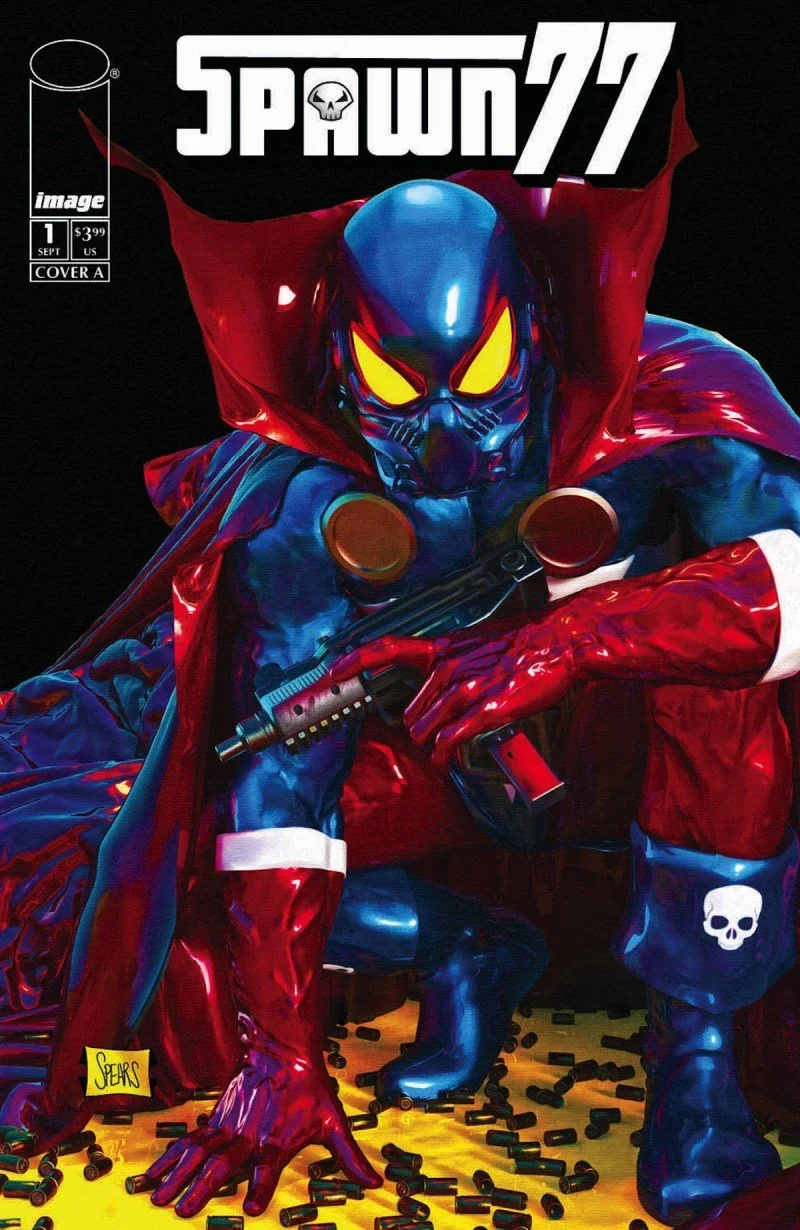
Credit: Image Comics/Todd McFarlane Productions
*** POSSIBLE SPOILER WARNING ***
STORY OVERVIEW:
The Moretti Crime Family rules over the city and controls the criminal underworld, or that was until now. They have a ghost that is following them and making them pay for their sins. A Hellspawn that has returned from the dead to make them pay for killing him and taking his daughter away. Now, Spawn is avenging these wrongs by taking out family members and associates alike. But there may be more to this Spawn than what we have become to know about the Hellspawn over the years. However, when Sal’s back is against the wall, it has now become Spawn hunting season, and this new Spawn is the number one target.
WRITING:
This first issue of Spawn ’77 hits the ground running and never looks back, immediately establishing a violent, dangerous world in which revenge is both intensely personal and impossible to escape. Mark Spears and Todd McFarlane take the familiar mythology of the Spawn franchise and reshape it into a clever period crime story that feels recognizable without simply repeating what readers have seen before. The premise had to fit within more than three decades of established Hellspawn lore, and the writers handle that challenge with confidence. Rather than introducing another conventional Hellspawn, they center the story on Tommy, a man who deliberately adopts Spawn’s terrifying image and reputation as a weapon against the Moretti Crime Family. That choice adds an intriguing layer to the narrative because Tommy is not relying on supernatural power; he is using fear, strategy, and the mythology surrounding Spawn to make his enemies believe that something from Hell has returned for them.
The issue also gives Tommy’s mission a strong emotional foundation. His anger is not presented as random violence but as the result of betrayal, murder, and the loss of his daughter. Spears and McFarlane provide enough backstory to explain who Tommy is, why he is seeking revenge, how he developed the idea of portraying Spawn, and what he ultimately hopes to accomplish. At the same time, they avoid revealing every detail, leaving important questions about his past, his plan, and the full extent of his connection to the Moretti family unanswered. This balance allows the issue to feel complete as an opening issue while still creating momentum for the rest of the series.
The brutal action sequences are unmistakably rooted in the Spawn franchise. The violence is graphic, fast-paced, and designed to show how far Tommy is willing to go, but it also serves a narrative purpose by steadily dismantling the Moretti organization and increasing the family’s desperation. Each confrontation makes Tommy more dangerous in their eyes and pushes Sal toward a more extreme response. Sal’s decision to hire a sadistic and highly capable hitman raises the stakes considerably, transforming the conflict from a one-sided campaign of revenge into a deadly hunt. By the end of the issue, that decision has serious consequences for Tommy and makes it clear that his enemies are no longer willing to wait for his next attack.
The appearance of a mysterious Hellspawn hunter from beyond Tommy’s world adds an even more compelling complication. Tommy may have successfully convinced criminals that he is a supernatural avenger, but this new threat could expose the limits of that deception. Because Tommy is not a true Hellspawn, the central question becomes how an ordinary man however determined, resourceful, and ruthless can survive against an opponent with genuine otherworldly powers. That contrast creates tension on two levels: Tommy must continue his war against the Moretti family while also facing something far beyond the human enemies he prepared to fight. Together, the hitman and the Hellspawn hunter broaden the scope of the story, deepen the danger surrounding Tommy, and create strong anticipation for the next issue. Readers are left wanting to know whether Tommy can maintain the illusion, complete his revenge, and save his daughter after drawing the attention of forces he may not fully understand.
ARTWORK:
The artwork in this first issue is outstanding, giving the world of Spawn ’77 a visual identity that feels both grounded in reality and unmistakably connected to the larger Spawn Universe. Mark Spears brings the realistic painted style for which he has become known directly into the franchise, and the result immediately separates this series from more traditional comic book interpretations of Spawn. His pages often resemble carefully composed photographs or cinematic stills rather than conventional panels. Faces carry convincing texture, clothing has weight, and locations feel tangible, allowing the reader to believe that these characters occupy a 1970s world rather than a stylized backdrop.
Spears’s attention to environmental detail is especially effective in the quieter scenes. Bars, pool halls, streets, and interiors are filled with period-specific textures, lighting, and objects that establish the era without making the setting feel like a costume. Even a simple game of pool is rendered with enough care to appear gallery worthy. The polished wood, reflected light, shadows, smoke, and surrounding figures create a sense of depth that draws the reader into the room. These details do more than showcase Spears’s technical skill; they slow the story down at key moments and make the criminal world of the Moretti family feel established, powerful, and real before Tommy begins tearing it apart.
That realism makes the action and violence considerably more unsettling. The Spawn franchise has always been known for graphic imagery, but Spears’s painted approach gives every wound and violent consequence an almost physical presence. A decapitated head is not treated as a quick burst of exaggerated comic book gore; it is given texture, weight, and disturbing believability. The final page image in the church is particularly memorable because the sacred setting contrasts sharply with the gruesome scene placed inside it. The composition, detailed rendering, and dramatic lighting transform the moment into something horrifying yet visually striking, leaving the issue on an image that is difficult to forget.
The strongest visual element, however, is the design of Spawn himself. Tommy’s costume preserves the familiar silhouette, colors, and threatening presence associated with the character while also making it clear that this is not a supernatural suit. Because Tommy is not truly a Hellspawn, the outfit looks assembled from practical, man-made materials. The mask, for example, appears to be a reshaped and repurposed gas mask, giving it a rough industrial quality that suits both the period and Tommy’s improvised campaign of fear. Other parts of the costume similarly suggest fabric, straps, armor, and equipment that a determined man could realistically acquire or construct. These visible imperfections make the design more convincing while reinforcing the central idea that Tommy is building the legend of Spawn for himself.
At the same time, the costume still has the commanding presence readers expect from the franchise. The yellow glow of the eyes creates an eerie focal point and makes Tommy appear inhuman when he emerges from darkness. The red accents cut sharply across the deep blue suit, producing a bold silhouette that is immediately recognizable without copying the traditional Spawn design. Spears successfully balances familiarity and originality: longtime readers can identify the visual language of Spawn at a glance, yet this version belongs specifically to Tommy and to the gritty 1977 setting.
The color palette plays an equally important role in unifying the artwork. Everyday scenes use earthy, muted hues that support the book’s realism and evoke the browns, oranges, faded greens, and warm interior lighting associated with the decade. Against those restrained surroundings, the stronger colors of Tommy’s suit become even more dramatic. The glowing yellow eyes, rich blue material, and sharp red outlining make him dominate each scene in which he appears. This contrast visually expresses Tommy’s purpose within the story: he is an unnatural, terrifying presence invading a criminal world that once believed it was untouchable. Through its detailed painting, period atmosphere, disturbing violence, inventive costume design, and carefully controlled color choices, the artwork gives Spawn ’77 a distinctive look that is both beautiful and deeply unsettling.
CHECK OUT OUR INTERVIEW ON YOUTUBE WITH TODD MCFARLANE
Final Thoughts:
Spawn ’77 #1 delivers a bold, brutal, and visually striking debut that successfully blends classic Spawn mythology with a gritty 1970s crime story. Tommy’s revenge driven mission, the escalating threats around him, and Mark Spears’ exceptional painted artwork make this an exciting and distinctive addition to the franchise. It is a compelling opening issue that leaves plenty of mystery and momentum for what comes next. This is a must have and you should definitely grab multiple copies when you visit the comic shop this week. If you haven’t put this on your Pull List yet, make sure to add it well you’re at the shop as well.
FINAL GRADE: 10/10
Let me know your thoughts on Spawn ‘77 #1 in the comments below. Thanks for reading!