SPACE GHOST VS THE HERCULOIDS #1 (DYNAMITE ENTERTAINMENT)
The wait for the return of Space Ghost is over and this time he isn’t coming alone! The crossover event we have all been waiting for is finally here and now that The Herculoids have joined the party all bets are off. What happens when the Herculoids are threatened by the Galactic Federation? Carnage that’s what, and there is only one man who can try and stop them and that’s Space Ghost. What will happen when these two titans face off? We will soon find out in this three issue mini-series from Dynamite Entertainment!
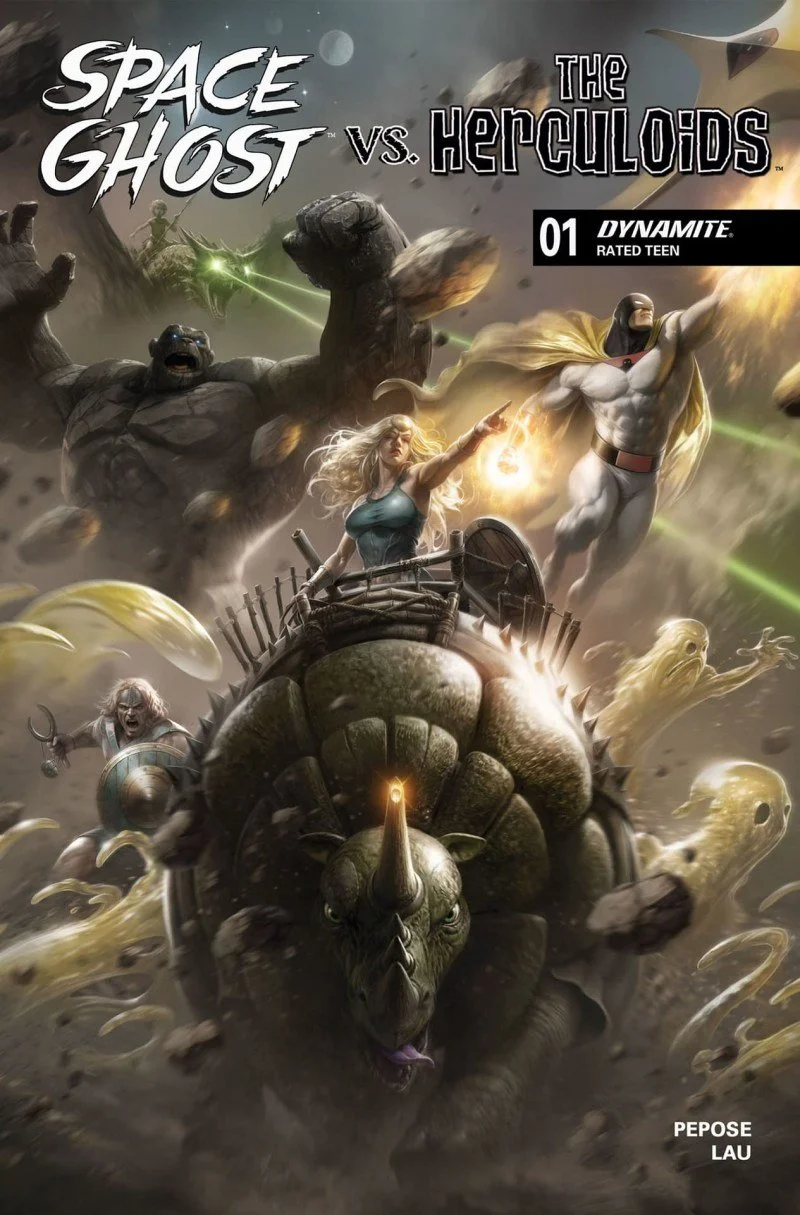
Space Ghost vs The Herculoids #1 - Written By David Pepose – Art By Jonathan Lau - Colors By Andrew Dalhouse - Letters By Taylor Esposito - Edited By Joseph Rybandt - Published By Dynamite Entertainment
Credit: Dynamite Entertainment
*** POSSIBLE SPOILER WARNING ***
STORY OVERVIEW:
We start with a backstory to catch readers briefly up on who the Herculoids are before yanking out their hearts out. The death of Zandor’s family sets in motion a wave of revenge focused straight on the Galactic Federation. We then get caught up on what Space Ghost and his team have been up to as well. They are fending off Krugar and his gang of space pirates. After Space Ghost and company apprehend Krugar and stop his pirates from taking a space freighter, they are summoned to Cetia-7, the home world of the Galactic Federation. They meet with the Chief Warden of the Galactic Federation, Doctor Arko Diem also known as the Evil Collector. He brings Space Ghost up to speed about the threat of a terrorist group known as the Herculoids. He lets them know that they are fueled by Quasarite, which is a rare mineral found on their planet of Amzot. That mineral can give beings super abilities and makes the Herculoids a massive threat. However, as they are talking the Herculoids attack Cetia-7 and Space Ghost and his team will come face to face with them for the first time.
WRITING:
This first issue performs the difficult task of reintroducing Space Ghost after the events of volume two while also presenting the Herculoids to readers who may have little or no familiarity with them. David Pepose handles that balancing act with confidence, giving each cast enough space to establish its history, emotional stakes, and role in the larger conflict. Rather than treating the crossover as a simple excuse for two famous properties to collide, he builds the confrontation around grief, misinformation, and competing ideas of justice. That approach makes the inevitable clash feel meaningful instead of manufactured.
The Herculoids’ opening backstory gives the issue its emotional foundation. By revealing the attack on Amzot and the apparent deaths of Zandor’s wife and son, Pepose immediately explains why Zandor and his allies are willing to strike at the Galactic Federation with such ferocity. Their actions may appear extreme from the outside, but the reader understands that they are driven by loss and a belief that a powerful institution has destroyed everything they were sworn to protect. This perspective keeps the Herculoids from becoming one-dimensional antagonists. They are dangerous, but they are also grieving defenders whose anger has been shaped by a devastating personal tragedy.
Pepose gives Space Ghost a similarly human motivation. The scenes involving him and his family remind readers that the physical and psychological wounds from the previous volume have not fully healed. Space Ghost can still overpower pirates and protect innocent travelers, yet his heroism does not erase the strain left by earlier events. That vulnerability adds weight to his return and prevents the opening action from feeling like an empty victory lap. His family dynamic also reinforces what separates him from the Herculoids: both groups are fiercely protective, but Space Ghost is trying to hold his family together while Zandor is reacting to the belief that his has already been taken from him.
The meeting with Doctor Arko Diem, better known as the Evil Collector, introduces the issue’s central mystery. Diem describes the Herculoids as Quasarite-enhanced terrorists intent on threatening the Federation and, potentially, the entire universe. His account is presented with official authority, but it immediately conflicts with what the reader has already witnessed on Amzot. We know the Herculoids did not begin their campaign without provocation, and that contradiction casts suspicion over every claim Diem makes. Pepose uses dramatic irony effectively here: Space Ghost has only the Federation’s version of events, while the audience has enough information to recognize that he may be manipulated into fighting the wrong enemy.
That gap in knowledge gives the crossover its strongest tension. Space Ghost and the Herculoids are not simply opposites; they are heroic forces approaching the same crisis from incomplete perspectives. Space Ghost believes he is preventing a terrorist attack, while Zandor believes he is striking back at those responsible for his family’s deaths. Their confrontation therefore carries a tragic quality because both sides may be acting from understandable motives while serving someone else’s hidden agenda. The Evil Collector’s history and carefully framed explanation make him an obvious source of suspicion, but Pepose leaves enough unanswered questions to keep the conspiracy compelling.
The issue also knows when to shift from exposition and emotional setup into spectacle. The battle with Krugar and the space pirates reestablishes Space Ghost’s abilities, the teamwork of his crew, and the adventurous energy of the series. Later, the Herculoids’ assault on Cetia-7 raises the scale and delivers the collision promised by the title. The action is not separate from the character work; it demonstrates how each group responds under pressure and how quickly misunderstanding can turn powerful protectors into enemies.
Overall, Pepose delivers a robust opening issue that respects both properties while giving the mini-series a clear emotional and narrative engine. The grief surrounding Zandor, the lingering trauma carried by Space Ghost, and the contradictions in Diem’s story establish several layers of conflict before the first major face-off even begins. At the same time, the energetic action ensures that the issue never becomes weighed down by its setup. The result is a thoughtful and entertaining first installment that gives longtime fans recognizable versions of these characters while providing new readers with enough context to become invested in what happens next.
ARTWORK:
The artwork in this first issue continues the high visual standard readers have come to expect from the Space Ghost franchise. Jonathan Lau once again brings a polished, cinematic quality to every page, combining clean character work, expressive faces, and large-scale science-fiction imagery. His layouts give the story momentum without sacrificing clarity, allowing the reader to follow each confrontation while still appreciating the size and detail of the environments. Whether the scene takes place aboard a spacecraft, on a distant planet, or within the imposing architecture of the Galactic Federation, Lau makes each location feel distinct and fully connected to the larger universe.
One of Lau’s greatest strengths is his ability to communicate scale. The ships, stations, alien landscapes, and futuristic structures feel massive, but they never overwhelm the characters at the center of the story. Wide shots establish the grandeur of the setting, while tighter panels bring the focus back to personal reactions and physical movement. This balance is especially important in a crossover that brings together two properties with very different visual identities. The familiar cosmic adventure of Space Ghost remains intact, yet the arrival of the Herculoids expands the world into something more primal, dangerous, and unpredictable.
Lau’s depiction of Space Ghost and his family retains the style that has become recognizable throughout the relaunched series. Space Ghost appears powerful and heroic, with a commanding presence that comes through in both quiet moments and explosive action scenes. At the same time, Lau gives the character enough physical expression to show the strain beneath that confident exterior. Jan, Jace, and Blip are not treated as background figures; their body language, reactions, and placement within the panels reinforce the sense that they operate as a family and a team. That visual connection makes their scenes feel more personal and gives the action greater emotional weight.
The Herculoids are the true visual highlight of the issue. Lau updates the classic characters without losing the qualities that made their original designs memorable. Zandor has the imposing appearance of a battle-hardened barbarian king, and his posture and expressions convey the burden of a leader driven by grief. The creatures surrounding him each have a strong and immediately identifiable silhouette. Igoo’s towering bulk gives him tremendous physical presence, Tundro’s armored form suggests unstoppable force, Zok brings speed and aerial danger to the page, and Gloop’s fluid shape adds an unusual sense of motion. Together, they look like a cohesive team rather than a random collection of monsters.
Their designs also help distinguish the Herculoids from Space Ghost’s typically sleek and technological world. Space Ghost and the Galactic Federation are surrounded by precise machinery, streamlined ships, and advanced weapons, while the Herculoids feel elemental and untamed. Lau uses that visual contrast to strengthen the conflict before the characters even exchange words. When the two sides finally occupy the same pages, the reader can immediately see the difference between disciplined cosmic heroism and raw, almost mythic power. Even so, the designs work together naturally, making the crossover feel visually unified rather than assembled from two unrelated franchises.
The action sequences are fast, energetic, and easy to follow. Lau varies the size and angle of his panels to create a steady rhythm, moving from sweeping establishing images to sharp bursts of impact. Attacks feel powerful because the artwork clearly shows their direction, force, and effect on the surrounding environment. Space Ghost’s movements retain the speed and precision associated with the character, while the Herculoids fight with overwhelming physicality. This difference gives each side its own visual language and makes their eventual confrontation feel larger than an ordinary superhero battle.
Andrew Dalhouse’s colors enhance every aspect of Lau’s linework. The familiar palettes associated with Space Ghost give returning readers an immediate visual connection to the earlier volumes, while the tones used for Amzot and the Herculoids introduce a harsher, more organic atmosphere. Bright energy effects, deep shadows, and contrasting environmental colors help separate characters from the background and guide the eye through crowded scenes. Dalhouse also uses color to reinforce mood, shifting from adventurous cosmic spectacle to grief, suspicion, and danger without making those transitions feel abrupt.
The lettering by Taylor Esposito completes the presentation by keeping the dialogue, captions, and sound effects readable even during the busiest sequences. The sound effects add impact without covering the artwork, while the placement of speech balloons supports the natural flow of each page. In a story with exposition, multiple teams, large creatures, and rapid action, that clarity is essential. Esposito’s work helps the issue maintain its pace and ensures that the visual storytelling never becomes confusing.
Together, Lau, Dalhouse, and Esposito deliver artwork that feels both familiar and newly expanded. The established look of Space Ghost remains strong, but the introduction of the Herculoids gives the team new textures, shapes, colors, and kinds of action to explore. Every member of the Herculoids receives a memorable visual presence, the settings communicate the enormous scale of the conflict, and the battle sequences carry the speed and force expected from a major crossover. The art team does more than make the issue look impressive; it gives the two franchises a shared visual identity and makes their first encounter feel worthy of the event.
check out my review of space ghost ANNUAL #1
Final Thoughts:
Space Ghost vs The Herculoids #1 is an exciting and emotionally grounded opening chapter that successfully brings these iconic heroes together. David Pepose builds the conflict around grief and deception, while the art team delivers dynamic, polished visuals. With strong characterization, energetic action, and an intriguing mystery, this crossover is off to an excellent start. This is another one of my most anticipated books of the week, and it does not disappoint. Make sure to grab a copy at your LCS this week and add this to your Pull List so you don’t miss a single issue of this run.
FINAL GRADE: 9.6/10
Let me know your thoughts on Space Ghost vs The Herculoids #1 in the comments below. Thanks for reading!