PRETTY HATE MACHINE #5 (Mad Cave Studios)
The sins of the father are now back to haunt the son. After finding out that the demon he knew as Luther is actually his father, Thomas with the help of his friend Joon must save his mom, uncle, and Gilly from the wrath of Stephen. But the demon has some new tricks as he can now possess anyone that he can convince to let him in. This makes for a thrilling conclusion to this horrific series.
Pretty Hate Machine #5 - Written By Tim Seeley & Ryan O’Nan – Art By Hank La Marca – Colors By Roman Stevens - Letters By Dave Sharpe - Edited By Ryan Carroll -Published By Mad Cave Studios
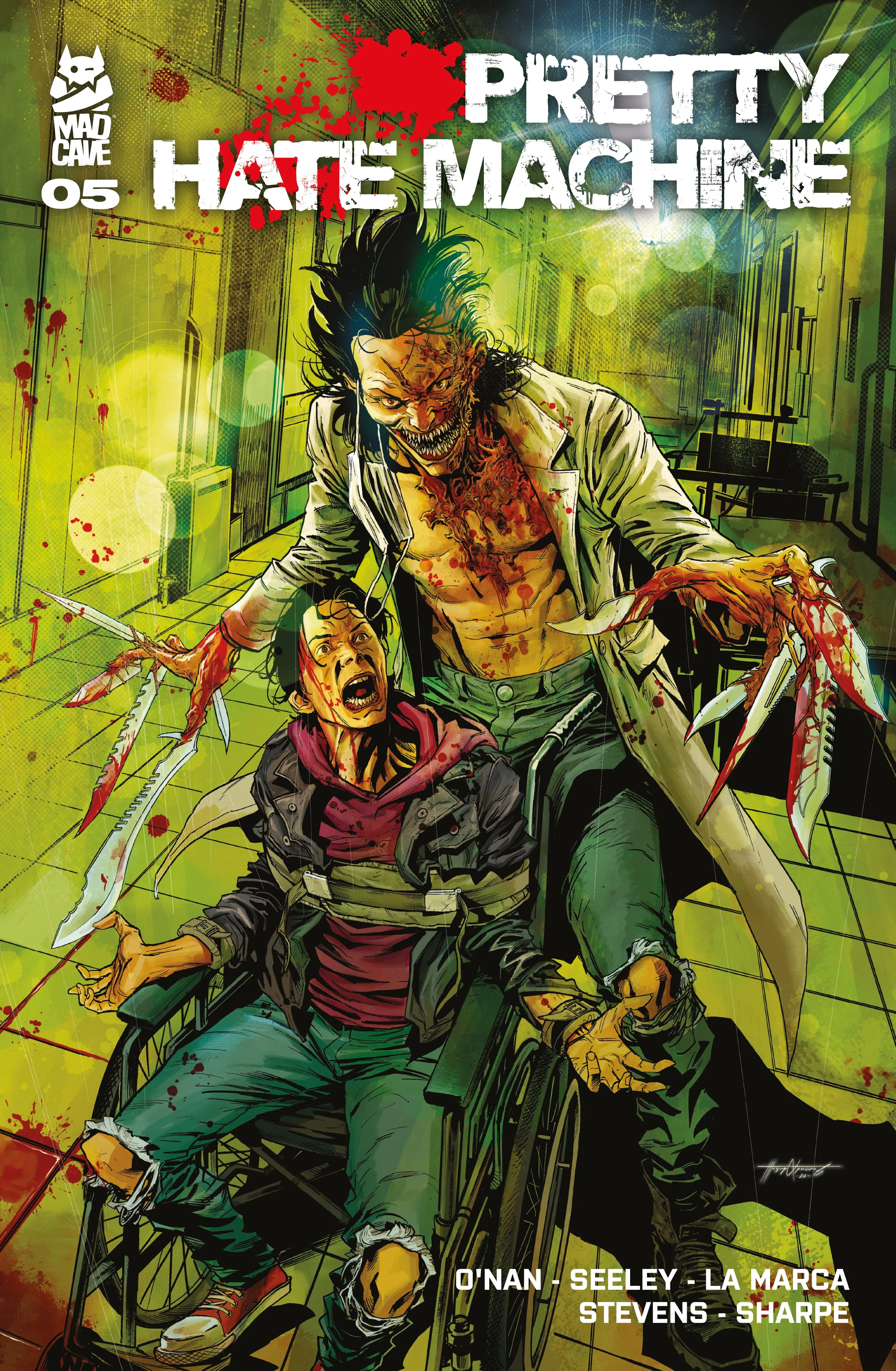
Credit: Mad Cave Studios
*** POSSIBLE SPOILER WARNING ***
STORY OVERVIEW:
Thomas and Joon are trying to figure out a way to get into the hospital so that they can make sure that Luther aka Thomas’ dad Stephen can’t kill his mom, uncle, and Gilly. However, after Thomas under the possession of his father tried to kill his mom and uncle, his mom has banned him from the hospital. Knowing that the danger can arrive at any moment the two boys storm the hospital. Well checking on Gilly, Thomas is attacked by her brother Liam, who turns out to be possessed by Stephen. The reveal of this new trick by the demon makes this mission even more dangerous. Thomas sends Joon to protect his mom and uncle, well Thomas faces off with his father. Stephen slaughters a bunch of patients and attacks the detective. But all of this is just the appetizer to the showdown between the entire family unit, where Thomas will have to use not only force but also his mind if he hopes to send his father to hell once and for all.
WRITING:
This final issue of the series takes the horror, gore, violence, and psychological twists and turns to another level while still making sure the story stays rooted in Thomas’ personal nightmare. Ryan O’Nan and Tim Seeley finish very strong here because the issue feels like a true culmination of everything the series has been building toward. The hospital setting immediately gives the story a claustrophobic and vulnerable feeling, because Thomas is not entering a battlefield where everyone knows a monster is coming. He is stepping into a place filled with injured people, scared family members, and people who have no idea that Stephen can now use almost anyone as a weapon. That choice of setting makes every hallway, hospital room, and confrontation feel dangerous before the violence even starts.
The reveal that Stephen can now possess other people is one of the issue’s strongest writing choices because it changes the rules right when Thomas thinks he understands the threat. Up to this point, the danger has been terrifying, but it has also been more direct. In this issue, O’Nan and Seeley make the horror more unpredictable by forcing Thomas to question who is actually in control of their own body. Liam is a great example of how effective that twist is. At first, his anger toward Thomas makes sense because of what happened to his mother and sister, so the confrontation begins as something grounded in grief and fury. Once it becomes clear that Stephen is using him, the scene shifts into something much more frightening, because it proves that Stephen is not only powerful but also manipulative enough to turn pain, anger, and confusion into openings for possession.
The hospital carnage also works because the writers understand that a finale needs escalation, not just more of the same. O’Nan and Seeley have not shied away from violence and gore throughout this series, but here the brutality feels bigger because the stakes are bigger. Stephen’s attacks are not random shock moments. They show how far he is willing to go to corner Thomas and break down everyone around him. The violence is ugly and relentless, but it also serves the story by making Stephen feel like a force that cannot be reasoned with in the physical world. When he possesses his own brother, the story goes to an even darker place. The way that moment plays out is brutal and disturbing, but it also reinforces how little humanity is left in Stephen when he is acting through the demon’s hunger and rage.
What keeps the issue from becoming only a blood-soaked finale is the emotional weight underneath the horror. The final confrontation between Thomas and Stephen taking place inside Thomas’ head is a smart decision because it allows the book to slow down at exactly the right moment. Instead of ending with only screaming, stabbing, and chaos, the writers force Thomas to face the complicated truth of who his father is. Stephen’s love for Thomas appears to be real, and that makes the scene more painful because it does not erase the monster he is. That emotional contradiction gives the finale more power. Thomas is not simply rejecting a demon; he is rejecting the possibility that love can excuse cruelty, manipulation, and murder.
That choice gives Thomas’ arc a satisfying payoff. He has spent the series being pulled between fear, guilt, anger, and the desire to understand what is happening to him. In the end, he has to decide whether to believe the softer version of Stephen that appears in his mind or accept that his father is still a threat to his mother, Gilly, and everyone else caught in his path. That decision is hard, and the writing makes sure it feels hard. The finale lands because Thomas wins by making a moral choice, not just by surviving a violent confrontation. O’Nan and Seeley also leave the door open for a possible return to this world in the final pages, which works because it does not undercut the ending. Instead, it suggests that nightmares like this may never be as finished as the characters want them to be.
ARTWORK:
The artwork in this final issue matches the intensity of the story and then pushes it even further. Hank La Marca brings a heightened sense of motion, panic, and brutality to the pages, making the finale feel bigger, nastier, and more emotionally desperate than anything that has come before it in the series. His work gives the issue the feeling of a horror film racing toward its final act, where every scene feels like it could become the next major kill or emotional collapse. The layouts keep the reader moving through the hospital quickly, but they never lose clarity. Even when the violence becomes chaotic, La Marca makes sure the reader understands where Thomas, Stephen, Joon, Gilly, and the rest of the characters are in relation to one another, which helps the action feel fast without becoming confusing.
The horror imagery is especially effective because La Marca does not pull away from the impact of the violence. The kills are bloody, direct, and unpleasant in the way a strong slasher finale should be. There is a real sense of physical weight to the attacks, and the damage shown on the page makes Stephen’s presence feel dangerous in a way that words alone could not fully capture. At the same time, the gore does not feel empty or thrown in only for shock value. The brutality reinforces the idea that Stephen is no longer hiding or trying to manipulate from the shadows. He is tearing through the hospital with full force, and La Marca’s unflinching approach makes that rampage feel vicious and immediate.
What makes the artwork work so well is that La Marca balances the gore with strong character acting. The fear, shock, anger, and exhaustion on the characters’ faces makes the horror feel more personal. Thomas does not look like a generic hero charging into a monster fight. He looks like someone who is scared, overwhelmed, and still trying to protect the people he loves. That emotional detail gives the issue more impact because the reader can see how much the situation is taking out of him. The same is true for the supporting characters, especially in the hospital scenes where ordinary people suddenly become victims or threats. Those expressions help sell the nightmare quality of Stephen’s new possession ability.
The possessed designs are another major strength of the issue. La Marca changes up the visual language we have come to associate with Luther by allowing Stephen’s demonic influence to merge with the bodies he takes over. That keeps the threat familiar while still making each possession feel unsettling in a new way. The designs do not simply copy and paste the same monster face onto every character. Instead, the possessed look like a disturbing blend of the host’s features and Stephen’s corrupting presence. That detail makes the possession concept feel more invasive and disgusting, because it looks like the demon is twisting people from the inside out rather than just wearing them like masks.
The hospital setting also gives the artwork a different kind of tension than earlier parts of the series. La Marca uses the sterile rooms, narrow hallways, beds, and medical equipment to make the environment feel cramped and unsafe. A hospital is supposed to be a place where people are protected and cared for, but the art turns it into a trap where escape feels almost impossible. That contrast makes the horror land harder. The setting also allows La Marca to fill the issue with vulnerable bodies and terrified bystanders, which makes Stephen’s rampage feel even more cruel. Every background and piece of staging adds to the sense that the danger can come from any direction.
Roman Stevens’ colors are a perfect match for La Marca’s linework. The use of reds makes the violence and gore stand out, but it also gives the pages a feeling of rage and danger. The reds do more than show blood. They become part of Stephen’s visual language, making it feel like his anger is spreading across the issue. Stevens also helps separate the cold, clinical feeling of the hospital from the warmer, more aggressive tones of the demonic violence. That contrast makes the pages visually striking and keeps the setting from feeling flat. Together, La Marca and Stevens create a finale that is disgusting, emotional, energetic, and memorable in all the right ways.
Check Out My Review of PRETTY HATE MACHINE #4
Final Thoughts:
Pretty Hate Machine #5 delivers a brutal, emotional, and satisfying near perfect finale that makes good on the series’ horror promise. Ryan O’Nan and Tim Seeley bring Thomas’ nightmare to a strong close with intense twists, personal stakes, and a final confrontation that hits hard. Hank La Marca and Roman Stevens make the violence, possession, and hospital chaos feel vicious and memorable. This is a strong ending to a disturbing horror series and an easy recommendation for any fan of the genre. If you have been following Thomas’ terrifying story issue to issue, you will be very pleased with this finale. If you haven’t been reading along, make sure to keep your eyes open for the Trade Paperback that drops in December, not only for yourself, but it also makes for a great gift for that horror fan you know in the holiday season.
FINAL GRADE: 9.8/10
Let me know your thoughts on Pretty Hate Machine #5 in the comments below. Thanks for reading!