ONLY THE SAVAGE ARE LEFT #3 (Dark horse comics)
Can you conquer your fears to save the one you love? This is exactly what Ryder needs to answer if there is any hope of saving Oaklynn from her captors while fighting off the monsters. But first Ryder and Fionn need to find a monster to kill so they can cure themselves of the infection before it takes more of a hold.
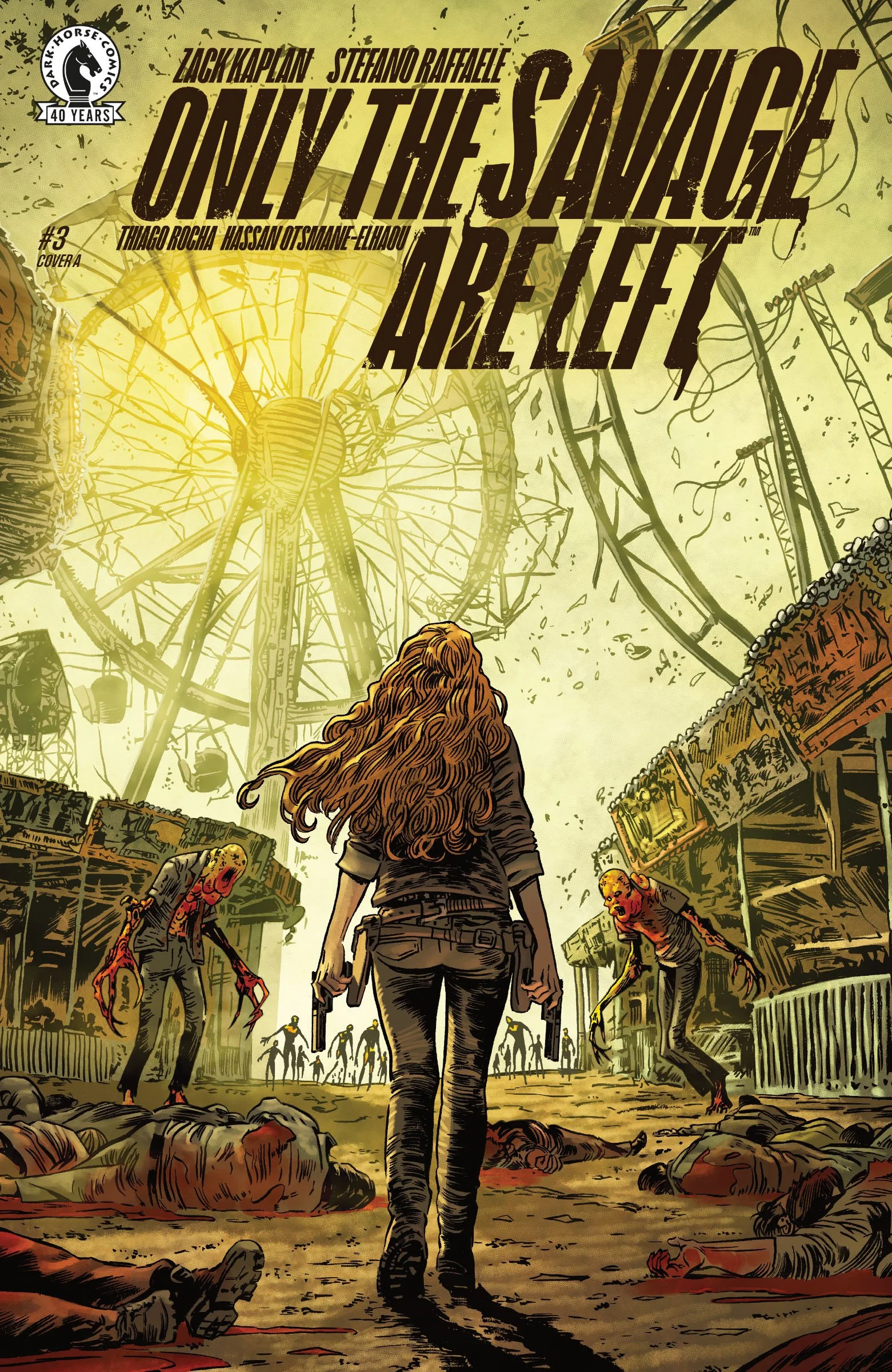
Only The Savage Are Left #3 - Written By Zack Kaplan – Art By Stefano Raffaele - Colors By Thiago Rocha – Letters By Hassan Otsmane-Elhaou - Edited By Spencer Cushing - Published By Dark Horse Comics
Credit: Dark Horse Comics
*** POSSIBLE SPOILER WARNING ***
STORY OVERVIEW:
Ryder and Fionn are still on the hunt for a monster to kill so they can inhale its smoke and cure themselves from the infection. They have been infected long enough that it is starting to set in, as Ryder’s eyes have become different colors. Fionn desperate not only to stop the infection, but also eager to save his daughter suggests a desperate measure. He suggests infecting one of Oaklynn’s captors, kill them, and then use their smoke for the cure. This morally gray area at best makes Ryder nervous and he is not onboard with this at all. Instead, he offers up that they should go find the bigger monster they saw earlier and kill that instead. Meanwhile, Oaklynn is being tested by her captors. They want to bring her back into their ranks but that doesn’t stop them from having some fun at her expense. However, the fun stops when they are able to capture Ryder and Fionn. Now the question is, what side will Oaklynn choose and what does this mean for Ryder and Fionn?
WRITING:
Zack Kaplan continues to deliver a tense, emotionally driven story set inside a world that feels broken beyond repair. What makes this issue work so well is that Kaplan does not rely only on monsters, violence, or shock value to create tension. Those elements are certainly present, but the real strength of the issue comes from the way he uses this horrific world to test Ryder’s humanity. The result is an issue that feels dangerous on the surface, but even more unsettling underneath because every choice carries a moral cost.
Kaplan has found a strong balance between showing how savage this world has become and still giving the reader a reason to hope through Ryder. The monsters dominate the landscape, but the surviving humans often feel even worse because they have adapted to the cruelty around them. In the middle of that, Ryder remains the character who still believes there are lines that should not be crossed. His innocence is not presented as weakness; instead, it becomes one of the most important parts of the story. He gives the reader something human to hold onto in a setting where almost everything else has been stripped of compassion.
That is why Ryder’s conflict in this issue is so compelling. Fionn’s suggestion to infect one of Oaklynn’s captors, kill them, and use their smoke as a cure is a brutal idea, but Kaplan writes it in a way that makes sense coming from Fionn’s perspective. Fionn is desperate, terrified for his daughter, and willing to live in the moral gray area if it means saving her. Ryder, however, is not ready to sacrifice that part of himself. His refusal is important because it shows that he is still fighting to survive without becoming the same kind of person this world keeps producing. Kaplan makes the moment tense because there is a part of the reader that understands Fionn’s logic, even while knowing Ryder’s hesitation is what keeps him grounded.
The best part of this moral dilemma is that Kaplan does not make it feel easy. Ryder does not simply reject the idea without feeling the pressure of it. There is a brief sense that he could choose the faster, darker path, especially with his own infection getting worse and Oaklynn still in danger. That small hesitation matters because it suggests that Ryder’s convictions may become harder to protect as the series continues. Kaplan rewards the reader in this issue by having Ryder choose the more difficult but more ethical route, yet he also plants the seed that future choices may not be so clean.
Kaplan also does a strong job keeping Oaklynn’s captivity from feeling like a passive subplot. Her scenes add to the pressure because they show that her captors are not only dangerous, but also cruel and manipulative. They are testing her, trying to pull her back into their world, and using her situation as another way to create uncertainty. This makes the rescue mission feel more complicated than simply getting to her and escaping. The question becomes not only whether Ryder and Fionn can save Oaklynn, but also what Oaklynn will choose when she is forced to decide where she belongs.
The pacing of the issue is another major strength. Kaplan keeps raising the stakes without making the story feel overloaded or predictable. Each new complication grows naturally out of the characters’ desperation, whether it is the worsening infection, the need for a cure, the danger surrounding Oaklynn, or the constant threat of violence. The story moves quickly, but the emotional beats still have room to land. That attention to human emotion is what allows the reader to stay immersed in the world rather than simply watching one horrific event after another.
Kaplan has also mastered the cliffhanger in this series. The ending does exactly what a strong issue ending should do: it resolves enough of the immediate tension to make the issue satisfying, while opening up a new and urgent question that makes the next issue feel impossible to skip. By putting Ryder, Fionn, and Oaklynn in a position where loyalty, survival, and morality all collide, Kaplan leaves the reader eager to see what happens next. This continues to be a series that understands how to build suspense, deepen character, and make every issue feel essential.
ARTWORK:
The artwork in this issue continues to flesh out this nightmare of a world while still capturing the drama, fear, and emotional weight of the story. Stefano Raffaele’s work is a major reason this series feels so easy to fall into despite how horrific the world has become. His environments are grounded in things the reader can recognize, which makes the destruction feel even more effective. The towns, farms, roads, homes, and open spaces all feel like they were once part of an ordinary world, but now they have been warped by decay, violence, and neglect. That contrast is what gives the setting so much power. It does not feel like a fantasy wasteland that is completely removed from reality. It feels like our world after everything familiar has been stripped down, broken apart, and left to rot.
Raffaele does an excellent job using the backgrounds to tell the reader what kind of place this has become without needing the script to overexplain it. The ruined structures, empty roads, damaged landscapes, and worn-down details all suggest a world where survival has replaced comfort and where danger can come from anywhere. Even when the focus is on the characters, the setting never feels like an afterthought. It constantly reinforces the idea that Ryder, Fionn, and Oaklynn are moving through a place that has lost its sense of safety. That helps build the apocalyptic atmosphere and gives every scene a layer of unease before the monsters or captors even appear.
The monster work is also strong because Raffaele makes the creatures feel disturbing without turning them into simple shock-value images. Their designs fit the harshness of the world, but they also feel connected to the larger themes of infection, corruption, and transformation. They are frightening because they look like the natural result of this world’s collapse. That makes them feel less like random enemies and more like physical symbols of what survival in this environment can do to a body and a soul. The monsters are horrifying on their own, but they become even more effective when placed next to humans who are not much better morally.
Raffaele’s character designs continue to be one of the strongest visual aspects of the series. Every character feels distinct, and their appearances communicate who they are before they even speak. This is especially important in an issue where Ryder’s condition is starting to become more visible. The change in his eyes is subtle, but it says a lot. On the surface, it lets the reader know that the infection is getting worse and that time is running out. Beneath that, it suggests something more troubling. In this series, physical transformation often seems tied to moral decay or emotional compromise. The more monstrous someone looks, the more questionable their choices and values tend to become. Because of that, Ryder’s eye change feels like more than just a symptom. It feels like a warning that the infection may not only threaten his body but could also test the part of him that has made him different from the rest of this world.
That visual detail works so well because it connects directly to the writing. Ryder is the moral center of the story, but the art quietly reminds the reader that even he is not untouched by what is happening around him. The altered eyes create a sense of tension every time he appears on the page because they make his internal struggle visible. He may still be trying to do the right thing, but the artwork makes it clear that the world is beginning to leave a mark on him. That makes his refusal to follow Fionn’s darker plan feel even more meaningful, because visually the reader can already see that Ryder is standing on dangerous ground.
Thiago Rocha’s colors do a lot of the heavy lifting when it comes to the tone and mood of the issue. The rusty oranges, sickly browns, deep shadows, and cold blues give the world a damaged and unnatural feeling. The warmer colors make everything feel dry, dirty, and infected, while the blues create a colder sense of isolation and hopelessness. Together, those choices make the world feel both familiar and alien at the same time. Rocha’s palette does not simply decorate the pages; it shapes how the reader experiences them. The colors make the world feel drained of comfort and warmth, which matches the emotional state of the characters as they are pushed further into desperation.
The combination of Raffaele’s linework and Rocha’s colors gives the issue a strong visual identity. The art captures the ugliness of this apocalyptic world, but it also understands when to slow down and focus on character emotion. That balance is important because the issue is not only about monsters and survival. It is about fear, loyalty, desperation, and the cost of staying human in a place that keeps demanding something worse. The visuals support all of that by making the world feel dangerous, the characters feel vulnerable, and the infection feel like both a physical and moral threat. This is another strong-looking issue that adds depth to the story instead of simply illustrating it.
Check Out MY REVIEW OF ONLY THE SAVAGE ARE LEFT #2
Final Thoughts:
Only The Savage Are Left #3 is another gripping issue that pushes Ryder, Fionn, and Oaklynn deeper into a world where survival and morality are constantly at odds. Zack Kaplan keeps the tension sharp, while Stefano Raffaele and Thiago Rocha make the horror of this world feel vivid and emotionally grounded. With strong character work, brutal stakes, and another excellent cliffhanger, this continues to be one of the most compelling new series on shelves. This series should definitely be on your Pull List at this point, and if it isn’t, what are you waiting for? Don’t miss what may be the best series of the year.
FINAL GRADE: 10/10
Let me know your thoughts on Only The Savage Are Left #3 in the comments below. Thanks for reading!