LAZARUS ORDER #2 (Mad Cave Studios)
The more we learn about the Order, the more we realize we have only scratched the surface. As Damien explains their fight against the First Sickness, we realize that this is bigger than even the Black Plague. But there are other dark forces that continue to threaten not just the Order, but also humanity as a whole.
Lazarus Order #2 – Created By Sloane M. Siegel, Benjamin J. Stockham, & Juan Doe – Written By Sloane M. Siegel – Art By Juan Doe – Letters By DC Hopkins - Edited By Ryan Carrol - Published By Mad Cave Studios
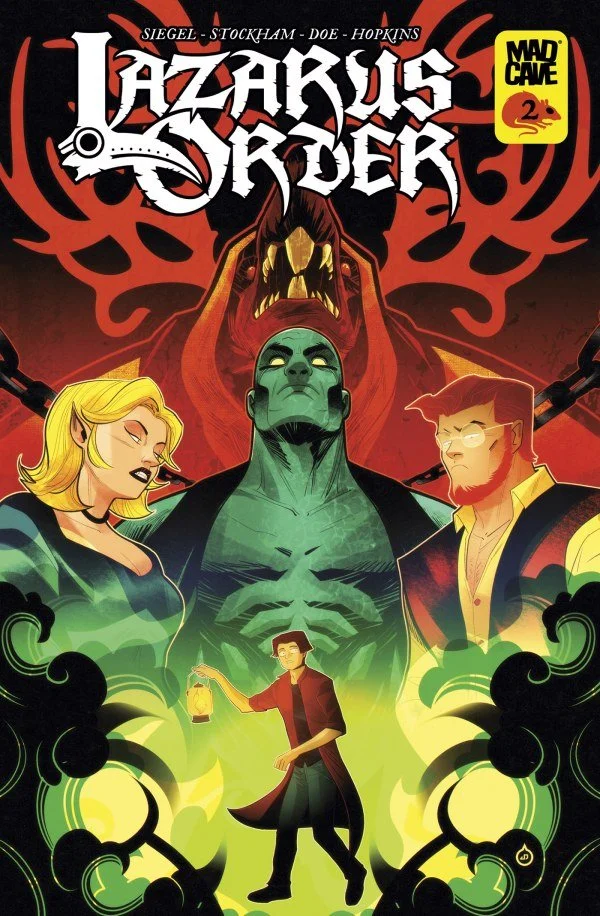
Credit: Mad Cave Studios
*** POSSIBLE SPOILER WARNING ***
STORY OVERVIEW:
This issue opens with an explanation of what the Order is fighting against, the First Sickness. This is something that is as much an actual illness as it is a supernatural happening. We find out that some are born into the Order, well others are bought in. But, no matter how you get in, the devotion to training and commitment to healing the sick in the name of God are the ultimate mission. The powers that are given to the Doctors help them with their mission and help protect not only the members, but the inflicted and their families. However, one of the younger members of the Order, Uriel, seems to be tasked with a mysterious mission that has a sinister undertone. Will this sinister feeling mean something bad for the Order moving forward?
WRITING:
This issue reveals considerably more about the Order, its history, and its sacred mission while still keeping many of its most important secrets hidden. Sloane M. Siegel draws the reader deeper into this plague ravaged world by showing that the Order is not simply a group of healers, but a disciplined and deeply devoted organization built around faith, sacrifice, and the responsibility of confronting the First Sickness. The added explanation of how members are either born into the Order or brought into it gives the group a stronger sense of tradition and structure. It also suggests that joining the Order is not merely a career choice, but a life altering commitment that demands years of training and complete dedication to protecting the sick, their families, and humanity itself.
Siegel balances these revelations with a deliberate amount of uncertainty. We learn enough to better understand why the Order’s mission matters, yet the true origin and full reach of the First Sickness remain unclear. That restraint creates suspense and makes the world feel much larger than what has appeared on the page so far. At times, however, the slow release of information causes the issue to feel more focused on setup than forward momentum. The mystery remains compelling, but a few scenes could have moved with greater urgency or delivered a more immediate payoff. Even so, the careful pacing reinforces the impression that the Order has spent generations fighting an enemy that neither the characters nor the reader fully understands.
Uriel’s introduction adds the strongest new layer of intrigue. He initially appears to be an innocent young member of the Order, especially through his friendship with a mouse named Reggie, but his actions quickly suggest that something darker is influencing him. His determination to locate the vials Tink has been working on feels less like simple curiosity and more like a compulsion. The apparent connection between that mission and Uriel’s father, the Doctor imprisoned and chained inside a cell, raises immediate questions about loyalty, inheritance, and corruption within the Order. Is Uriel secretly trying to help his father, being manipulated by him, or responding to the same supernatural force that created the First Sickness? Siegel wisely avoids answering those questions too soon, allowing Uriel’s seemingly small mission to become one of the issue’s most unsettling developments.
The return to the monsters imprisoned in the basement also pays off their brief reveal from the first issue. Seeing more of them confirms that the Order is containing dangers far beyond ordinary disease, but their identities and purpose remain unknown. They could be victims, failed experiments, former members of the Order, or weapons being held for a future conflict. That uncertainty gives the basement scenes real tension and suggests that the Order may be hiding morally difficult choices beneath its holy mission. By expanding the mythology without fully explaining it, Siegel makes every new answer feel connected to an even larger question.
Overall, the writing succeeds because it treats mystery as the central engine of the story. The issue does not rush to explain the Order, the First Sickness, Uriel’s father, or the imprisoned monsters. Instead, it offers carefully chosen details that deepen the world and encourage the reader to keep searching for connections. Although the pacing occasionally feels slow, the unanswered questions, ominous character developments, and growing sense of internal danger make the story increasingly compelling. This is a world shrouded in secrecy, and that atmosphere gives the series the kind of long-form intrigue that can keep readers invested for many issues to come.
ARTWORK:
The artwork in this issue continues to deliver the neon-steampunk aesthetic that gives Lazarus Order such a distinctive visual identity. Juan Doe blends gothic horror, religious imagery, industrial technology, and vivid modern color into a world that feels both ancient and strangely futuristic. That combination is especially effective because it reflects the central conflict of the series: an old and secretive organization using extraordinary powers and unusual tools to fight a threat that has existed for generations. Rather than presenting the setting as a conventional medieval plague story, Doe fills it with glowing colors, mechanical details, shadowy corridors, and unsettling supernatural imagery. The result is a world that feels familiar enough to understand but unusual enough to remain unpredictable.
The Order’s headquarters is one of the strongest examples of Doe’s visual storytelling. Its maze-like halls, hidden rooms, stairways, cells, and workspaces make the building feel less like a simple base of operations and more like a living extension of the Order itself. The headquarters appears organized enough to support the group’s mission, yet its scale and layout are never made completely clear. Doe deliberately avoids giving readers a complete map or a comfortable sense of direction. That choice creates unease because every corridor seems capable of leading to another secret, another experiment, or another imprisoned danger. The architecture reinforces the story’s larger mysteries by suggesting that even the members of the Order may not fully understand everything concealed within their own home.
Doe’s character designs also help distinguish the cast and communicate personality before the dialogue provides additional explanation. The clothing, equipment, silhouettes, and facial details give each member of the Order an individual presence while still making them feel connected to the same organization. Their designs balance ceremonial elements with practical ones, visually supporting the idea that these characters are both servants of a sacred mission and trained professionals prepared to confront supernatural disease. Uriel’s younger and more innocent appearance is particularly effective because it contrasts with the possible sinister nature of his secret task. That contrast makes his scenes more unsettling: the artwork presents someone who looks vulnerable and harmless while the story hints that he may be connected to a much darker threat.
The monster designs are even more memorable. Some of the imprisoned creatures evoke familiar legends, including imagery associated with Frankenstein’s monster and the traditional vampire, but Doe avoids making them feel like simple copies. Instead, those recognizable influences act as visual shorthand, immediately telling the reader that the world of Lazarus Order contains horrors beyond the First Sickness. Their distorted bodies, confinement, and placement beneath the headquarters create questions about whether they are enemies, victims, experiments, or former allies. The creatures therefore contribute to the plot even when they are not speaking or moving. Their mere presence expands the mythology and suggests that the Order has encountered and possibly created or contained, many different forms of supernatural danger.
Color is another major strength of the issue. Doe’s neon palette pulls the eye across each page and separates this series from more muted historical horror comics. Bright greens, blues, purples, and other intense tones illuminate otherwise dark environments, producing an energetic contrast between beauty and decay. The glowing colors can make the Order’s powers and technology appear wondrous, but they can also make the surrounding horror feel unnatural and dangerous. This gives the art a constant visual tension. The pages are exciting to look at, yet the brightness never completely removes the sense that something disturbing is hiding nearby. The color choices also help guide attention toward important characters, objects, and supernatural details without overwhelming the composition.
The panel layouts and visual pacing support the mystery as well. Wider views establish the scale and strangeness of the setting, while tighter panels draw attention to expressions, hidden objects, and ominous details. This movement between expansive environments and close character moments helps the issue shift naturally from exposition to suspense. Even when the script slows down to explain the Order’s history or mission, the artwork keeps the pages visually active through changes in perspective, architecture, lighting, and color. Doe’s compositions encourage readers to study the backgrounds because important clues may be placed outside the most obvious point of focus.
Meanwhile, DC Hopkins’s lettering strengthens the storytelling by clearly separating dialogue, narration, and emotionally heightened moments. The placement of balloons and captions makes conversations easy to follow without distracting from Doe’s detailed artwork. Differences in presentation help readers understand when the story is offering explanation, when characters are speaking directly, and when a line carries additional urgency or intensity. That clarity is especially important in an issue containing considerable world building, because the lettering organizes the information and keeps the narrative from becoming visually confusing.
Overall, the art team does more than make the issue visually striking; it deepens the atmosphere and supports the central mysteries of the story. Doe’s architecture makes the Order feel vast and unknowable, his character designs reveal personality and allegiance, his monsters expand the mythology, and his neon colors give the series a recognizable identity. Hopkins’ lettering brings order and emotional clarity to those complex pages. Together, the artwork and lettering create an immersive visual experience that makes the world of Lazarus Order feel dangerous, layered, and unlike anything else on the shelf.
CHECK OUT MY REVIEW OF LAZARUS ORDER #1
Final Thoughts:
Lazarus Order #2 deepens the Order’s mythology while introducing ominous new questions about Uriel, the First Sickness, and the creatures hidden beneath its headquarters. Although the pacing is occasionally slow, Sloane M. Siegel’s intriguing world building and Juan Doe’s vivid neon-gothic artwork keep the mystery compelling. This is a strong second issue that expands the series’ scope and leaves readers eager for the next issue. If you didn’t grab issue one, make sure to grab a copy this go around as well as pick up issue two, this series is definitely worth a shot.
FINAL GRADE: 8.6/10
Let me know your thoughts on Lazarus Order #2 in the comments below. Thanks for reading!