LAZARUS ORDER #1 (Mad Cave Studios)
It is the time of the Black Death and Plague Doctors are tasked with healing the sick and infected. But this isn’t the plague years you read about in your history books, as this Black Death is something far more sinister. The Lazarus Order is a supernatural group of Plague Doctors who are fighting the very supernatural plague that looks to take over the world.
Lazarus Order #1 – Created By Sloane M. Siegel, Benjamin J. Stockham, & Juan Doe – Written By Sloane M. Siegel – Art By Juan Doe – Letters By DC Hopkins - Edited By Ryan Carrol - Published By Mad Cave Studios
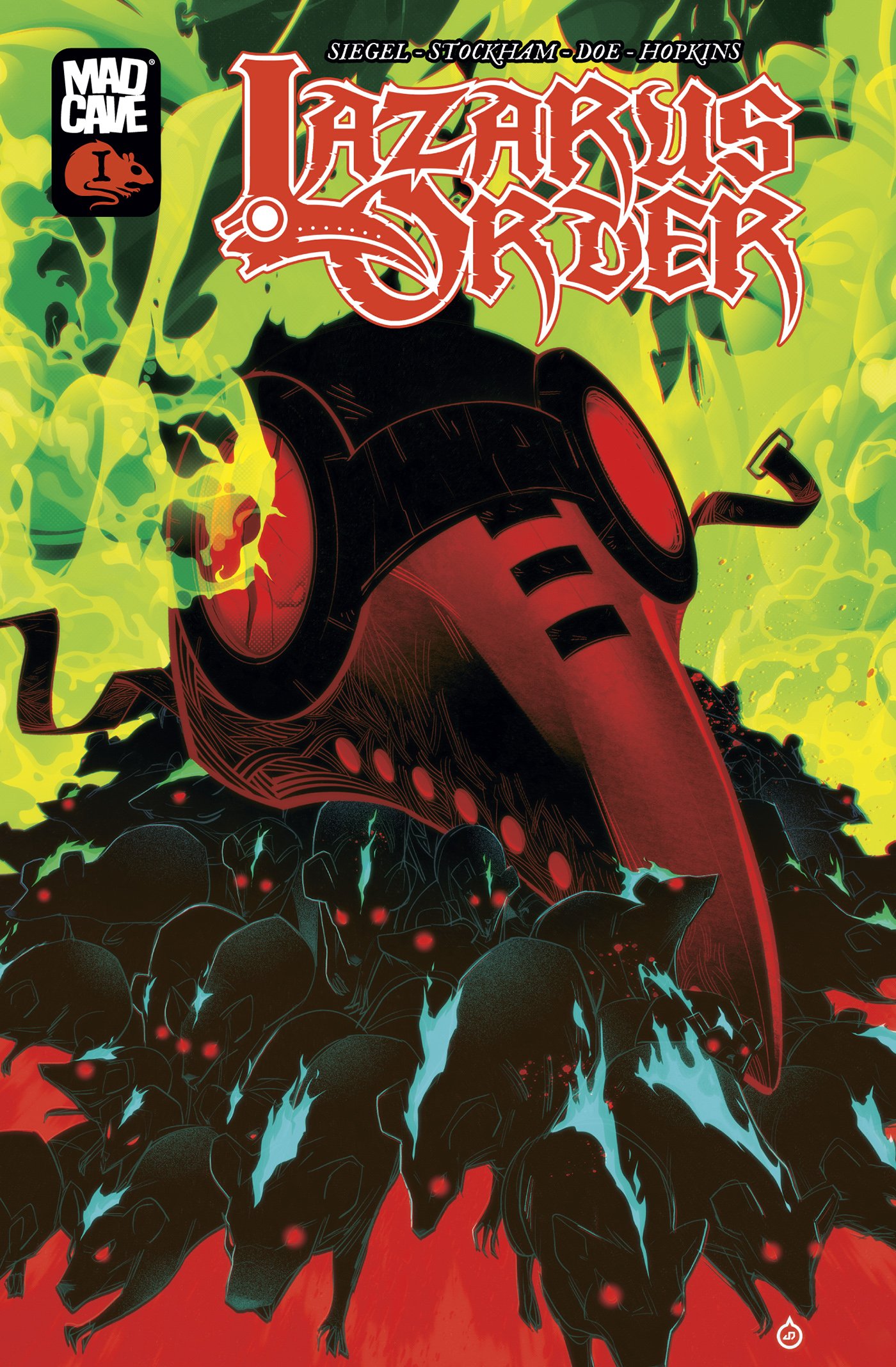
Credit: Mad Cave Studios
*** POSSIBLE SPOILER WARNING ***
STORY OVERVIEW:
We meet two Plague Doctors, Damien & Edward, who belong to the elite order, the Lazarus Order. From the start we get a feeling that they are not just fighting off a normal sickness, but rather something more. They enter the Porter family house where the husband Howie has been infected with the plague. Mrs. Porter shares with the doctors that the walls were full of rats and her husband was attacked and then came down with the sickness. After assessing that her and her daughters weren’t scratched or bitten the younger of the doctors goes in to help Howie. However, what he finds is that Howie has transformed into a giant rat monster, that easily overpowers him. At this time Damien reveals that the doctors have powers of their own, using magic to try and overcome the monster. At first, it seems like it worked, until the monster just gets bigger and stronger. Edward steps in and freezes the monster as they explain that they will have to take Howie to their facility to treat him. Once at the facility we see that there is more than just this rat monster housed there. But something far more evil has its claws in Howie and it wants far more power.
WRITING:
This first issue does an amazing job setting the tone and pace for what looks like a much larger and darker series. Sloane M. Siegel immediately establishes a world that feels familiar because of its Black Death setting, but then twists that history into something far more supernatural and unsettling. The story does not overload the reader with exposition, which works in its favor. Instead, Siegel lets the mystery build naturally through the characters’ actions, the strange details surrounding the infection, and the growing sense that the plague is not simply a disease but a force with intelligence and purpose behind it. That balance between historical horror and supernatural fantasy gives the issue a strong hook right from the opening pages.
One of the best choices Siegel makes is keeping the Lazarus Order slightly out of reach. Damien and Edward clearly belong to something organized, powerful, and ancient, but the issue only gives readers enough information to understand their role without fully explaining the group’s history or rules. That restraint makes the Order more intriguing. Damien comes across as the younger and more by-the-book member, someone still trying to follow procedure even when the situation becomes horrifying. Edward, on the other hand, feels like the seasoned veteran who has seen too much and knows when the normal rules no longer apply. Their contrast gives the issue a strong character dynamic, and it helps the reader understand the danger through two different perspectives: Damien’s shock and Edward’s grim experience.
The reveal of Howie as a grotesque rat-like monster is where the issue really announces what kind of story this is going to be. Up to that point, the plague could still be read as something strange but somewhat grounded. Once Howie transforms, the book fully embraces its monstrous side, and that moment changes the scale of the threat instantly. It is not just that people are getting sick; they are being changed into something violent, unnatural, and difficult to control. The fact that Damien and Edward respond with magic adds another major layer to the series. It shows that the Lazarus Order is not simply made up of doctors wearing plague masks, but supernatural warriors using forbidden or hidden knowledge to fight an infection that humanity does not fully understand.
The pacing also works well because each new reveal feels like it opens another door instead of answering every question. The Porter house scene gives the story immediate horror and tension, while the move to the facility suggests that Howie is only one small piece of a much bigger nightmare. Seeing that there are other monsters being contained creates a strong sense of scale and makes the reader wonder how long the Order has been fighting this war, what else they have hidden away, and what kind of evil is truly spreading through the world. By the end of the issue, Siegel has created a world full of mystery, magic, body horror, and supernatural danger while still keeping the focus on character and atmosphere. It is a first issue that captures your imagination quickly and leaves you wanting to know much more about the Lazarus Order and the plague they are trying to stop.
ARTWORK:
The artwork in this first issue is stunning and immediately grabs your attention. Juan Doe gives the book a visual identity that feels gothic, grimy, theatrical, and strange in all the right ways. The story may be set during the era of the Black Death, but Doe does not simply make the world look like a standard medieval plague story. Instead, he blends period detail with an exaggerated, almost steampunk-gothic style that makes the setting feel both historically familiar and completely its own. The buildings, carts, streets, and interiors all suggest the 1300’s, but they are heightened with sharp shapes, heavy shadows, and dramatic design choices that make the world feel infected long before the monsters even appear.
The character designs are a major part of what makes the issue work. The plague doctor outfits look fantastic, with long coats, masks, and sharp silhouettes that give Damien and Edward an intimidating presence. Their costumes feel practical for their role, but they also carry a sense of mystery and danger, which helps sell the idea that they are part of something much larger than ordinary medicine. Edward’s design especially stands out because he does not need the mask to feel dangerous or experienced. He has the look of someone who has been through countless horrors and is no longer easily shaken. That visual confidence tells the reader a lot about him before the story has to explain it.
The rat monster design is also one of the issue’s strongest visual moments. Howie’s transformation is disturbing because it does not just look like a man turning into a rat; it looks like a body being overtaken by something violent and unnatural. The size, posture, teeth, claws, and raw physical power of the creature make it feel like a real threat the second it appears. Doe makes the monster intimidating without losing the grotesque horror of the transformation, and that is important because the story needs the reader to understand that this plague is not simply killing people. It is mutating them into something that feels impossible to cure and terrifying to contain.
What really pushes the artwork over the top is the color work. Rather than relying only on muddy browns, grays, and muted medieval tones, Doe uses loud, vibrant colors that make the horror feel more feverish and unreal. The neon greens, deep reds, yellows, purples, and bright blues give the issue an almost toxic energy, as if the plague has infected the world’s atmosphere as much as its people. The glowing red eyes of the plague doctor masks are especially effective because they make Damien and Edward look both heroic and frightening. The colors should feel too bright for a Black Death story, but that contrast is exactly why they work. They make the book stand out visually while adding to the sense that this is not a normal historical plague, but a supernatural nightmare spreading through a world already on the edge of collapse.
CHECK OUT MY REVIEW OF THE LAST STARFIGHTER #1
Final Thoughts:
Lazarus Order #1 is an awesome debut that mixes historical horror, supernatural mystery, and bold artwork into a first issue that immediately stands out. Sloane M. Siegel sets up an intriguing world without revealing too much, while Juan Doe’s striking visuals give the plague-ridden setting a unique and unsettling energy. With memorable characters, grotesque monster designs, and a larger threat waiting in the shadows, this issue does exactly what a first chapter should: it pulls you in and leaves you wanting more. This should be a must get at the LCS this week and you should definitely consider adding this series to your Pull List.
FINAL GRADE: 9.8/10
Let me know your thoughts on Lazarus Order #1 in the comments below. Thanks for reading!