GEIGER #25 (GHOST MACHINE/IMAGE COMICS)
The showdown between Geiger and Griffin is upon us and the main event fight feel is in full effect. Who will come out on top, the Glowing Man or the iron fisted President? No matter who wins the trajectory for what’s coming next in the Unnamed Universe is set into motion.
Geiger #25 - Written By Geoff Johns – Art By Gary Frank - Colors By Brad Anderson - Letters By Rob Leigh - Edited By Brian Cunningham - Published By Ghost Machine/Image Comics
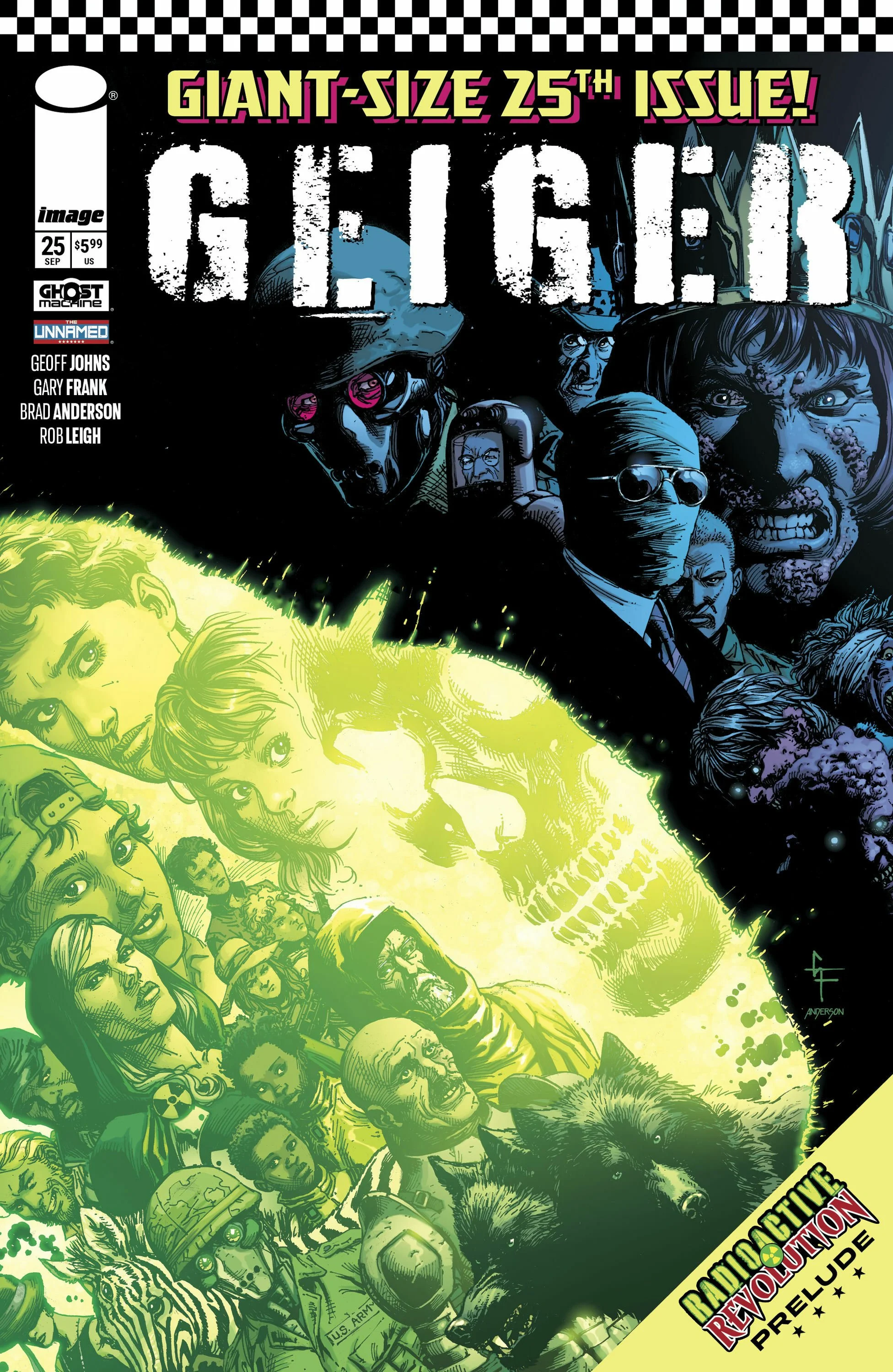
Credit: Ghost Machine/Image Comics
*** POSSIBLE SPOILER WARNING ***
STORY OVERVIEW:
We get a flashback to National Security Advisor Griffin trying to make it to his family before the nuclear missiles hit Washington D.C. This gives us a true origin of how President Griffin got his powers and how he looks. When we come back to the present the fight between Geiger and Griffin is ready to start and boy is it a doozy. The two titans clash and pull out all of the stops, but what one will get the edge and take out the other one. Meanwhile, Geiger’s family is trying to get to him, but they have to fight off not just the robots but also Griffin’s security forces. As they fight to help their friend, they suffer a tragic loss that will surely shape where this series will be going next.
WRITING:
This issue delivers the excitement and major-event atmosphere that the previous issues have been steadily building toward. Geoff Johns does more than simply pay off that anticipation; he gives the confrontation the scale, intensity, and narrative weight it needs to feel like a true turning point for the series. The clash between Geiger and President Griffin lives up to its promise because both characters enter the battle as overwhelming forces, yet neither is allowed to dominate without being pushed to the edge. Their back-and-forth struggle is filled with momentum and spectacle, but it never becomes action for action’s sake. As the fight develops, Johns layers in emotional consequences and dramatic stakes that make every blow feel connected to the characters’ histories, beliefs, and relationships. By the time the battle reaches its conclusion, the outcome matters for reasons that extend far beyond determining who is physically stronger. Johns’ ability to combine explosive superhero action with genuine emotional meaning is what makes the sequence so effective and serves as a strong testament to his writing.
The expanded backstory for President Griffin is equally valuable because it transforms him from a powerful obstacle into a more fully realized antagonist. Learning how he became what he is physically gives the reader important context for his abilities and appearance, while seeing the personal circumstances surrounding that transformation explains how his worldview was forged. His desperate attempt to reach his family before the nuclear missiles struck Washington, D.C., adds a tragic dimension to the character and helps clarify the fear, anger, and need for control that continue to shape his decisions in the present. That history does not excuse what Griffin has done, nor does it require the audience to agree with his methods, but it makes his position easier to understand. By grounding his ideology in loss and trauma, Johns gives Griffin motivations that feel personal rather than purely villainous, adding complexity to both the character and his conflict with Geiger.
As impressive as the action is, the emotional drama unfolding around the battle is just as compelling and ultimately gives the issue its lasting impact. Junkyard Joe’s evolving relationship with his creator gains additional layers as the story continues to explore the difference between being manufactured as a machine and choosing to act with compassion. Joe’s willingness to protect others and make morally difficult decisions reinforces the idea that his humanity is defined by his actions rather than by the materials from which he was built. At the same time, the bond between Molotov and Geiger becomes stronger and more affecting. Their connection has developed through shared danger, trust, and sacrifice, so the painful turn in their story feels earned rather than included only for shock value. The resulting sequence is one of the most emotionally draining moments the series has delivered to date, and it changes the tone of the victory by reminding readers that even winning a fight can come with a devastating cost.
The tease for the larger Unnamed Universe crossover is also handled effectively because it expands the scope of the story without distracting from the issue’s central conflict. Simon Pure’s appearance immediately creates anticipation around the possibility of him crossing paths with Geiger, especially given how different their personalities, histories, and goals appear to be. Johns also finds a clever way to bring the Department of Historic Preservation back into the narrative by having Griffin dismiss it as little more than a conspiracy theory. That detail adds an interesting layer of dramatic irony: readers know the department is real and active, while even the President remains unaware of the forces operating beyond his understanding. It makes the world feel larger, more secretive, and more interconnected than any single character realizes. By planting these elements now, Johns opens the door to future alliances, clashes, and revelations while ensuring the conclusion points toward something bigger than the fight readers have just witnessed.
ARTWORK:
The visuals in this issue are stunning and deliver on every level, giving the climactic conflict the size and energy readers would expect from such a heavily anticipated showdown. Gary Frank brings the battle between Griffin and Geiger to life with sharp storytelling, forceful movement, and an impressive sense of physical impact. Each exchange is staged clearly, allowing the reader to follow the action even when the fight becomes chaotic and destructive. The poses feel powerful, the facial expressions communicate strain and determination, and the environments react convincingly to the force being unleashed. Cracked surfaces, explosive impacts, and visible damage make every attack feel dangerous rather than purely decorative. Frank leaves little to the imagination as he pulls out all the stops, creating a sequence that feels brutal, cinematic, and worthy of the long buildup.
The most memorable visual element of the fight is the striking design of the two combatants themselves. The Glowing Man has long been one of the series’ signature creations, and Frank once again emphasizes the unsettling power of Geiger’s irradiated form. However, his treatment of Griffin is equally impressive. When the bandages finally come off and Griffin reveals a glowing form of his own, the confrontation immediately gains a new visual identity. The cracks, scars, and imperfections across Griffin’s face and hands give his power a damaged, unstable quality that distinguishes him from Geiger while still creating a clear visual parallel between them. As the battle intensifies and their luminous forms collide, overlap, and seem to blend together, the artwork turns their physical similarities into part of the storytelling. The spectacle is undeniably exciting, but the careful contrast between their bodies, energy, and expressions is what makes the sequence truly distinctive. More than the destruction surrounding them, the visual interplay between Geiger and Griffin becomes the real centerpiece of the fight.
Frank is just as effective in the quieter, more emotional moments as he is during the large-scale action. As the fight approaches its conclusion, he gives the characters’ reactions enough space to communicate relief, exhaustion, and the brief possibility that the worst may finally be over. Those lighter beats make the devastating event involving Molotov near the end of the issue hit even harder. Frank conveys the shift through body language, carefully framed reactions, and expressive faces rather than relying only on dialogue to tell the reader how to respond. Small details in a character’s posture or expression reveal shock and grief with an immediacy that makes the scene feel personal. Because the emotional storytelling remains clear from panel to panel, the reader never loses sight of what the characters are experiencing amid the larger chaos. This attention to human reaction grounds the spectacle, makes the pain feel genuine, and reinforces the high cost of survival in this world.
Brad Anderson’s colors are especially important in this issue because the central battle features not one glowing figure, but two, and each must remain visually distinct. Frank’s designs provide the foundation, but Anderson’s color work gives the characters their heat, intensity, and radioactive presence. The luminous effects surrounding Geiger and Griffin make their power seem almost tangible, while shifts in brightness and contrast help guide the reader’s eye through the busiest moments of the fight. Anderson also balances those vivid effects against the darker environments and damaged surroundings, ensuring that the characters stand out without overwhelming the linework. The result is a confrontation that feels hotter, more dangerous, and more otherworldly with every exchange.
Rob Leigh’s lettering completes the presentation by integrating dialogue, captions, and sound effects smoothly into the artwork. His placement supports the natural flow of each page, clarifies the order of events, and adds force to the action without covering important visual details. Leigh also uses the size, weight, and rhythm of the lettering to reinforce shifts in tone, helping the issue move convincingly between explosive combat, tense exchanges, and emotionally painful moments. Together, Anderson and Leigh enhance Frank’s artwork while preserving its clarity and dramatic impact.
Check Out My Review of Geiger #24
Final Thoughts:
Geiger #25 delivers a powerful payoff to the battle with Griffin, combining explosive action, emotional consequences, and outstanding visuals. The issue also pushes the larger Unnamed Universe forward with intriguing new possibilities. As both a conclusion and a launch point for what comes next, this is another excellent issue in Ghost Machine’s flagship series. This is a must grab issue at the shop this week and a worthwhile add to your Pull List as you won’t want to miss where this story is going.
FINAL GRADE: 9.6/10
Let me know your thoughts on Geiger #25 in the comments below. Thanks for reading!