EVENT HORIZON: INFERNO #5 (IDW PUBLISHING)
Everyone on the Event Horizon is on the fast lane of the highway to hell. As Durante’s wish of being royalty in hell comes closer to fruition, it’s clear that he should have been careful with what he wished for. After all, who trusts demons from hell about anything?
Event Horizon: Inferno #5 - Written By Christian Ward – Art By Rob Carey – Colors By Xenon Honchar - Letters By Alex Ray – Edited By Nicolas Niño - Published By IDW Publishing
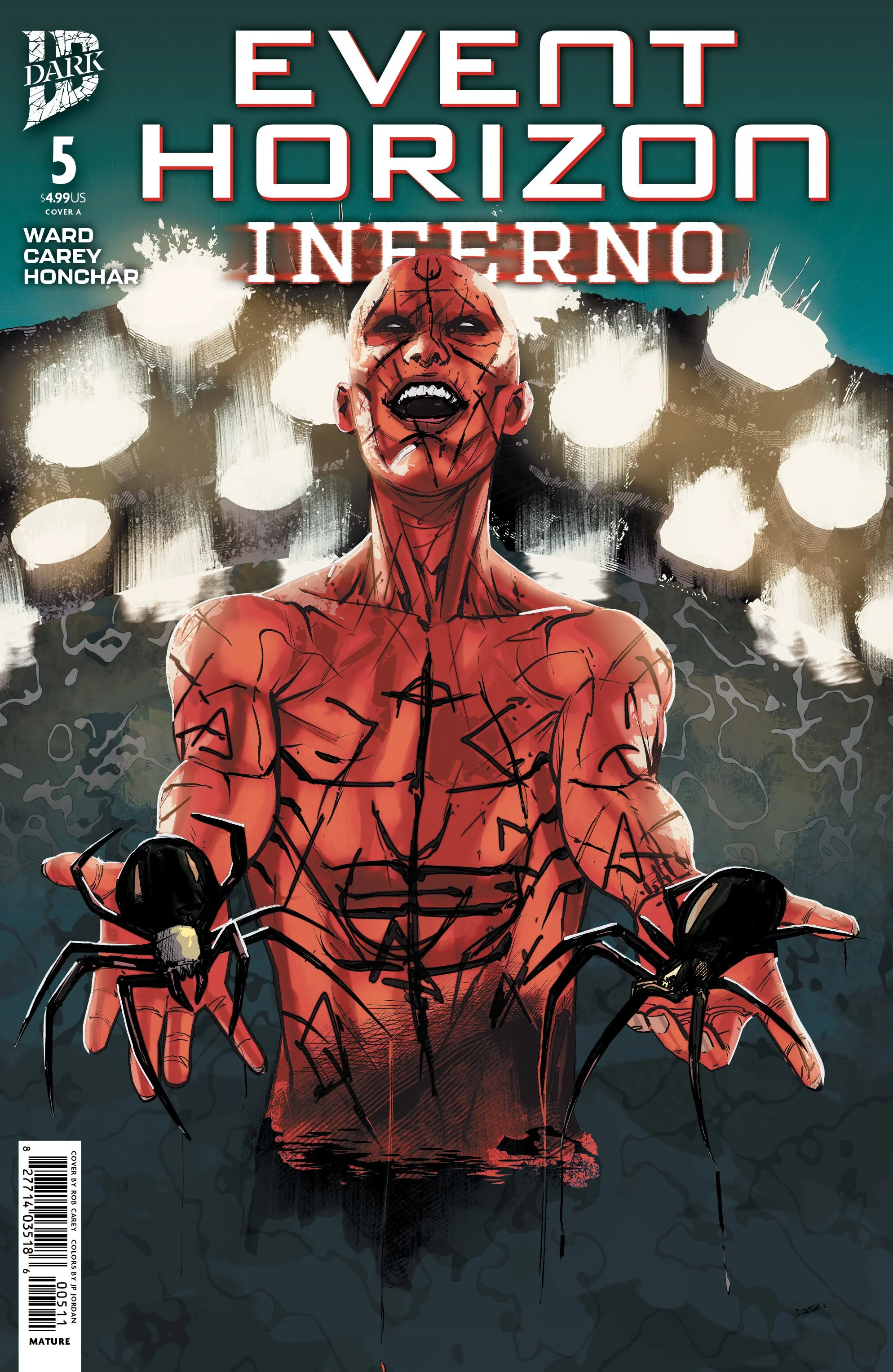
Credit: IDW Dark
STORY OVERVIEW:
After Annabelle set the connection between the two halves of the Event Horizon into motion, she has regrets about her role. Unfortunately for her Durante doesn’t like this and shoots her on the spot. Fully tempted by the demon, Durante believes he will rule in hell when this is all said and done. Meanwhile, Starck is trying to escape back to the Virgil with the few mercenaries that remain. Bad news for them is that Weir in a spider-like appearance is hot on their trail, setting up a final showdown between Starck and Weir. Finally, we come to Skylar, who is ready to end this entire nightmare as she is searching for her husband to end him and his plans once and for all.
WRITING:
This final issue wastes no time escalating the danger, and delivering a relentless conclusion that keeps the reader on edge from the opening page to the final moments. Christian Ward builds the finale around a powerful combination of gruesome horror, fast-moving action, and mounting suspense, but the issue works because its violence is tied to a clear thematic idea. The opening reference to the temptation of Adam and Eve becomes an effective metaphor for Durante’s entire journey: he is offered a vision of paradise and power, only to discover that accepting the offer destroys the world he already possessed. His dream of earning a royal place in hell blinds him to the most obvious question, why would anyone trust a demon to honor its promises? Ward makes Durante’s downfall feel inevitable rather than convenient, showing how ambition, arrogance, and desperation have gradually stripped away his judgment. Like Adam and Eve, he accepts a seductive promise without understanding its true cost, only to learn that what he was sold was a cruel and calculated deception.
That thematic payoff makes Durante’s fate deeply satisfying. After everything he has done to the crew and to Skylar, the story refuses to reward his cruelty or allow him to escape the consequences of his choices. Skylar’s role in the conclusion is especially important because Ward gives her more than a simple act of revenge. After surviving her husband’s abuse, torture, manipulation, and attempt to use her as a sacrifice, she finally reclaims control of her own life and becomes an active force in ending the nightmare he created. Her victory feels earned because it grows directly from what she has endured throughout the series. The moment is triumphant without erasing the trauma that brought her there, giving the finale an emotional resolution beneath all the bloodshed and supernatural chaos.
Ward also provides a fitting conclusion to the conflict between Starck and Weir. Their final confrontation is wild, violent, and appropriately unpredictable, capturing the sense that the Event Horizon has transformed their struggle into something far beyond an ordinary fight for survival. Weir remains a terrifying embodiment of the ship’s influence, while Starck’s determination gives the sequence urgency and momentum. Rather than treating their showdown as a separate action scene, Ward uses it to reinforce the larger idea that no one who encounters the Event Horizon can leave unchanged. Every victory comes at a cost, and every moment of escape feels temporary until the final threat has been confronted.
Most importantly, the issue succeeds as a finale because it resolves the major character arcs while preserving the savage tone that defined the series. Ward delivers the action, gore, and body horror readers have come to expect, never softening the Event Horizon’s nightmare or allowing the ship’s presence to fade into the background. The vessel remains an omnipresent force part haunted location, part living predator, and part gateway to something incomprehensibly evil. Even when the characters appear to gain the upper hand, the story maintains the feeling that the horror is larger than any single person and may never be fully contained. By the end, Ward has tied up the central loose ends, punished Durante’s hubris, given Skylar a meaningful victory, and brought Starck and Weir’s conflict to a memorable close. The result is a brutal, suspenseful, and emotionally satisfying ending that provides a welcome glimmer of hope without pretending that anyone can pass through this nightmare completely untouched.
ARTWORK:
The artwork in this final issue is simply stunning, serving as a masterclass in how visual storytelling can make horror feel both spectacular and deeply unsettling. Rob Carey does more than illustrate hell; he gives it a physical weight and an overwhelming presence, capturing the brutal mythology of the Event Horizon franchise while still bringing his own distinct energy to every page. His layouts emphasize the scale of the chaos, with sprawling images of demonic destruction and supernatural violence that make the characters seem trapped inside something far larger than themselves. At the same time, the tight framing, distorted bodies, and crowded environments create an intense sense of claustrophobia. Even when the action expands across the page, there is rarely any feeling of escape. The ship, the monsters, and the characters all appear to be pressing inward, transforming each sequence into a suffocating nightmare.
Carey’s handling of the body horror is especially effective because the imagery is simultaneously fascinating and repulsive. The grotesque forms are rendered with enough detail to make every transformation feel painfully real, yet the compositions remain visually controlled rather than becoming a confusing collection of gore. Spider-like Weir is a perfect example of this balance. His unnatural anatomy, predatory movement, and warped silhouette immediately communicate that he is no longer human, while the recognizable remnants of his former appearance make the transformation even more disturbing. The demon is equally imposing, filling the panels with an ancient and malicious presence that makes Durante’s promised reward feel obviously false. Durante’s final encounter with the true meaning of hell is depicted with savage clarity, turning his punishment into both a major horror set piece and a visual culmination of his arrogance. Carey does not hide the consequences behind shadows or suggestion; he forces the reader to witness the nightmare in full, making Durante’s fate feel immediate, brutal, and completely deserved.
The action scenes are just as accomplished. Carey maintains a strong sense of movement through shifting perspectives, expressive poses, and panel-to-panel momentum, so the violence never feels static despite the immense amount of detail on the page. The confrontations have a frantic rhythm, but the storytelling remains clear enough that the reader can follow every attack, reaction, and reversal. This clarity is essential because the issue constantly moves between physical danger and surreal imagery. Carey knows when to widen the view and reveal the full scale of the horror, and when to move close to a face, wound, or distorted limb to make the terror personal. The result is an issue that feels cinematic without losing the particular strengths of comic book storytelling. Each page controls the reader’s attention carefully, building anticipation before delivering images designed to shock.
The colors by Xenon Honchar elevate the artwork even further and give the issue its infernal atmosphere. Honchar’s heavy use of reds does more than signal blood, violence, and hellfire; it makes the entire nightmare feel unreal, as though the characters have crossed into a dimension where normal light no longer exists. Deep crimson shadows, harsh bursts of illumination, and sickly contrasting tones separate figures from the chaos while also making the environment feel unstable. The colors guide the eye through Carey’s dense compositions, drawing attention to important expressions, movements, and points of impact without diminishing the overwhelming nature of the scenes. Honchar never softens the gore. Instead, the coloring adds texture and depth to it, making flesh, smoke, metal, and supernatural energy feel like parts of the same corrupted world.
Together, Carey and Honchar create artwork that is beautiful in its craftsmanship and horrifying in its subject matter. Every visual choice supports the story’s themes of punishment, temptation, and inescapable corruption. The scale makes hell feel limitless, the claustrophobic compositions make survival feel impossible, and the unflinching body horror ensures that the consequences of every character’s choices remain impossible to ignore. This creative team has delivered some of the strongest imagery of the entire series in this final issue, producing a conclusion that is not only memorable for its violence but also for the precision, atmosphere, and visual imagination behind it. The result is a gruesome, immersive masterpiece that gives readers a terrifying front-row seat to hell.
CHECK OUT MY REVIEW OF EVENT HORIZON: INFERNO #4
Final Thoughts:
Event Horizon: Inferno #5 delivers a brutal, suspenseful, and satisfying finale. Christian Ward brings the major character arcs to a fitting close, while Rob Carey and Xenon Honchar fill the issue with unforgettable body horror and infernal atmosphere. It is a strong conclusion that honors the franchise’s terrifying legacy. For those of us who have been following this series issue to issue, we get a satisfying ending that is rewarding of our time spent with this series. However, if you haven’t been reading this series, you need to make sure you order a copy of the Trade Paperback as soon as it goes up for order. Don’t make the mistake of missing out on this series for a second time.
FINAL GRADE: 9.5/10
Let me know your thoughts on Event Horizon: Inferno #5 in the comments below. Thanks for reading!