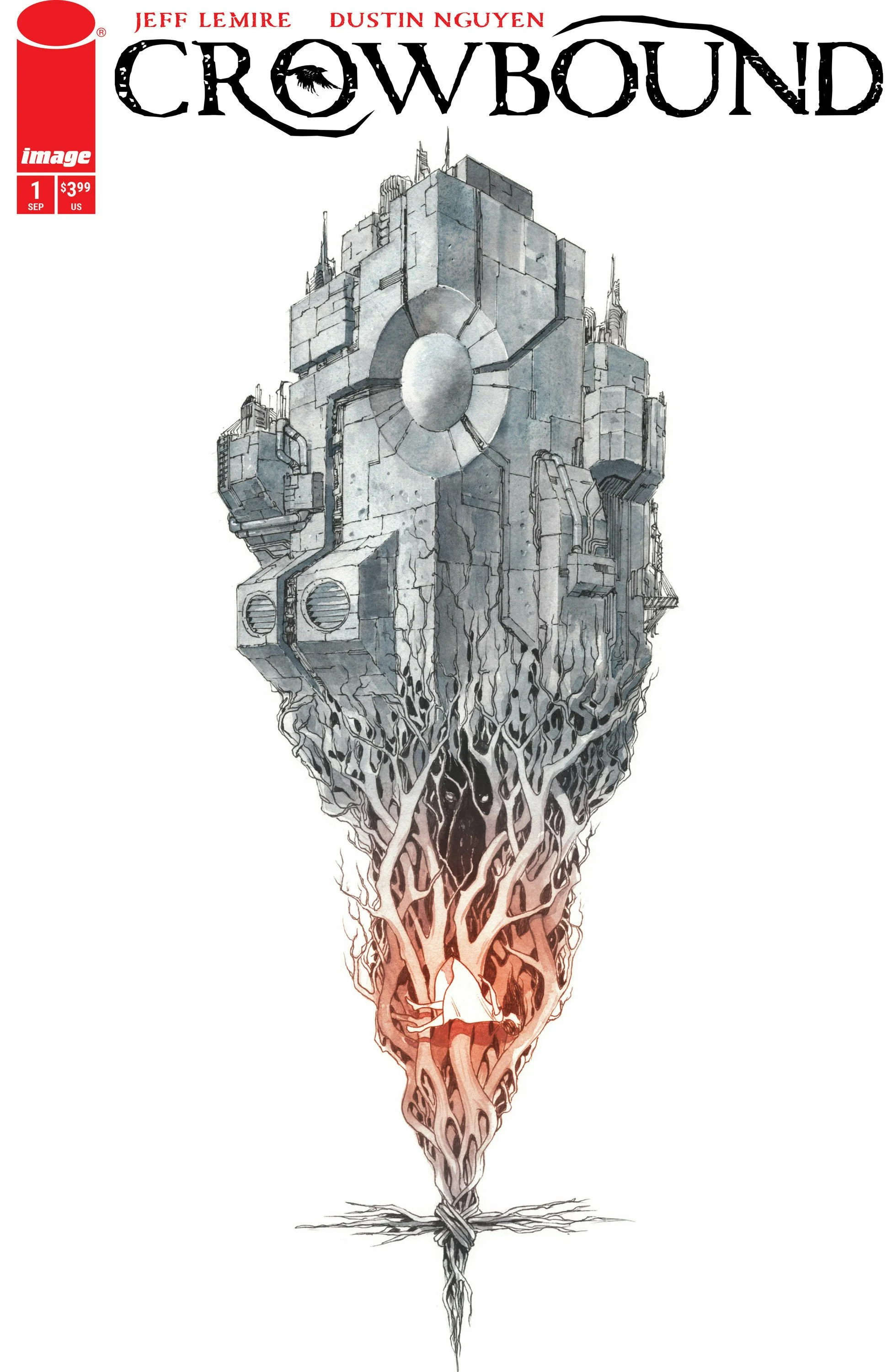
CROWBOUND #1 (IMAGE COMICS)
The Factory is life and your life belongs to the Factory. Everyone in this coastal area works in the factory and their lives are lived for the factory. Rose is just another employee trying to survive. But when her daughter is kidnapped, Rose makes a stand. But that stand has consequences in this world and one she didn’t even knew existed.
Crowbound #1 - Written By Jeff Lemire – Art By Dustin Nguyen – Letters By Steve Wands – Edited By Eric Harburn - Published By Image Comics
Credit: Image Comics
*** POSSIBLE SPOILER WARNING ***
STORY OVERVIEW:
The monolithic Factory divides the area in half and sits on the coast. It’s oppressive and intimidating façade reminds everyone that their lives don’t matter, only the Factory matters. Rose is a daydreamer who always thought there was more to life than working in the Factory. Unfortunately for her that is only a dream. She has a young daughter named Ava that is only one year away from joining the Factory’s workforce and this scares Rose. However, one day after work she discovers her daughter was taken and may be on her way to New Bedlam for “special service”. She can’t stand the thought of losing her daughter, so she breaks free and tries to save her. But this world has a rigid set of rules and consequences if you break said rules. Rose finds this out the hard way and pays the ultimate price. But this is where her story just gets started.
WRITING:
This first issue gives the reader a strong sense of the world without overexplaining it. Jeff Lemire establishes the Factory as more than just a workplace; it is the center of society, the source of control, and the symbol of everything that keeps Rose and the people around her trapped. The opening has an oppressive rhythm to it because the Factory is treated like something unavoidable, almost as if it has replaced family, freedom, and personal identity. That makes the world feel strange and dystopian, but still grounded in real working-class anxieties. Lemire gives just enough information for the reader to understand the rules of this place while holding back enough mystery to make the larger mythology feel worth exploring.
Rose works especially well as the emotional center of the issue. She is not introduced as a traditional hero, but as someone exhausted by a system that has taken away her choices. Her desire for a better life, especially for Ava, makes her instantly relatable. Lemire builds that connection through simple but effective motivations: a parent wants to protect their child, a worker wants to believe life can be more than labor, and a person pushed too far finally decides to resist. Because those feelings are so universal, Rose’s decision to act feels earned rather than forced. The reader understands why she cannot simply accept what has happened, even when every part of this world tells her that resistance is impossible.
The class conflict in the issue also gives the story a strong foundation. The divide between those who control the Factory and those who serve it creates an immediate us-versus-them feeling, but Lemire avoids making the setup feel too simple. The Factory’s power is not only physical; it is cultural and psychological. Everyone has been trained to accept that their purpose is to work, obey, and sacrifice themselves for the system. That makes Rose’s rebellion feel dangerous on more than one level. She is not just breaking a rule; she is challenging the basic idea this society is built on. That gives the issue more weight and makes the world feel real, even in a first issue.
One of the strongest parts of the writing is how Lemire shifts the tone as the issue progresses. At first, the story feels like a grounded dystopian drama about labor, poverty, and control. The stakes are personal and immediate because Rose is trying to save her daughter. Then, as her mission fails and the issue takes a darker turn, the story opens the door to something more supernatural and mysterious. That shift could have felt jarring, but Lemire connects it to Rose’s emotional journey, so the change feels like an escalation rather than a completely different story. The ending suggests that Rose’s struggle is much bigger than she understands, which gives the issue a strong hook for what comes next.
Overall, the writing succeeds because it balances clarity and mystery. Lemire gives the reader enough emotional grounding to care about Rose immediately, while also building a world that clearly has secrets waiting beneath the surface. The issue works as both a character introduction and a larger series setup. By the final pages, the reader has a clear understanding of what Rose has lost, why her choices matter, and why this world is more dangerous than it first appeared. It is a strong opening chapter because it makes the story feel personal, political, and supernatural all at once.
ARTWORK:
The artwork in this first issue has a beautiful but unsettling quality that fits the tone of the story extremely well. Dustin Nguyen’s watercolor style gives the world a soft, dreamlike appearance, but that softness never makes the setting feel safe. Instead, it creates a strange contrast between how delicate the pages look and how cruel the world actually is. That contrast is one of the strongest visual choices in the issue. The art can feel quiet, gentle, and almost storybook-like, while the events themselves are bleak and oppressive. Because of that, the reader is pulled into Rose’s perspective, where hope and imagination still exist even though the world around her keeps trying to crush both.
Nguyen’s use of color is especially effective. The scenes connected to the Factory feel drained and muted, which makes the entire place seem lifeless before the story even explains how it controls people. The lack of warmth in those pages reinforces the idea that the Factory has consumed the community and stripped away individuality. When the issue shifts into memories, dreams, or moments that suggest a world beyond the Factory, the colors become brighter and more expressive. That change makes those scenes feel like glimpses of possibility. The difference between those palettes tells the reader something important without needing extra dialogue: Rose’s world is small and gray, but there are hints that something larger and stranger exists beyond it.
The design of the Factory itself is also important to the issue’s visual power. It does not just look like a building; it feels like a force that dominates the landscape and the people living beneath it. Whenever it appears, it carries a sense of weight and permanence. Nguyen makes it feel massive without needing to over-detail every part of it. Its scale and placement are enough to make it seem unavoidable, almost like a monument to control. This makes the Factory one of the most memorable images in the issue because it visually communicates the same idea the story is built around: everyone’s life is shaped by this place, whether they want it to be or not.
The characters are expressive in a way that feels understated but emotionally clear. Rose’s exhaustion, fear, and determination come through in her posture and the quiet moments between actions. Nguyen does not rely on exaggerated expressions to show what she is feeling. Instead, the emotion comes from small details: the way she moves through the Factory-controlled world, the way she reacts when Ava is taken, and the way the panels slow down around her decisions. This gives the issue a strong emotional rhythm. The reader can feel Rose’s panic and desperation because the art keeps the focus on her humanity, even when the world around her becomes increasingly strange.
The reveal of the Scarecrow Queen is the strongest visual moment in the issue. Her design immediately feels different from the rest of the world, which makes her introduction stand out. She has an intimidating presence, but there is also something oddly warm and familiar about her appearance. That combination makes her feel mysterious rather than simply frightening. She looks like someone who could be dangerous, protective, ancient, or all of those things at once. That uncertainty makes the final pages more compelling, because her design raises questions before the story gives answers. Nguyen uses that reveal to push the issue from dystopian tragedy into something larger and more mythic.
Overall, the artwork works because it deepens the story rather than simply illustrating it. Nguyen’s pages make the Factory feel oppressive, Rose feel vulnerable and determined, and the supernatural elements feel strange without losing their emotional connection to the main character. The watercolor style gives the issue an identity that separates it from a more traditional dystopian comic. It makes the world feel fragile, haunted, and full of secrets. By the end, the art has helped make Crowbound #1 feel like a story caught between a nightmare, a memory, and a dark fairy tale.
CHECK OUT MY REVIEW OF D’ORC #7
Final Thoughts:
Crowbound #1 is a strong and atmospheric debut that uses personal tragedy to open the door to a much larger world. Jeff Lemire gives Rose an emotional reason to fight back, while Dustin Nguyen’s haunting watercolor art makes the Factory and the Scarecrow Queen feel unforgettable. It is a mysterious, emotional, and visually distinct first issue that leaves plenty of questions while giving readers a clear reason to come back for more.
FINAL GRADE: 9/10
Let me know your thoughts on Crowbound #1 in the comments below. Thanks for reading!