UNIVERSAL MONSTERS: BLOOD OF THE WOLF MAN #3 (SKYBOUND ENTERTAINMENT/IMAGE COMICS)
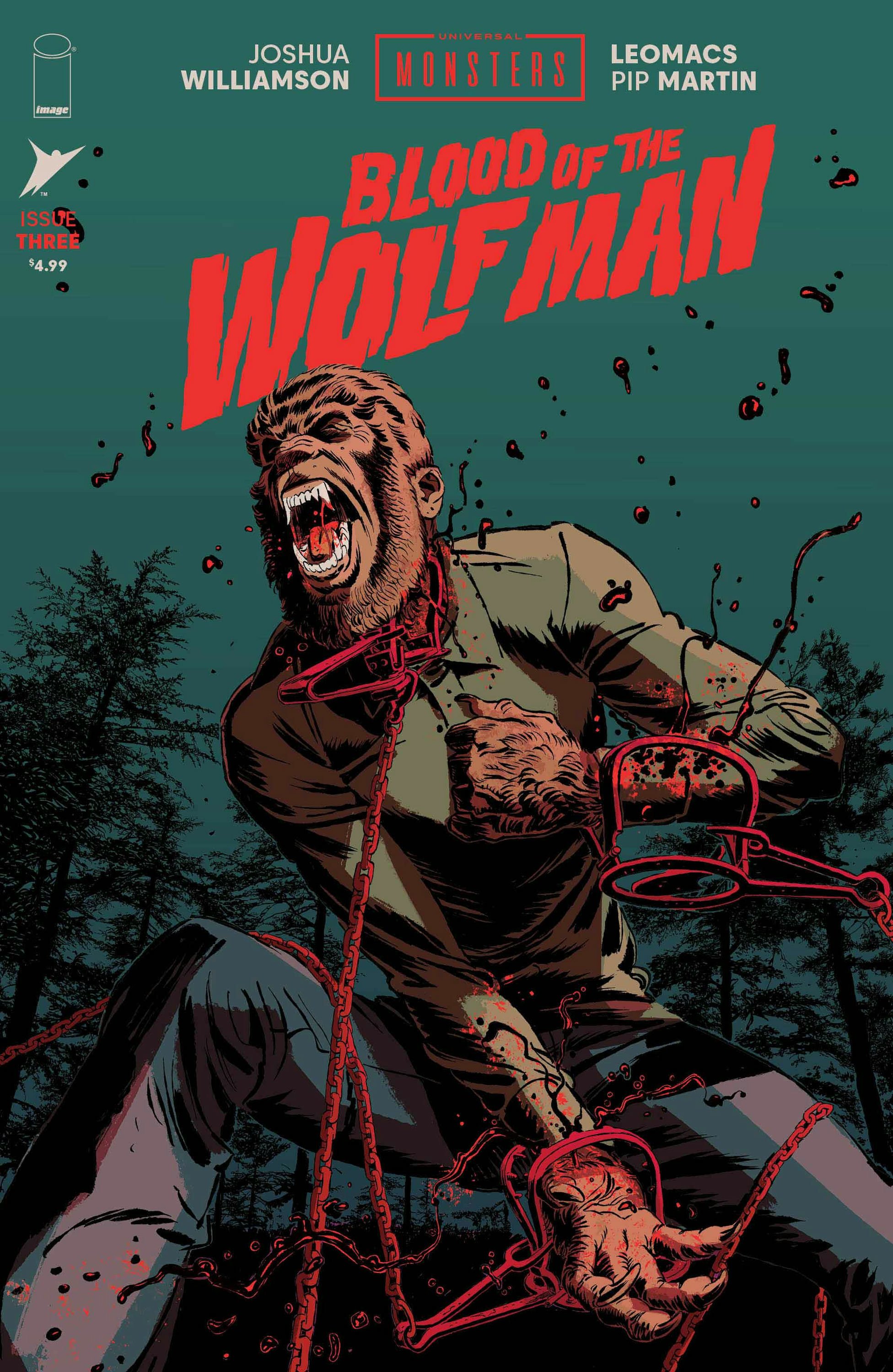
The full moon is upon us again and that can mean bad things for those around Adam. As Adam tries to prevent himself from hurting anyone else while he figures out this curse he is afflicted with. His father can’t let him be taken from him and will stop at nothing to protect his son, no matter the cost. These two sides will clash and unfortunately others will pay the cost for this clash.
Universal Monsters: Blood of the Wolf Man #3 - Written By Joshua Williamson - Art By Leomacs - Colors By Pip Martin – Letters By D.C Hopkins - Published By Skybound Entertainment/Image Comics
Credit: Skybound Entertainment/Image Comics
*** POSSIBLE SPOILER WARNING ***
STORY OVERVIEW:
Adam has turned himself in and has decided to cooperate with the police. He is being interrogated by Detective Coates, and she is trying to relate to him. His father Henry shows up and tries to stop the interrogation but since Adam is 18, he can’t stop it. Adam says he feels like he was the one who killed everyone at the college party. He says he is cursed and is a werewolf, which Coates seems leery of but listens intently. Adam then starts talking about his brother and mothers’ death, to which Henry has heard enough and storms into the interrogation room. After arguing with his son and telling him he’s crazy, he rips the amulet that belonged to Adam’s mother off his neck. Unfortunately, that act was a big mistake as it is a full moon.
WRITING:
This penultimate issue of the series reveals a lot about what is happening while still holding back enough major answers to make the final issue feel essential. Joshua Williamson does a strong job taking Adam, who could easily be dismissed by everyone around him as a scared kid speaking nonsense, and slowly showing that his fear may be the most honest thing in the room. Much of the issue is built around Adam explaining what he believes is happening to him, as well as opening up about the painful truth surrounding his mother and brother. That choice gives the story an emotional center instead of making it only about the werewolf curse. Adam is not just trying to convince people that monsters are real; he is trying to make sense of trauma, guilt, and the terrifying possibility that he has already hurt people he never wanted to harm.
Williamson uses the interrogation room setting very effectively because it keeps the story contained while allowing the tension to keep tightening. The scene is mostly conversation, but it never feels slow because every answer Adam gives creates another question. Detective Coates works well as the calm presence in the room. She listens to Adam without immediately judging him, and that makes her feel compassionate and intelligent rather than simply serving as the skeptical authority figure. Her patience gives Adam the space to be vulnerable, which helps the reader connect with him even more. At the same time, it gives the issue a brief sense of safety, making it seem like maybe someone in this town is finally willing to hear Adam out.
That sense of safety is constantly challenged by Henry’s presence. The more Adam talks, the more Henry’s frustration grows, and Williamson smartly leaves room for multiple interpretations of that reaction. On one level, Henry could simply be a father desperate to protect his son from saying something that will make his situation worse. On another level, his anger feels like it may come from a deeper fear that Adam is getting too close to a truth Henry has worked hard to keep buried. That uncertainty makes Henry one of the most intriguing parts of the issue. His behavior adds family drama to the supernatural mystery, and it makes the reader question how much of Adam’s curse is fate, how much is family history, and how much has been hidden from him his entire life.
The pacing of the issue is also handled very well. Williamson spends enough time on the emotional and investigative side of the story that the eventual horror feels earned instead of sudden for shock value alone. The amulet being ripped away is a great turning point because it takes something that has been treated as a personal keepsake and reveals it to be much more important. Once that protection is gone and the full moon takes hold, the issue shifts from quiet dread to brutal confirmation. Adam’s transformation proves that he has not been imagining things, and the violence that follows gives the issue the classic Wolf Man tragedy it has been building toward. The police station becoming a bloodbath is not just a gore sequence; it is the horrible proof that Adam’s worst fear about himself is true.
What makes the writing work so well is the balance between mystery, emotion, and monster horror. Williamson gives readers answers, but not all of them. He deepens Adam’s tragedy, complicates Henry’s role, and uses Detective Coates to bring a human sense of compassion into a story that could otherwise be overwhelmed by violence. By the end, the issue has laid down the emotional stakes, raised bigger questions about the family’s past, and delivered the kind of horrific payoff readers expect from a Wolf Man story. It is a strong penultimate issue because it feels satisfying on its own while still making the final issue feel like it has some major secrets left to reveal.
ARTWORK:
The artwork in this penultimate issue follows suit with the rest of the series and continues to be one of the biggest reasons this book works as well as it does. Leomacs does an excellent job bringing this version of the Wolf Man mythos to life by grounding the supernatural horror in a very specific and believable time period. The 1970’s influence comes through clearly in the clothing, hairstyles, police station details, and general design of the world. Nothing feels overly polished or modern, which helps the story feel authentic. That realistic visual foundation makes the horror hit harder because the monster violence is not happening in some exaggerated fantasy space; it is tearing through a world that feels familiar, worn down, and human.
The police station setting is used very effectively throughout the issue. Since so much of the story takes place in interrogation rooms, hallways, and tight office spaces, Leomacs leans into the confined environment to create a strong sense of pressure. The panels often make the characters feel boxed in, which matches Adam’s emotional state and the growing feeling that there is no easy escape from what is coming. Even before the transformation begins, the issue has a tense, trapped feeling. That visual claustrophobia helps build suspense because the reader can sense that when the horror finally breaks loose, there will be nowhere safe for anyone to go.
Leomacs also does a great job with character acting, which is especially important in an issue driven by conversation before the violence erupts. Adam’s fear, exhaustion, and desperation come through in his posture and expressions, making him feel like someone who is barely holding himself together. Detective Coates has a calmer and more controlled presence, and her body language helps sell her role as someone trying to understand Adam rather than simply dismiss him. Henry is drawn with a much more aggressive energy, and the tension in his face and movements makes every panel with him feel like it could explode. These choices add a lot to the writing because the art often communicates what the characters are feeling before they fully say it out loud.
The transformation sequence is where the artwork really gets to cut loose. Leomacs captures the physical horror of Adam becoming the Wolf Man in a way that feels painful, chaotic, and tragic all at once. The scene does not just look cool; it feels like Adam is losing control of his own body. That makes the monster reveal more effective because it keeps the focus on the tragedy of the curse, not just the spectacle. Once the werewolf is unleashed, the action becomes fast, brutal, and messy in the best possible horror-comic way. The panels make the violence feel sudden and overwhelming, and the carnage leaves a major impact without losing the emotional weight of what is happening to Adam.
Pip Martin’s colors are a perfect match for Leomacs’ linework. The earth tones and muted palette help reinforce the 1970’s atmosphere while keeping the issue grounded in a gritty, almost dirty realism. The colors make the calmer scenes feel tense and heavy without drawing attention away from the performances on the characters’ faces. Then, when the violence starts, the blood and harsher colors stand out much more because they are cutting through that more restrained palette. That contrast makes the gore feel more shocking and gives the back half of the issue a strong visual punch.
D.C. Hopkins’ lettering also deserves credit for helping the issue move smoothly from quiet interrogation to full-on horror. The dialogue-heavy scenes are easy to follow and never feel crowded, which is important because so much information is being delivered through Adam’s confession. Once the shouting, transformation, and chaos begin, the lettering helps increase the intensity without overwhelming the artwork. All of the visual elements work together to make the issue feel atmospheric, emotional, and violent when it needs to be. The end result is artwork that does more than illustrate the script; it elevates the dread, the tragedy, and the monster-movie energy of the entire issue.
CHECK OUT MY REVIEW OF BLOOD OF THE WOLF MAN #2
Final Thoughts:
Universal Monsters: Blood of the Wolf Man #3 is a tense and emotionally charged penultimate issue that delivers answers, raises new questions, and unleashes the horror in brutal fashion. Joshua Williamson deepens Adam’s tragedy while the art team bring the dread, violence, and monster-movie atmosphere to life. This issue sets the stage perfectly for the finale and continues to prove this series is one of the strongest horror comics on the stands.
FINAL GRADE: 9.3/10
Let me know your thoughts on Universal Monsters: Blood of the Wolfman #3 in the comments below. Thanks for reading!