THE PUNISHER #7 (MARVEL COMICS)
The Punisher is facing one of the most daunting foes he’s ever faced, as this foe doesn’t have to be anywhere near where he’s shooting. How can Frank fight an enemy that can fire a magic bullet from miles away? It’s simple, draw him out and make him pay!
The Punisher: #7 - Written By Benjamin Percy - Art By Farid Karami – Colors By Frank D’Armata - Letters By Corey Petit - Edited By Devin Lewis w/ Mark Basso - Published By Marvel Comics
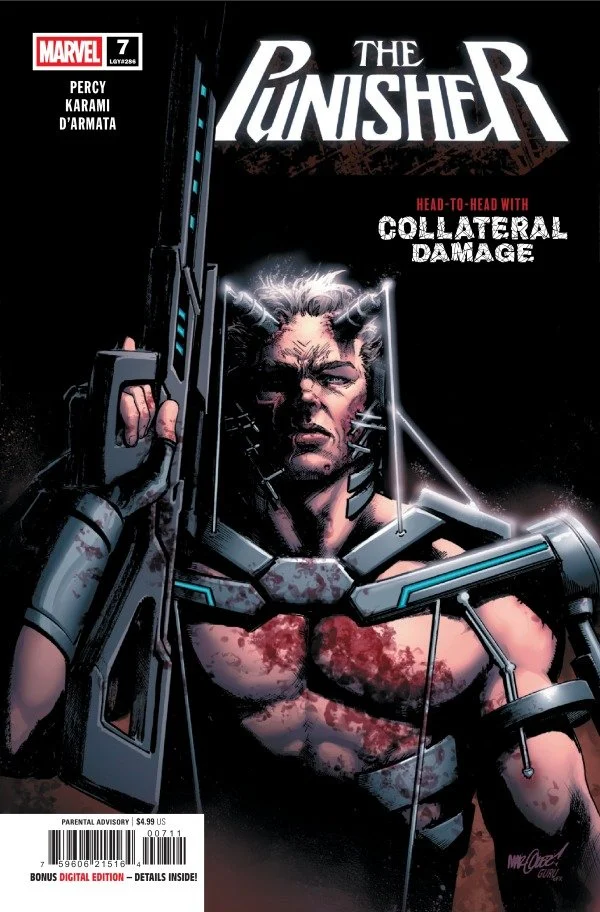
Credit: Marvel Comics
*** POSSIBLE SPOILER WARNING ***
STORY OVERVIEW:
As Collateral Damage grips the city with fear of his magic bullets, Frank is not deterred as he knows he has to stop this mystery villain. However, as Frank hunts him down he fires another new and unique bullet. This one maims Frank but then goes on to kill people around him. As he tries to stop this bullet and save lives finally his enemy reveals himself. We learn Collateral Damage has a shared history with the Punisher and that his ailments were caused by one of the Punisher’s many shoot outs. Now that they are face to face will Collateral Damage get his revenge on the Punisher or will Frank overcome this foe and save some lives in the process?
WRITING:
This issue runs hot and heavy from the opening pages and rarely gives the reader a chance to catch their breath. Benjamin Percy keeps the pace aggressive, but what makes the writing work is that the action is not just there for shock value. Every violent turn pushes Frank deeper into a problem he cannot solve with his usual methods. Collateral Damage is dangerous because he can strike from a distance, but he is even more effective as a thematic threat. Percy uses him to force Frank to confront the kind of fallout that usually gets left behind once the Punisher moves on to the next target.
The backstory for Collateral Damage is one of the stronger pieces of the issue because it gives the villain more weight than simply being another shooter with a gimmick. We learn that he was Ken Skilling, a PhD candidate from Columbia University who was caught in the wrong place during one of Frank’s many shootouts. That detail immediately makes him more interesting because his pain is tied directly to the chaos Frank creates, even when Frank believes he is only punishing the guilty. Percy makes it clear that Skilling’s life was destroyed by collateral damage in the most literal sense, and that gives his anger a clear emotional foundation.
Percy also does a good job showing how Skilling’s intelligence survived the tragedy that changed his body. After being left as a quadriplegic, he creates a robotic spine that allows him to move again, and that same genius leads to the development of the high-tech magic bullets he uses against Frank. That combination of science, trauma, and revenge makes Collateral Damage feel like a fresh addition to the series. He is not just physically dangerous; he is someone who has studied Frank, understands what kind of monster Frank can be, and has built himself into a weapon designed to expose that hypocrisy.
The fight between Frank and Ken is tense because it puts the Punisher in a rare position where brute force is not enough. Frank is wounded, outmaneuvered, and nearly made to feel as helpless as the man who blames him for ruining his life. That idea gives the action scene more dramatic impact than a standard shootout. Percy briefly flips the power dynamic, making Frank look vulnerable while also reminding the reader that his war on crime has always carried a cost. The arrival of the detective as an unlikely savior is a smart way to tie one of the better supporting characters back into the main conflict and keep the story from becoming only a one-on-one revenge tale.
However, the resolution is also where the issue stumbles the most. After spending two issues making Collateral Damage feel like a major new threat, his defeat comes too quickly. Percy frames him like someone who could have a lasting impact on Frank’s world, so seeing him taken down in such short order feels like a missed opportunity. There was room for this character to challenge Frank over a longer stretch, especially because his origin connects so directly to one of the biggest criticisms of the Punisher’s methods. The concept is strong enough that it feels like it deserved more space to breathe before being wrapped up.
Thankfully, the issue still ends with momentum thanks to the reveal that Wilson Fisk is not dead. That final development gives the story a larger sense of danger and suggests that Frank’s problems are only getting worse from here. Even with the rushed handling of Collateral Damage’s defeat, Percy delivers an issue that understands the Punisher’s appeal while also questioning the destruction he leaves behind. The writing is strongest when it pushes Frank to face the consequences of his crusade, and this issue succeeds because it makes the violence personal, messy, and impossible for Frank to ignore.
ARTWORK:
The artwork in this issue continues to be one of the strongest parts of the run. Farid Karami understands the visual language of the Punisher and gives the book a gritty, dangerous energy that fits Frank Castle’s world perfectly. The streets feel crowded, tense, and unpredictable, which makes Collateral Damage’s attack feel even more frightening. Because the danger can come from anywhere, Karami fills the pages with a constant sense of movement and vulnerability. The innocent bystanders are not just background decoration; they help sell the idea that this villain’s weapon can turn any ordinary public space into a battlefield.
The busy street sequence is especially effective because Karami makes the action feel chaotic without making it confusing. Frank is trying to protect people while also tracking a threat he cannot immediately see, and the artwork captures that pressure well. The placement of civilians, vehicles, and flying bullets gives the scene an anxious rhythm. You can feel the panic building as the magic bullet keeps moving from one victim to the next. That visual setup makes the danger feel larger than a normal gunfight because the reader understands that Frank is not simply fighting one man in front of him; he is fighting a weapon that turns the entire environment against him.
Karami also does strong character work throughout the issue. Frank looks beaten down, frustrated, and pushed past his usual limits, which is important because Collateral Damage is one of the few enemies who can make him seem genuinely vulnerable. The fight between Frank and Ken works because the body language tells as much of the story as the dialogue. Frank’s pain, Ken’s rage, and the physical awkwardness of Ken’s robotic support system all come through clearly. The panels make Collateral Damage feel dangerous but also tragic, which gives the confrontation more emotional weight than a standard revenge fight.
The flashback sequence revealing Ken Skilling’s past is another highlight. Karami shifts the visual tone just enough to separate the memory from the present-day violence, while still keeping it connected to Frank’s world. The scene of Ken being caught in the aftermath of one of the Punisher’s shootouts is precise and uncomfortable in the right way. It shows the cost of Frank’s war without overexplaining it, and the artwork makes it clear why Ken sees himself as a victim of Frank’s crusade. That visual storytelling helps make Collateral Damage more than a new villain with a clever weapon.
Frank D’Armata’s colors add a lot to the mood of the issue. The blue hue used during Collateral Damage’s backstory gives those scenes a colder, sadder feeling, which helps the reader understand Ken’s pain even if his actions are horrifying. In contrast, the stronger reds in the hospital sequence with Wilson Fisk immediately create a sense of danger and dread. D’Armata’s color choices help guide the emotional tone of each scene, making the flashbacks feel tragic, the street violence feel urgent, and the final reveal feel ominous.
Overall, the art team gives the issue the intensity it needs. Karami’s detailed action, expressive character work, and strong sense of location make Collateral Damage’s threat feel immediate and dangerous. D’Armata’s colors sharpen that impact by giving each major scene its own emotional identity. The result is an issue that looks brutal, tense, and visually engaging from start to finish, while also making sure the human cost of the violence is never completely lost.
Check Out My Review of THE PUNISHER #6
Final Thoughts:
The Punisher #7 is a fast, brutal, and engaging issue that gives Frank Castle a threat with real thematic weight. Collateral Damage makes for a compelling villain, even if his defeat comes too quickly, and the artwork gives the action a tense, gritty edge. With the reveal that Wilson Fisk is still alive, this issue leaves the run in a stronger and more dangerous place moving forward.
FINAL GRADE: 8/10
Let me know your thoughts on ThePunisher #7 in the comments below. Thanks for reading!