EXQUISITE CORPSES: RASCAL RANDY #2 (TINY ONION/IMAGE COMICS)
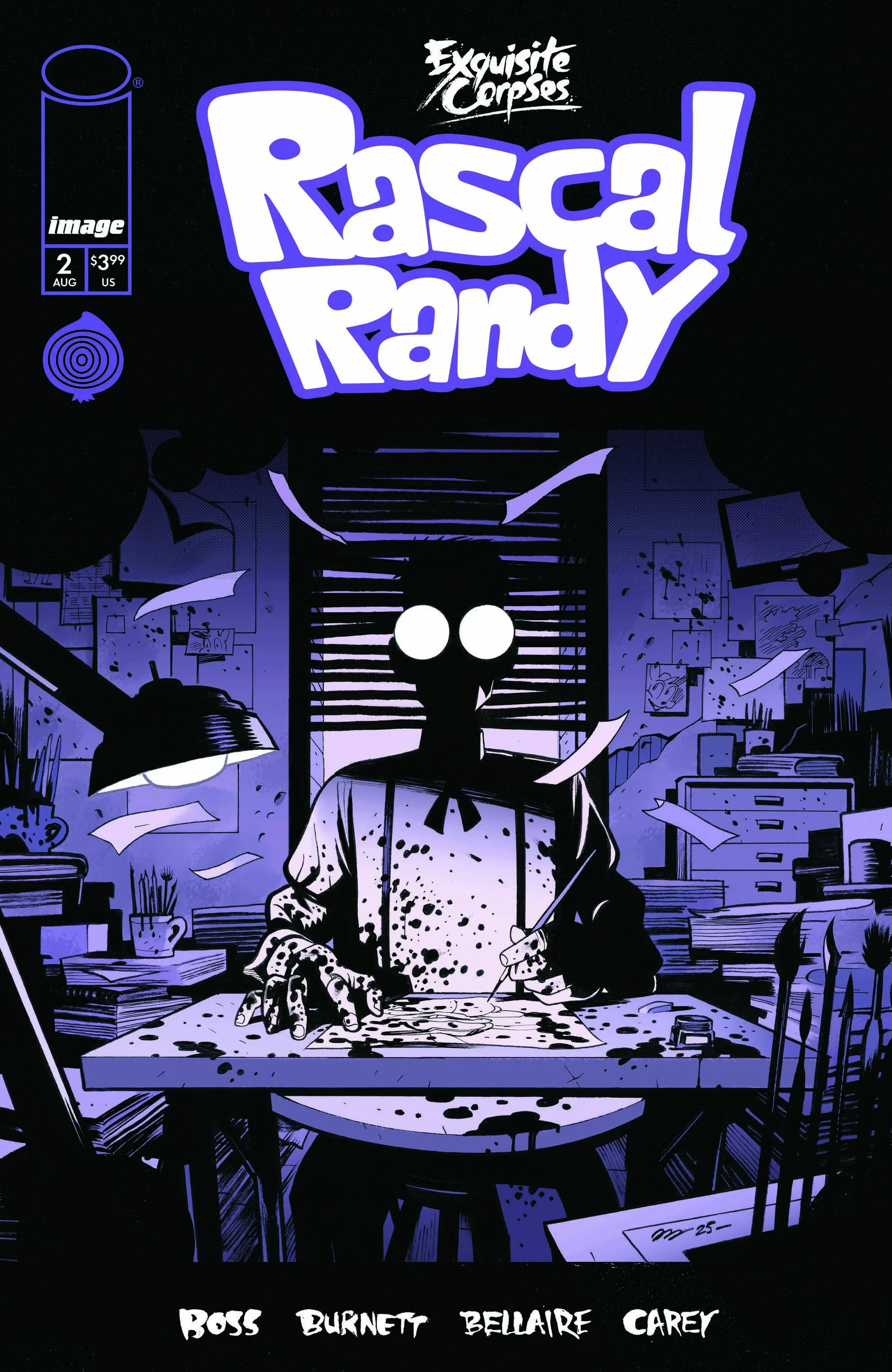
To truly understand Rascal Randy, we need to know how he began and issue two of this series gives us just that. We see how Elias Friedman created the character that would go on to become one of the biggest icons of his era. But we also see how this dream scenario can also be turned into a nightmare quickly. Oh yeah, we also catch up with what’s happening in the present with the killer that has taken up the mantle.
Exquisite Corpses: Rascal Randy #2 - Written By Tyler Boss – Art By Dylan Burnett - Colors By Jordie Bellaire – Letters By Becca Carey - Edited By Steve Foxe, Greg Lockard, and Eric Harburn - Published By Tiny Onion/Image Comics
Credit: Tiny Onion/Image Comics
*** POSSIBLE SPOILER WARNING ***
STORY OVERVIEW:
We open up in the past and learn how Elias Friedman created the cartoon character Rascal Randy. The character that would take him from a small apartment and slaving away as a cartoonist, to an animated icon. Of course, he couldn’t have accomplished any of this without his loving wife Rose who always nudges him in the right, but uncomfortable direction. As the character blows up increasingly, the Friedman’s become more successful, and it seems like things will only get better. But unfortunately for them, Mr. Tatum rears his ugly head and wants to take what Elias has built. Meanwhile, in the present day Lilly & Eli are trying to figure out who committed the grizzly murder at the park to potentially clear Eli’s name. However, the further down the rabbit hole they go, the more reality becomes a nightmare.
WRITING:
This issue gives the reader the backstory on the animated character that has sparked the creation of a present-day killer, and that added context makes the larger mystery feel much more layered. Tyler Boss reveals the creation of Rascal Randy as something that begins from a sincere, personal place before eventually being twisted by greed, ownership, and legacy. The opening stretch works because it is not just exposition for the sake of explaining where the character came from. Instead, Boss frames Elias Friedman as a struggling creator trying to build something meaningful while his family supports him through the uncertainty. That makes Rascal Randy feel less like a random mascot and more like an idea born out of desperation, creativity, and love. Because of that, the eventual conflict surrounding the character lands harder. We are not just watching a successful cartoon get taken away; we are watching someone’s dream become a commodity other people feel entitled to control.
Boss also does a great job of tying that past to the present-day storyline without making the issue feel split in two. The history of Elias, Rose, and Mr. Tatum gives the reader a better understanding of why Rascal Randy carries such a strange and unsettling weight in the world of the story. What should be an innocent cartoon icon slowly becomes something with a darker shadow behind it, and that makes the present-day killings feel more disturbing. The killer is not simply wearing a recognizable costume for shock value; the character now comes with a history of exploitation, resentment, and unresolved pain. That connection gives the horror more substance because the violence feels rooted in something bigger than a single murder scene.
The present-day material with Lilly and Eli continues to be the strongest forward momentum for the series. Their investigation has the energy of a classic small-town mystery, but Boss keeps the tone uneasy enough that it never feels too safe or playful. Lilly and Eli are kids trying to make sense of something far beyond their control, and that makes their amateur sleuthing feel both exciting and dangerous. There is also a strong sense of mistrust running through the issue. The authorities do not feel like people who will easily solve the problem, and Eli’s connection to the murder gives the story an immediate emotional hook. That uncertainty helps the whodunit aspect work because the reader is pushed to question not only who the killer is, but also how much of the town’s history is connected to what is happening now.
Most importantly, Boss does not let the backstory or mystery slow down the horror. The scene at the Wilkins house plays out with a strong sense of dread, building from investigation into something far more terrifying. The pacing of that sequence is effective because it lets the tension rise before revealing just how bad things have become. By the time the issue reaches that discovery, the reader has already been pulled into the emotional history of Rascal Randy and the more immediate danger surrounding Lilly and Eli. That balance is what makes the writing so effective. Boss gives the issue enough mythology to deepen the world, enough character work to make the danger personal, and enough horror to remind us that this is still a story about a killer hiding behind the face of a childhood icon.
ARTWORK:
The artwork in this issue serves the story incredibly well because Dylan Burnett does not simply illustrate what is happening; he helps define the tone of each era and gives the reader visual cues that make the structure of the issue easy to follow. The scenes set in the past have a very different texture from the present-day material, and that distinction matters because so much of the issue depends on moving between Rascal Randy’s origin and the horror unfolding now. Burnett gives the flashback sequences an aged, almost newspaper-strip quality that immediately places the reader in an earlier time. The clothing, office layouts, character designs, and background details all help sell that period setting without the story needing to over explain it. There is a warmth and looseness to those sections that reflects the creative spark behind Elias Friedman’s work, but there is also enough visual tension underneath to suggest that this dream is not going to stay innocent forever.
The present-day scenes have a sharper and more immediate feel, which helps separate them from the nostalgic quality of the flashbacks. Burnett makes the modern world feel heavier and more unsettled, as if the darkness surrounding the town has started to seep into every location. The character expressions carry a lot of the emotional weight, especially with Lilly and Eli, because their fear, confusion, and curiosity come through clearly without needing the dialogue to do all the work. That visual storytelling is important for a mystery like this because the reader is always looking for small clues, shifts in body language, and background details that might matter later. Burnett understands that and fills the pages with enough texture that the world feels lived in, while still guiding the eye toward the key emotional beats.
The horror elements are where the artwork becomes especially effective. The sequence at the Wilkins house plays with the kind of pacing you would expect from a strong horror film. Burnett lets the tension build through framing, shadows, and the slow reveal of information before pushing the reader into the disturbing payoff. The scene works because it does not rush to the shock. Instead, the artwork creates anticipation first, making the reader feel like something is wrong before the full horror of the moment arrives. That controlled build makes the reveal hit harder and gives the issue one of its strongest visual sequences.
One of the best things Burnett does is work hidden details and visual easter eggs into the backgrounds. The appearances of Randy the killer in certain panels give the issue a strong sense of unease because it makes the reader feel like the threat is always closer than the characters realize. Those details also reward closer reading, since the backgrounds feel like they may be planting clues or setting up future reveals. Jordie Bellaire’s colors are just as important to the success of the visuals. Her choices give the past sequences an aged quality through browns and muted tones, while the use of purples keeps those scenes from looking flat or lifeless. In the present, the color work helps emphasize the darker mood and makes the horror feel colder and more dangerous. Together, Burnett and Bellaire create a visual identity that supports the mystery, strengthens the atmosphere, and makes each timeline feel distinct while still belonging to the same nightmare.
check out my review of exquisite corpses: RASCAL RANDY #1
Final Thoughts:
Exquisite Corpses: Rascal Randy #2 is a strong follow-up that deepens the mythology behind Rascal Randy while keeping the present-day mystery moving in an unsettling direction. Tyler Boss adds emotional weight to the character’s origin, while Dylan Burnett and Jordie Bellaire make each timeline feel distinct, eerie, and full of atmosphere. This issue balances backstory, suspense, and horror extremely well, making it another must-read issue for fans of Exquisite Corpses. Make sure to grab a copy from your Local Comic Shop and keep this series on your Pull List!
FINAL GRADE: 9.4/10
Let me know your thoughts on Exquisite Corpses: Rascal Randy #2 in the comments below. Thanks for reading!