MASTERS OF THE UNIVERSE: GENESIS #1 (Dark horse comics)
By the power of Grayskull! The Dark Horse Comics, Masters of the Universe line, has just expanded even more! MOTU: Genesis will take readers on a journey to discover the origins of franchise favorites and what better kickoff than the origin of Skeletor! Find out the evil origins of He-Man’s number one nemesis in this 3-issue arc.
Masters of the Universe: Genesis #1 - Written By Rich Douek – Art By Gavin Smith - Colors By Fabi Marques - Letters By Andworld Design - Edited By Brett Israel - Published By Dark Horse Comics
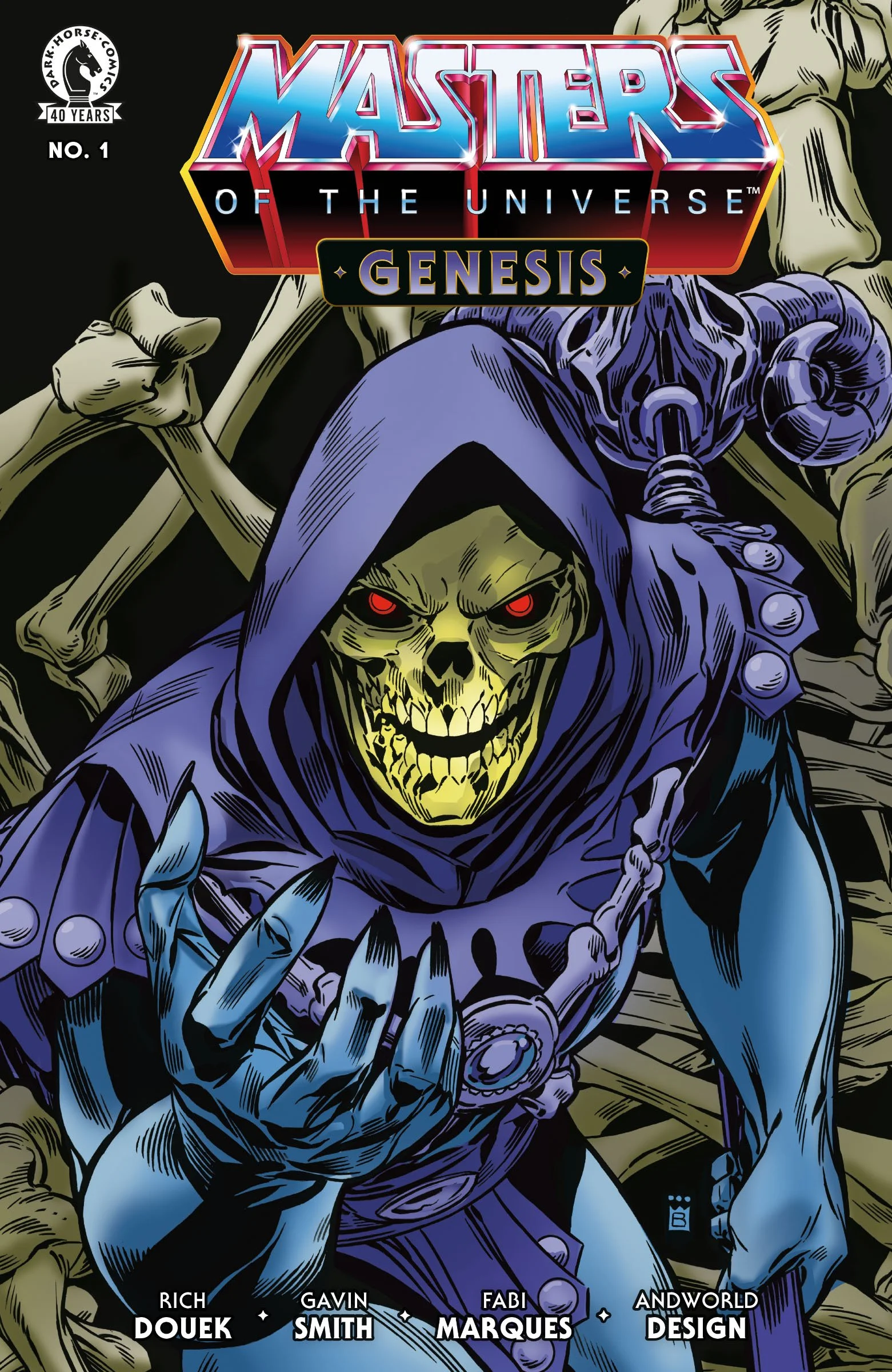
Credit: Dark Horse Comics
*** POSSIBLE SPOILER WARNING ***
STORY OVERVIEW:
The first issue of this origin series centered on Skeletor does a strong job of setting the pace, tone, and larger sense of purpose for what is to come. Rich Douek uses this opening issue to dig into what makes one of MOTU’s most recognizable villains tick, but he does so by focusing less on simple evil-for-evil’s-sake and more on the anger, humiliation, and hunger for payback that have shaped Skeletor into the threat readers know him to be. From the start, this issue makes it clear that Skeletor is not merely looking for power because he enjoys ruling over others. Power is part of it, of course, but Douek frames revenge as the real fire burning underneath everything he does. That makes his actions feel more personal, and it gives this version of Skeletor a sharper edge.
The history between the Mer-People and Beast Men also gives the issue a useful foundation. Their war has gone on for so long that it feels almost built into the world itself, and that long-running hatred makes Skeletor’s arrival feel even more disruptive. These are two sides that have spent ages seeing one another as enemies, yet the second Skeletor appears, the dynamic begins to change. Douek uses that shift to show how dangerous Skeletor can be as both a physical and psychological force. He does not need to earn loyalty through trust or respect. Instead, he overwhelms both groups, breaks their resistance, and forces them to understand that their survival now depends on serving him.
What I liked most about that setup is how it shows the uneasy alliance beginning to form under Skeletor’s rule. The Mer-People and Beast Men clearly do not forget their hatred overnight, and Douek does not pretend they suddenly become one united army because Skeletor tells them to. There is still distrust, resentment, and pride on both sides. However, when they briefly join forces against Skeletor, it proves that they are capable of working together when the threat is great enough. Even though their attempt fails, that moment matters because it gives Skeletor something valuable to exploit. If he can redirect their violence away from each other and toward his enemies, then he has the beginnings of a terrifying army.
Skeletor himself is where the writing really starts to click. By tying his current campaign to his past with Hordak and his former allies, Douek gives him a motivation that feels bigger than a standard quest for conquest. The flashbacks reveal a character who has been dismissed, mistreated, and pushed aside, and that history helps explain why his need to dominate Eternia feels so obsessive. Skeletor does not just believe he deserves power; he believes it was stolen from him. That distinction is important because it makes his arrogance, cruelty, and ambition feel connected to a wound he has never allowed to heal. His narcissism is still front and center, but there is now a deeper bitterness fueling it.
That sense of grievance gives this version of Skeletor a familiar feel while still making him compelling within this specific story. He is still theatrical, forceful, and larger than life, but Douek also emphasizes the dangerous intelligence behind his threats. Skeletor understands how to turn chaos into opportunity. He steps into a war that has exhausted both sides, proves he is stronger than anyone on the battlefield, and immediately reshapes that conflict around his own goals. This makes him feel like more than just a powerful villain. He feels like someone who sees every person, army, and kingdom as a possible tool in his revenge.
The only real issue I had with this first issue is that it may not be as clean of a jumping-on point as an origin story ideally should be. Since this is being presented as the start of a new origin-focused arc, it feels like it should be easy for any reader to pick up, even if they have not been following Dark Horse’s main Masters of the Universe comic line. For the most part, the issue succeeds at giving readers enough information to understand the immediate conflict. Still, there are a few moments that may leave newer readers with questions. The rivalry between Hordak and Skeletor is clearly important, but the full weight of that relationship is not completely explained yet. The flashbacks also show Skeletor’s familiar core group without giving much context as to why they are no longer standing beside him in the present.
To be fair, this is only the first issue of a three-part arc, so there is plenty of room for those answers to come as the story continues. Douek seems to be planting those questions intentionally, and the mystery surrounding Skeletor’s fall from Hordak’s circle does create a strong reason to keep reading. Even so, I did find myself wanting just a little more context in this opening issue, especially because the premise has so much potential to welcome new readers into this corner of Eternia. If future issues build on these questions while continuing to explore Skeletor’s ego, rage, and need for revenge, then this arc could become a very satisfying look at how one of the franchise’s greatest villains fully steps into his destiny.
ARTWORK:
The artwork in this first issue captures Eternia and the larger Masters of the Universe franchise in a way that feels both immediately recognizable and visually exciting. Gavin Smith brings a strong sense of scale to Eternia, making the world feel much bigger, stranger, and more dangerous than what readers may already have in their minds from past versions of the franchise. The environments do not feel like simple backdrops placed behind the action. They help sell the idea that Eternia is a living world filled with different kingdoms, species, histories, and conflicts that have existed long before Skeletor steps into the story. The battlefields, cavern spaces, and fantasy landscapes all give the issue a sense of depth.
Smith’s character work is just as strong as the world-building. The Mer-People, Beast Men, Skeletor, Hordak, and the rest of the cast all carry that classic Masters of the Universe energy, but they are not drawn as simple throwbacks. There is a muscular, rough-edged quality to the designs that fits the war-torn tone of this issue. Skeletor, in particular, looks intimidating from the moment he appears. His body language, facial expressions, and presence on the page make it clear that he is not just another warrior entering the battlefield. He feels like a force that changes the atmosphere around him. When he stands against entire groups of fighters, Smith frames him in a way that makes his power feel overwhelming before the story even needs to explain it.
The action also works really well because the pages have a strong sense of movement and impact. The battles feel chaotic without becoming confusing, and every major strike or magical attack has enough weight behind it to make Skeletor’s dominance believable. Smith knows when to pull the view back and show the larger scope of the fight, but he also knows when to move in close and focus on a character’s reaction, fear, or anger. That mix gives the issue a more cinematic quality. It allows the artwork to support both the big fantasy spectacle and the more personal story of Skeletor.
Fabi Marques’ colors are another major reason the issue captures the franchise so well. The color palette instantly brings back the kind of bold, adventurous feeling many fans associate with the classic 1980s cartoon, but it never feels flat or overly simple. The colors are bright enough to give the book that nostalgic MOTU identity, while still having enough shadow, texture, and atmosphere to make the world feel dangerous. The contrast between the different groups also helps each side stand apart visually.
What makes the art and colors work so well together is that they do not rely only on nostalgia. Older fans will definitely recognize the spirit of the franchise, especially in the designs and bold visual choices, but the issue also looks modern enough to stand on its own. There is a freshness to the way Smith and Marques present Eternia that makes it feel like this world still has new corners to explore. The artwork respects what came before, but it also gives this origin story the darker, grander, and more dangerous feel it needs. By the end of the issue, the visuals make Skeletor’s rise feel like a major event, not just another chapter in a familiar franchise.
Check Out MY REVIEW OF MOTU: THE WINGS OF FATE #2
Final Thoughts:
Masters of the Universe: Genesis #1 does not disappoint with its origin premise and new revelations. The story unfolds just a bit without revealing its full hand in the first issue. This leaves room for intrigue and speculation that will surely add to conversations at the shop this week. Although there was a bit of confusion along the way, that does not detract from where this story should be headed. If you are a fan of the Masters of the Universe franchise, this is a must get book this week and should easily make your Pull List going forward.
FINAL GRADE: 9/10
Let me know your thoughts on Masters of the Universe: Genesis #1 in the comments below. Thanks for reading!