IF DESTRUCTION BE OUR LOT #4 (IMAGE COMICS/ASHCAN PRESS)
"Always bear in mind that your own resolution to succeed is more important than any other one thing.". As Abe falls deeper into a spark addiction, he just wants to forget that he saw a human. But no matter how much spark he takes, he just can’t forget. However, does he really need to give up and forget, or does he need to find the truth for himself no matter how crazy other robots think he is?
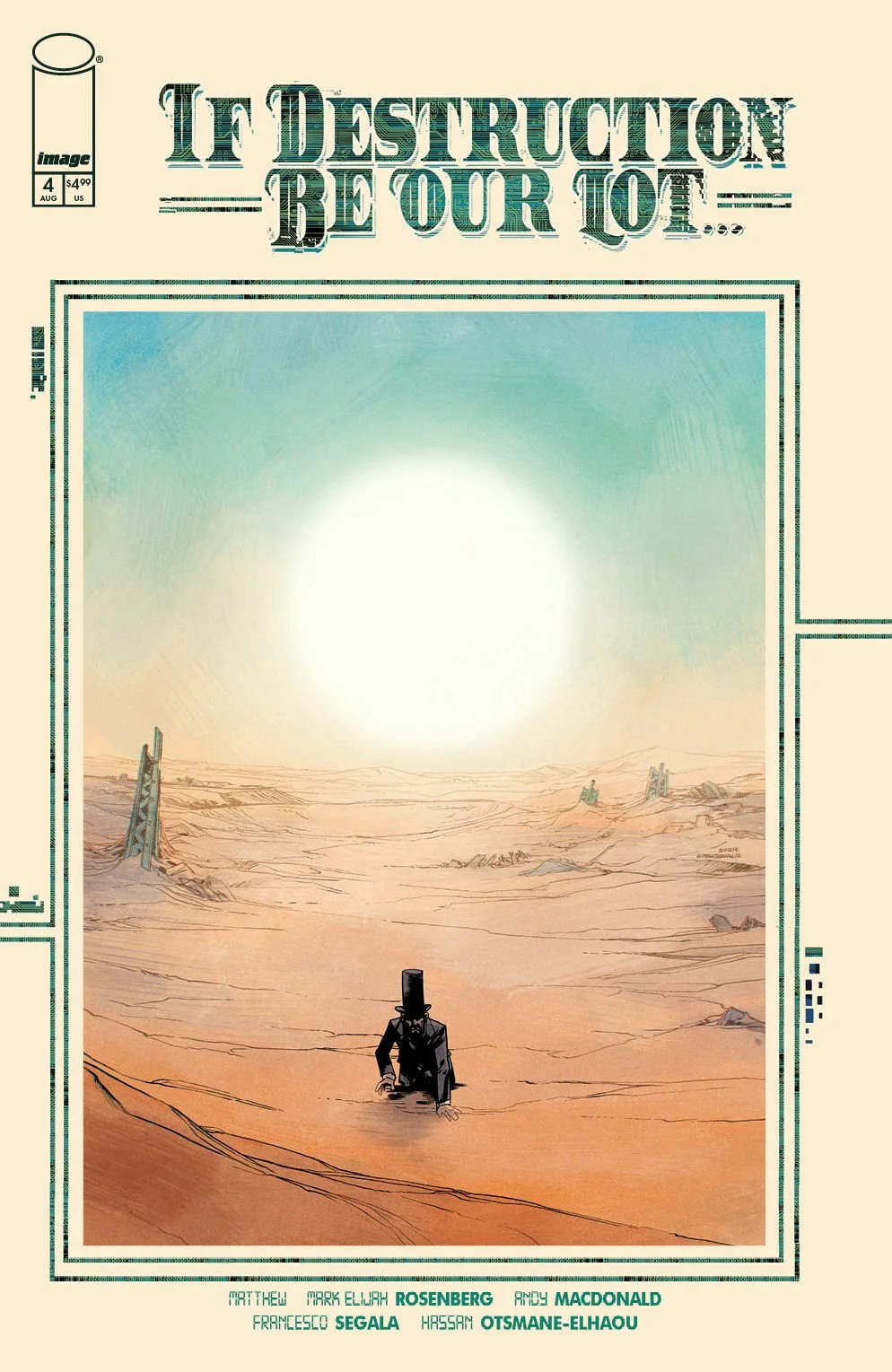
If Destruction Be Our Lot #4 - Written By Matthew & Mark Elijah Rosenberg – Art By Andy MacDonald – Colors By Francesco Segala – Letters By Hassan Otsmane-Elhaou - Published By Image Comics/Ashcan Press
Credit: Image Comics/Ashcan Press
*** POSSIBLE SPOILER WARNING ***
STORY OVERVIEW:
Abe has become a spark junky as he tries to forget about the fact he saw a human. Even though Speed saw the same human, he denies it, so no other robot believes Abe. As he moves around trying to get his next fix with the group of junkies Speed hangs with, they rummage through different abandoned areas. One of the junky robots even falls to their death from the top of a building on this search. Abe thinks he sees the girl again and bringing this up to Speed in front of the other robots causes Speed to tell Abe to get lost. Now all by himself Abe is wandering the streets when he comes across an accident where one of the robots involved claims he saw a human. As the authorities take that robot away, Abe starts to search for the girl. The trail takes Abe to somewhere he’s never been before, but he needs answers, so he presses on.
WRITING:
This issue does a strong job showing just how far Abe has fallen since seeing the human girl. What started as confusion and disbelief has turned into a full downward spiral, with Abe using spark not because he enjoys it, but because he is desperate to silence the one memory he cannot escape. Matthew & Mark Rosenberg make that pain feel personal by focusing on the emotional weight behind Abe’s addiction. He is not simply written as a robot making bad choices. Instead, he comes across as someone who has been pushed into isolation, ignored when he needed support, and left with no healthy way to process what he knows he saw.
The way the Rosenbergs give Abe such human qualities is what makes this part of the story work so well. His need to be believed, his shame over how far he has fallen, and his fear that he might actually be losing his mind all make him easy to connect with. The depression that comes from no one believing him gives Abe a sharper sense of desperation. He wants to belong somewhere, but every time he tries to explain the truth, he is treated like an embarrassment or a problem. That makes his addiction feel less like a plot device and more like a cry for help from a character who has been completely cut off from validation.
Speed’s role adds another layer to Abe’s pain because he is the only other robot who saw the girl, yet he refuses to stand beside Abe. His denial is not just frustrating; it shows how powerful fear and social pressure are in this world. Speed would rather let Abe be labeled as unstable than risk being treated the same way. That betrayal makes Abe’s loneliness hit harder because the one person who could prove he is telling the truth chooses self-preservation instead. It also strengthens the larger theme of a society that punishes anything outside its accepted reality.
Because of that, Abe hitting rock bottom feels earned rather than exaggerated. The spark addiction, the rejection from Speed, and the constant doubt all build toward a moment where Abe has almost nothing left to hold onto. That is why the ending lands with real impact. When Abe receives confirmation that there may truly be a human girl out there, the issue shifts from despair into determination. He is still damaged and still uncertain, but he finally has a reason to move forward instead of trying to bury the truth. Following the trail into an unknown place shows that Abe has reached the point where proving he is not crazy matters more than his own safety.
That turn also brings a welcome sense of adventure back to the series. After spending so much of the issue inside Abe’s pain and addiction, the final stretch opens the story up again and creates excitement for what comes next. The Rosenbergs balance the darker emotional material with forward momentum, making the issue feel both heavy and thrilling. It deepens Abe as a character while also expanding the mystery of the world around him, which makes the next issue feel even more important.
ARTWORK:
The artwork in this issue is beautifully depressing, and it captures the despair of Abe’s situation with a level of detail that makes the emotional weight of the story hit even harder. Andy MacDonald does an excellent job showing how far Abe has fallen, not just through the events of the story, but through Abe’s body language and overall appearance. Even though Abe is a robot, MacDonald gives him the worn-down presence of someone completely consumed by addiction. His slouched posture, tired movements, and increasingly unkempt look make him feel broken down in a way that is instantly recognizable. He does not just look like a character having a bad day; he looks like someone who has been slowly drained by hopelessness, shame, and obsession.
The setting adds another powerful layer to that feeling. The abandoned areas, damaged streets, and decaying corners of the city give the issue a bleak atmosphere. These places feel forgotten by the rest of the world, which makes them the perfect reflection of Abe’s state of mind. The comparison to places like Skid Row works because MacDonald draws this section of the world with a sense of neglect that feels painfully familiar. The broken surroundings, dirty spaces, and sense of people being left behind bring an authenticity to the story. It makes the world feel larger than Abe while also showing that his addiction is part of a much bigger cycle of abandonment and despair.
The designs of the addicted robots help sell that reality even more. They look old, dirty, damaged, and barely held together, almost as if the world has been wearing them down piece by piece. Their metal bodies may make them visually different from humans, but their expressions, poses, and physical decay make their suffering easy to understand. Abe stands out in this group because the further he sinks into his addiction, the more unstable and unrecognizable he seems. His design shows the progression of his collapse without needing the story to explain every detail. The reader can see the damage in the way he moves, the way he carries himself, and the way he seems less and less connected to the world around him.
Francesco Segala’s colors are just as important to the mood of the issue. The palette is grimy, dark, and muted through much of the story, which matches the hopeless tone surrounding Abe’s addiction. The dingy colors make the city feel cold and unhealthy, while also emphasizing the emotional heaviness of every scene. Nothing feels clean or safe, and that visual choice keeps the reader trapped in Abe’s bleak mindset. Then, when Abe follows the girl into the unknown zone, the shift in color becomes noticeable and meaningful. The brighter tones do not erase everything Abe has been through, but they do suggest that there may still be something beyond his addiction, beyond the lies, and beyond the world that has rejected him.
That contrast is what makes the artwork so effective. MacDonald and Segala do not simply make the issue look sad; they use the visuals to show Abe’s emotional and physical decline while also preparing the reader for the possibility of change. The art makes the addiction feel harsh, the world feel unforgiving, and the final movement toward the unknown feel like a small but important spark of hope. It is a strong visual match for the writing because every page reinforces Abe’s struggle to survive long enough to find the truth.
CHECK OUT MY REVIEW OF IF DESTRUCTION BE OUR LOT #3
Final Thoughts:
If Destruction Be Our Lot #4 is a dark, emotional chapter that pushes Abe to his lowest point while also giving the series a stronger sense of mystery and momentum. The issue handles addiction, isolation, and disbelief with real weight, making Abe’s search for the truth feel personal and urgent. With strong writing, bleak but effective artwork, and an ending that opens the door to something bigger, this continues to be a smart, thought provoking series that is absolutely worth following.
FINAL GRADE: 9.4/10
Let me know your thoughts on If Destruction Be Our Lot #4 in the comments below. Thanks for reading!